
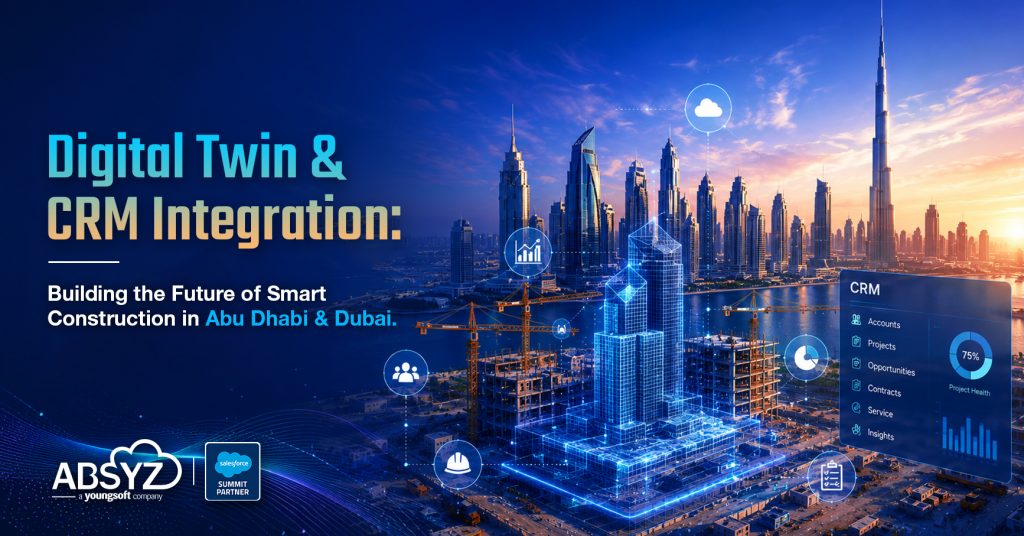
Megaprojects across Abu Dhabi and Dubai — from giga-scale mixed-use developments to infrastructure and utilities builds — increasingly run on digital twin technology to model and monitor construction in real time. But a digital twin is only as useful as the operational systems connected to it. A live 3D model of a site is of limited value if the subcontractor managing a delayed work package, the field engineer flagging a defect, or the inspector closing out a site visit are all still working from disconnected spreadsheets and WhatsApp threads.
That’s the gap a properly connected construction CRM closes. Pairing digital twin data with Salesforce — particularly Salesforce Field Service — gives megaproject teams a way to turn a visual model of the site into an operational system that actually drives field work, subcontractor accountability, and inspection workflows.
Why Construction Doesn't Fit a Generic CRM Model
Most CRMs are built around a sales pipeline: a lead moving toward a close. A construction megaproject has a fundamentally different shape — dozens or hundreds of subcontractors, thousands of individual work orders, and field teams distributed across a site (or multiple sites) who need real-time direction, not a system they check once a day from an office desktop.
A handful of dynamics make this genuinely different from standard CRM use cases:
- Deeply layered subcontractor relationships, each governed by its own contract terms, milestones, and payment schedules
- High-volume, time-sensitive work orders — inspections, snagging, defect resolution — that need to be assigned, tracked, and closed out against real deadlines.
- Field teams working on-site, often with limited connectivity, who need mobile-first tools rather than desktop dashboards
- A live digital twin generating data that’s disconnected from the operational systems, tracking who’s actually doing the work
Without a system built to connect these pieces, project teams end up managing megaproject-scale complexity through manual coordination, which doesn’t scale and creates the kind of delays and cost overruns megaprojects can least afford.
Where Salesforce Field Service Fits the Construction Model
Connecting field engineering teams: Salesforce Field Service gives site engineers and inspectors a mobile-first way to receive, update, and close out work orders directly from the field — rather than relaying updates back to a central office for someone else to log. Real-time visibility into where every field team is and what they’re working on replaces the daily catch-up call or end-of-day status email.
Managing complex subcontractor contracts: Subcontractor relationships in a megaproject typically involve multiple work packages, milestone-based payments, and performance obligations that need to be tracked against contract terms — not just a generic vendor record. Structuring this properly in Salesforce means project teams can see at a glance which subcontractors are on schedule, which work packages are at risk, and which contractual milestones are approaching, without manually cross-referencing spreadsheets against contract documents.
Automating site inspection work orders: Inspections are one of the highest-volume, most time-sensitive workflows on any large site. Automating how inspection work orders are generated, assigned, and tracked — triggered by project milestones or scheduled intervals rather than manually created — reduces the lag between when an issue is identified and when it is resolved. Defect tracking, sign-off workflows, and photo/documentation capture can all run through the same mobile interface field teams are already using for other work orders.
Connecting the digital twin to operational data: The real payoff comes from linking the digital twin’s spatial and status data to the operational system to track who’s doing the work. A defect flagged in the digital twin model can automatically generate a work order in Field Service, assigned to the right subcontractor or field team, with full traceability from identification to resolution — instead of someone manually translating what the model shows into an email or a phone call.
What This Looks Like in Practice
Before: A site inspection identifies a defect, which is logged in a report and emailed to a project coordinator, who then manually assigns it to the relevant subcontractor via phone or email — a process that can take days and is difficult to track once it leaves the inspector’s hands.
After: The defect is logged directly against the relevant work order in the field, automatically routed to the responsible subcontractor with full documentation attached, and tracked through to sign-off — all visible in real time to the project team.
Before: Subcontractor milestone tracking relies on a combination of spreadsheets and manual contract reviews, making it difficult to identify at-risk work packages before they become critical-path delays.
After: Milestone and performance data against each subcontractor’s work packages are visible in a live dashboard, with at-risk items flagged before they escalate.
Before: Field engineers rely on daily calls or end-of-shift reports to communicate status to the project office, creating a lag between what’s actually happening on-site and what leadership sees.
After: Field teams update work orders directly on mobile devices as work progresses, providing project leadership with near-real-time visibility into site status.
Implementation Considerations for Megaprojects
A few factors are worth getting right early in any Salesforce Field Service implementation on a construction megaproject:
- Design the data model around work packages and contracts, not generic accounts: Subcontractor relationships and work order structures need to reflect how the project is actually contracted and delivered — this is difficult to retrofit later.
- Prioritize offline-capable mobile functionality: Site connectivity is often inconsistent, particularly on large or remote sites — field tools need to function reliably without constant connectivity and sync when back online.
- Plan the digital twin integration as a distinct workstream: Connecting spatial/model data to operational work orders typically requires custom integration and should be scoped explicitly, rather than assumed to be a standard configuration task.
- Phase the rollout by work package or site zone: Piloting on a defined portion of the project before full rollout reduces risk and surfaces issues with subcontractor adoption early, while the stakes are lower.
Getting Started
Smart construction in Abu Dhabi and Dubai is increasingly defined by how well digital modeling and field operations work together — not just by the sophistication of the digital twin itself. Salesforce Field Service gives megaproject teams the operational backbone to turn that model into real-time, trackable field work: connecting engineers, holding subcontractors accountable against contract terms, and closing out inspections faster.
If you’re evaluating how to connect digital twin data to your field operations, or looking to modernize subcontractor and inspection management on a current megaproject, we’d be glad to walk through what that could look like for your specific site structure.
Book a consultation to discuss Salesforce Field Service for your construction project