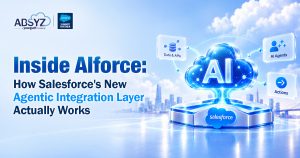
Salesforce’s AIforce announcement at Dreamforce ’26 generated plenty of headlines about “AI replacing the UI,” but the more interesting story is beneath the surface: how the pieces actually fit together architecturally and what that means for security, governance, and the broader ecosystem. A deeper look at AIforce fills in that picture — the stack it’s built on, the trust model behind it, and the tooling meant to keep it manageable at scale.
The Big Idea: Salesforce Comes to You
AIforce is best understood as an interface layer that sits atop the existing Salesforce platform, allowing users to interact with their org through whatever tool they already use — Claude, Slack, or Lightning — rather than requiring them to log in to Salesforce directly. The shift in mentality is captured well by one line from a Salesforce executive: people don’t use the UI anymore, they just talk to Claude. Whether that’s true for every user today or not, it’s clearly the target Salesforce is building toward.
The 3 Core Components:
Claudeforce is the deepest integration point with Anthropic’s Claude. It ships with 37 prebuilt sales skills and more than 40 builder skills, letting sales teams and developers work with Salesforce data and automation directly inside Claude rather than switching context into the CRM itself.
Slackforce is actually 4 distinct pieces bundled under one name:
- Slackforce Surfaces — live, collaborative interfaces built directly inside Slack
- Slackbot — a personal AI assistant for day-to-day tasks
- Slack CRM — record creation and management without leaving a Slack conversation
- Slack Code — natural-language software development happening inside Slack
Agentforce Coworker is the AI teammate that lives within Lightning Experience. Unlike the other two, it doesn’t take users out of Salesforce. Instead, it reasons across records and takes action from within the existing UI, governed by the same security permissions already in place.
The Architecture Underneath
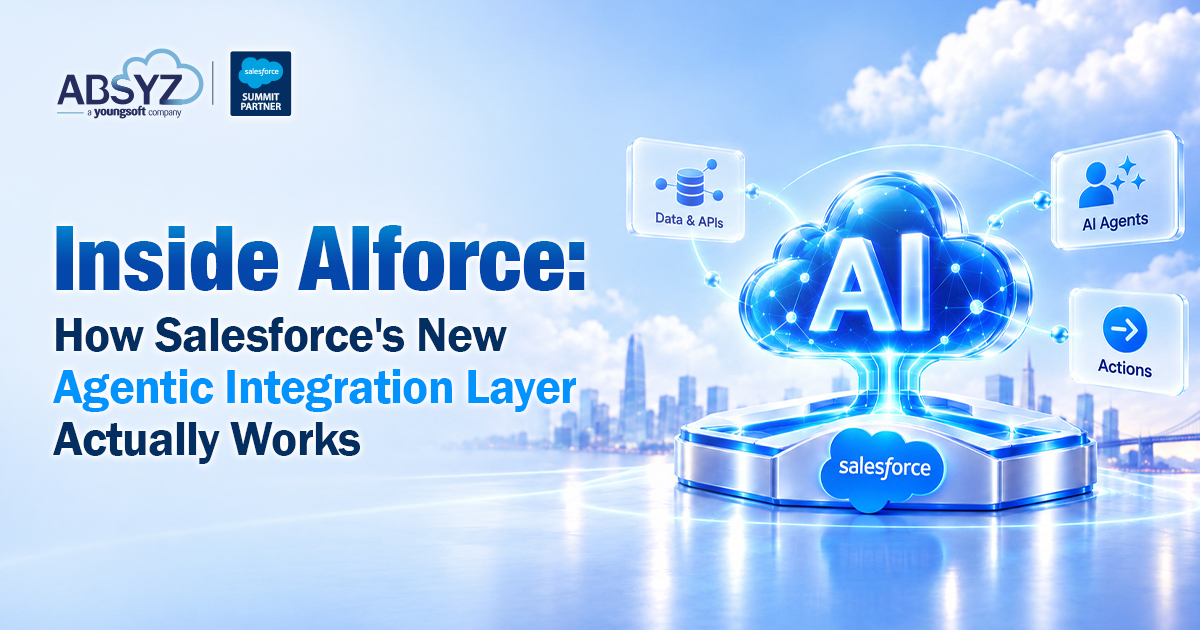
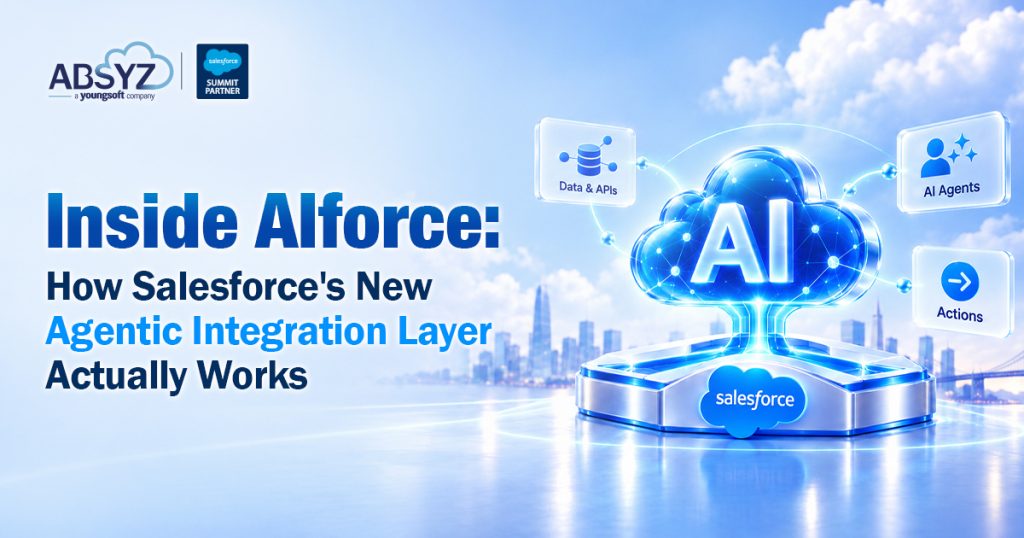
All of this runs on what Salesforce calls the Headless Toolkit. This open architecture exposes the platform’s permissions, metadata, and workflows to MCP servers, APIs, and other external tools, without requiring anyone to touch the Lightning UI to get there.
That toolkit sits within a larger stack:
- Data 360 — the unified data layer
- Customer 360 — the application layer built on top of that data
- Agentforce — the digital workforce of agents that can reason and act
- AIforce — the interface layer that exposes all of the above to wherever the user is working
In other words, AIforce isn’t a replacement for Agentforce or Customer 360 — it’s a new access layer built on top of investments Salesforce customers have already made in those systems over the past two decades.
Trust: Zero Data Retention as the Core Promise
If there’s one detail Salesforce leadership wanted to land above all else, it’s Zero Data Retention (ZDR). The company’s position is that customer data is never retained by, or used to train, any AI model it works with — a claim Marc Benioff repeated and underscored by saying the company has “audited it, tested it” thoroughly. For enterprise buyers, this is likely to be the single most scrutinized claim in the entire AIforce package, since it’s the thing standing between “convenient AI interface” and “unacceptable data exposure risk.”
The Ecosystem Layer
AIforce also comes with a handful of supporting pieces aimed at keeping this new, more distributed way of working manageable:
- AgentExchange — the rebranded marketplace for AI agents and integrations, featuring partners like Anthropic, AWS, Google, Lovable, Vercel, and DocuSign, among others
- Agentic Identity — arriving in November, this tracks all activity across both human users and AI agents, with granular permission controls to match.
- Observability Center — gives admins and architects visibility into what agents are actually doing and the ability to control that behavior.
- Builder Central — a beta no-code environment for building directly on the Headless Experience Layer
Customer and partner commentary reinforced the “meet people where they work” theme — Anthropic’s involvement was framed as pairing “the #1 AI with the #1 CRM.” At the same time, Deloitte’s take emphasized the value of reaching teams in their existing tools without constant tab-switching.
Why This Matters
The most important framing here is that AIforce complements Agentforce rather than replacing it. Agentforce is the layer that provides actual AI agents capable of reasoning and acting; AIforce is the layer that lets those agents and human users reach Salesforce from anywhere, without Salesforce having to rebuild its governance or security model from scratch for every new surface.
For any organization that has spent years investing in Salesforce’s platform — its metadata, its permission model, its automation- AIforce is effectively Salesforce’s answer to a real risk: that all of that investment stops mattering if users increasingly expect to work through AI assistants instead of dashboards. Rather than fighting that shift, Salesforce is betting it can extend its governance and security model into every surface, rather than lose users to tools that bypass it entirely.
The pieces: Claudeforce, Slackforce, Agentforce Coworker, the Headless Toolkit, and the trust and ecosystem layer around them, are still rolling out in stages, several of which are betas. But the direction is clear: less UI, more interface, and a lot riding on whether Zero Data Retention holds up to the scrutiny enterprise security teams are about to give it.