At Dreamforce ’26, Salesforce made its headline announcement of the show: AIforce. The pitch is bold and a little unusual for a company that built its empire on a dashboard-driven interface — Salesforce is now arguing that the UI itself is becoming optional, and that AI agents operating inside tools like Slack, Claude, and Lightning will increasingly be how people actually get work done.
The Core Idea
The concept behind AIforce is simple to state, even if it’s a big shift in practice: workers shouldn’t have to open Salesforce to get value from Salesforce. Instead, Salesforce comes to wherever people already work — whether that’s Claude, Slack, or Lightning. Someone who has never opened a Salesforce dashboard in their life can, in theory, update records, kick off workflows, and ask questions about their business without ever navigating the traditional UI.
The underlying justification is that access has always been the limiting factor. Company knowledge has lived inside Salesforce for decades, but accessing it required opening an app and clicking through menus — a barrier that limited who could use the system, what they could see, and how much value they could extract from it. AIforce is designed to remove that barrier by letting agents read across large numbers of records at once, pull in connected systems, reason over the results, and take action with a full picture of the business.
One of the more eye-catching claims is that AIforce lets people build their own interface just by describing what they want, rather than working within fixed layouts and field arrangements. In effect, each person gets an interface tailored to the exact insights they need, assembled on the fly inside whatever platform they’re already using.
Architecturally, AIforce sits atop Salesforce’s existing Agentic Enterprise stack — layering in the customer context from Data 360, the semantic and application intelligence of Customer 360, and Agentforce’s agent capabilities so that any AI interface can tap into them. Salesforce is also keen to stress that none of this bypasses governance: every request still runs under existing permissions and business rules, so an agent only surfaces what the person using it is already allowed to see. The company says business data is used to answer questions but not retained by the model provider.
How It Was Built
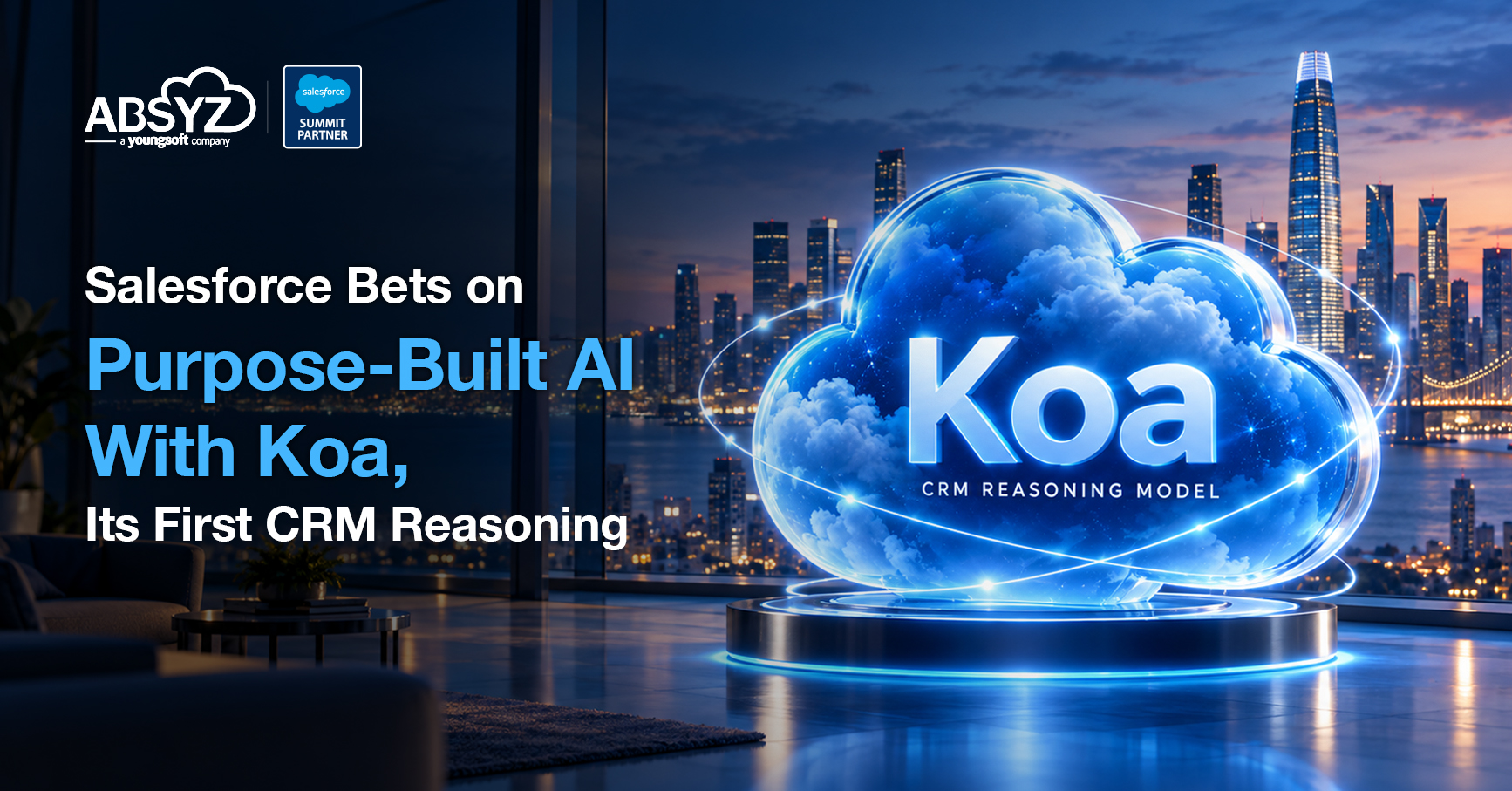
Under the hood, the training process combined multiple techniques. Salesforce modeled scenarios across more than a dozen industries, including manufacturing, financial services, healthcare, and travel, pairing personas with tasks and mapping out the exact sequence of actions and tool calls an agent would need to complete each one.
From there, the team applied supervised fine-tuning and reinforcement learning (specifically Group Relative Policy Optimization) using NVIDIA’s NeMo RL, NeMo Gym, and NeMo AutoModel tooling. The goal wasn’t just to get Koa to produce correct answers, but to have it learn the step-by-step actions required to achieve a business outcome.
What's Actually Inside AIforce
Rather than being a single new product, AIforce is more of an umbrella for several announcements Salesforce has been rolling out around Dreamforce:
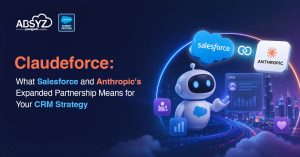
Claudeforce — the expanded partnership between Salesforce and Anthropic. It brings Salesforce’s intelligence into Claude through a prebuilt MCP server loaded with dozens of sales skills out of the box, with analytics (via Tableau) and skills for service, marketing, commerce, and industry verticals expected to follow. There’s also a Salesforce development plug-in for Claude Code that adds dozens more skills and provides access to Salesforce’s broader public skills library. Salesforce in Claude is now in beta for all customers.
Slackforce — brings Salesforce context directly into Slack conversations. This includes the ability to pull live data from Salesforce and other connected tools into interactive interfaces inside Slack itself, a “Slack CRM” layer that ties every conversation and update back to Salesforce records (so users can create accounts, log notes, or update records with a simple prompt), and “Slack Code,” which turns AI-assisted development into a shared, multiplayer activity inside Slack.
Agentforce Coworker — an AI teammate that lives inside the Lightning interface itself. Because it runs natively in Salesforce, it inherits existing permissions and keeps data inside the customer’s trust boundary. It can also call on any specialized Agentforce agents a company has already built, effectively growing alongside a company’s broader agent workforce. It’s available to Salesforce customers now.
The Headless Toolkit — the underlying plumbing that makes all of this possible. Salesforce describes it as the architecture exposing every part of the platform — MCPs, APIs, plug-ins, skills, and developer tools — so builders can construct custom AI experiences on top of Salesforce without being constrained by the traditional UI.
The Thinking Behind It
Salesforce executives were candid about the reasoning in press remarks ahead of the announcement. Patrick Stokes, President of Applications and Marketing, argued that Salesforce’s real value was never the interface — it was the platform underneath that encodes how a business actually runs. He suggested the UI is often the part of enterprise software people like least, since the sheer number of rules and screens can slow people down rather than help them. His framing was that AIforce essentially pulls the UI apart and lets AI step in to replace it.
Marc Benioff, Salesforce’s Chair and CEO, tied the announcement to a bigger industry shift, describing it as part of an “interface revolution” driven by combining model intelligence with the deep business context companies have already built into Salesforce — while still keeping the system securely governed, built on zero data retention, and connected to the core systems that already run the business.
Why It Matters
Compared to the sweeping introduction of Agentforce two years ago, AIforce reads as more of a consolidation than a single big reveal — it’s really a collection of announcements (Claudeforce, Slackforce, Agentforce Coworker, and the Headless Toolkit) packaged under one banner. But the direction it signals is significant: Salesforce is explicitly betting that the next phase of enterprise software competition won’t be fought over who has the best screens and dashboards, but over who can enable AI agents to access a company’s data and workflows wherever people already choose to work. If that bet pays off, the “UI” as a differentiator may matter a lot less than it used to — and the fight shifts to which platform’s agents can reason most reliably across the messiest parts of a real business.