Announcing a partnership is easy. Rolling it out across a live Salesforce org with real customer data, real compliance requirements, and real sales teams who don’t want to learn another tool is a different problem entirely. That’s the gap this guide is meant to close.
Claudeforce, the expanded partnership between Salesforce and Anthropic, announced on August 26, 2026, brings Claude into the Salesforce ecosystem in three distinct ways: as a reasoning model within Agentforce, as the default model in Slack, and as a plugin that brings Salesforce data directly into the Claude interface.
For enterprise IT and Salesforce teams, that’s not one integration decision; it’s at least three, each with its own configuration, governance, and rollout considerations. This guide walks through what each surface actually does, how to think about model selection and security, and a phased implementation approach that avoids the two most common failure modes: rushing agents into production before the data is ready, or treating this purely as a security review that never turns into a working pilot.
Understanding the 3 Integration Surfaces
Before writing an implementation plan, it’s worth being precise about what “Salesforce Claude integration” actually includes, because the three surfaces have different owners, different setup paths, and different risk profiles.
Claude is inside Agentforce. Claude is available as a reasoning model for the Atlas Reasoning Engine — the planning-and-decision layer that determines what an Agentforce agent does next — and powers Agentforce Vibes and Agentforce Coworker by default. It’s also selectable inside Agent Builder for custom agents. This surface is configured by Salesforce admins and architects, inside the platform you already administer.
Claude is inside Slack. Claude is now the default model powering Slackbot and related Slack AI features, embedding reasoning directly into the workspace where teams already communicate. This surface is largely a Slack admin and IT decision, and for many organizations, will roll out on a separate timeline from Agentforce changes.
Salesforce in Claude. This is the reverse direction — a plugin, run on Anthropic’s side, that brings 37 prebuilt sales skills into the Claude interface itself: meeting preparation, deal-health evaluation, pipeline performance reviews, and governed pipeline updates, all reasoning over live Salesforce data without the seller opening the CRM. Critically, this is opt-in per customer — an organization that doesn’t connect the plugin isn’t using it, which makes it a good candidate for a contained pilot with a specific sales team before any broader rollout decision.
Treating these as three separate initiatives, each with a clear owner and a clear success metric, is the single biggest structural decision that determines whether this rollout stays organized.
Choosing Your Model Strategy
One of the more consequential yet least understood parts of this integration is that “using Claude in Salesforce” isn’t a single on/off switch; it’s a model-configuration decision made at multiple levels.
At the org level, Salesforce’s current model options for Agentforce include a Salesforce Default (a Salesforce-managed mix), an AWS-Hosted option that runs Claude via Amazon Bedrock within the Salesforce Trust Boundary, and Google Gemini. This is set on the Agentforce Agents page in Setup. From there:
- Admins can override the model per agent or per subagent, meaning a customer service agent and a sales-forecasting agent in the same org can run on different underlying models based on what each task actually needs.
- Custom actions that call a prompt template, Apex, or the Models API can use other Salesforce-managed models or a fully custom model brought in via BYOLLM (bring your own large language model), for teams with existing model relationships or specific compliance requirements.
- Atlas itself is built as an ensemble — Salesforce routes different sub-tasks to different specialized models under the hood, using a highly capable model for strategic planning and a faster, lighter one for simple lookups, largely invisible to the end user.
The practical takeaway for an implementation team: don’t approach this as “should we turn Claude on.” Approach it as a per-agent, per-action model strategy, decided by what each workflow actually needs in terms of reasoning depth, latency, and cost — and revisited as new agents are built, not set once and forgotten.
Security, Compliance, and the Salesforce Trust Boundary
For regulated industries in particular, the security architecture underneath this integration matters as much as the reasoning capability itself. Claude’s AWS-Hosted option runs on Amazon Bedrock within the Salesforce Trust Boundary, which is designed to let organizations deploy domain-specific AI while keeping data and AI workloads within Salesforce’s existing security perimeter — rather than routing sensitive customer data to an external API surface outside that boundary.
For an implementation team, this raises a specific set of questions to work through with security and compliance stakeholders before any pilot goes live:
- Which data fields and objects will be in scope for agent grounding, and does that scope match existing field-level security and sharing rules?
- For the Salesforce-in-Claude plugin specifically, since it runs on Anthropic’s side of the relationship, what data leaves the Salesforce Trust Boundary versus what stays governed within it?
- Does your industry’s compliance framework (HIPAA, SOC 2, financial services regulations, and so on) provide guidance on AI reasoning over regulated data, and does the AWS-Hosted deployment path satisfy it?
- Who owns the ongoing audit and monitoring of which agents are using which models, and how is that reviewed as new agents are added?
These aren’t questions to answer once at kickoff and file away — they’re the foundation on which the entire rollout plan sits, and skipping this step is the single most common reason enterprise AI programs stall after a promising pilot.
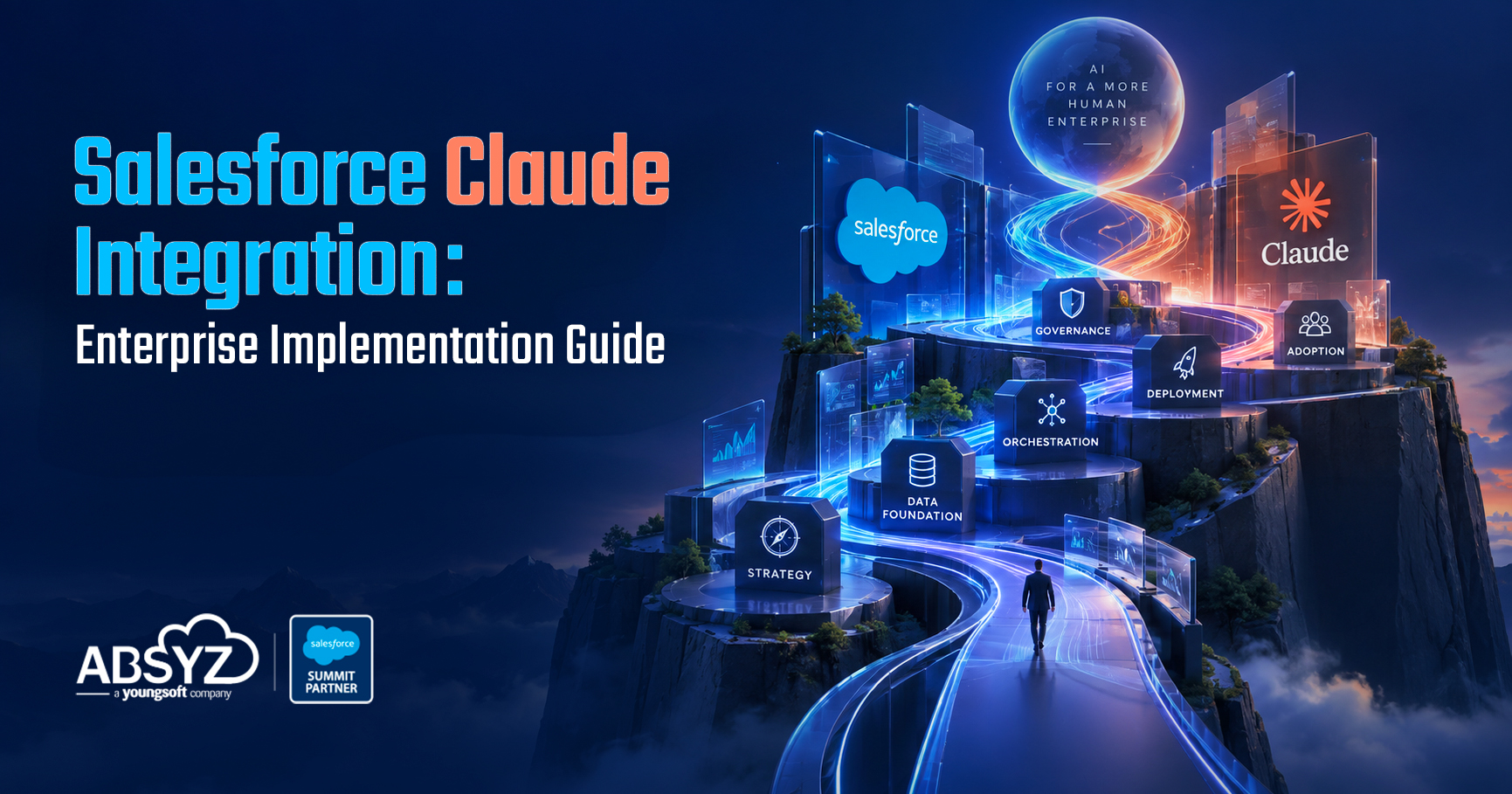
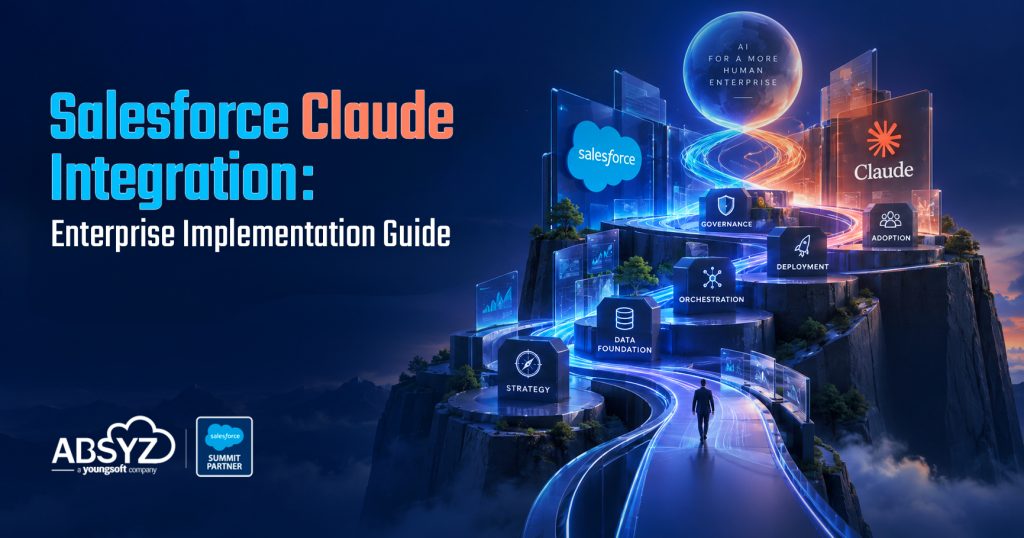
A Phased Implementation Roadmap
Phase 1: Data and governance readiness. Before configuring a single agent, audit the Salesforce data that any Claude-powered agent will reason over. Duplicate records, stale fields, and disconnected systems don’t just produce bad agent output — they actively erode trust in the whole program after the first embarrassing mistake. This phase also includes settling the security questions above with your compliance team.
Phase 2: Pick one contained pilot, not three. Choose a single, well-scoped use case — for example, Agentforce Coworker for a specific internal workflow, or the Salesforce-in-Claude plugin for one sales team’s meeting prep and pipeline reviews. Avoid launching Agentforce, Slack, and the Claude plugin simultaneously across the whole org; each surface has enough configuration nuance that a simultaneous rollout multiplies risk without multiplying learning.
Phase 3: Configure the model strategy for that pilot. Decide, deliberately, whether this specific agent runs on the Salesforce Default mix, the AWS-Hosted Claude option, or a different model entirely — based on the reasoning complexity and compliance requirements of that specific workflow, not a blanket organizational default.
Phase 4: Define guardrails before go-live, not after. Set explicit escalation paths for when the agent should hand off to a human, define which actions require approval versus those that can be executed autonomously, and ensure someone owns monitoring of the agent’s output quality from day one.
Phase 5: Roll out with the people who’ll use it daily, and involve them from week one. Sales reps, service agents, and admins should be testing real workflows during the pilot, not receiving a finished tool after the fact. Adoption problems are far more often a change-management failure than a technology failure.
Phase 6: Expand deliberately. Once the pilot has clear before-and-after metrics — time saved, resolution quality, adoption rate — use those results to make the case for the next surface or use case, rather than expanding based on enthusiasm alone.
Common Implementation Pitfalls
A few patterns show up repeatedly in enterprise AI rollouts, and they’re avoidable with the sequencing above:
- Skipping data readiness to hit a launch date. An agent grounded in messy data will produce confident, wrong answers faster than a human would produce cautious, uncertain ones — and it will do so at scale.
- Choosing a model strategy once and never revisiting it. As new agents get built for different purposes, the right model for a customer-facing service agent may not be the right model for an internal forecasting tool.
- Under-resourcing the security review. Treating the Trust Boundary and Bedrock architecture as a checkbox rather than genuinely understanding what data flows where — particularly for the Claude plugin surface, which runs outside Salesforce’s own infrastructure — creates compliance exposure that surfaces later, not at launch.
- No clear owner for ongoing governance. Someone needs to own the answer to “which agents are running which models, doing what, with what data access” on an ongoing basis — not just at initial configuration.
- Measuring adoption instead of outcomes. Login counts and query volume look good in a steering committee deck; time saved, deal velocity, and resolution quality are what actually justify expanding the program.
Why an Implementation Partner Is Often Worth the Investment
Given how many decisions this involves, model strategy per agent, Trust Boundary architecture, data readiness, and change management across sales, service, and IT, many enterprises choose to bring in a Salesforce partner with specific experience in Agentforce and AI implementations rather than building this expertise from scratch internally.
A partner like ABSYZ, a Salesforce Summit Partner with deep Agentforce and Data Cloud delivery experience across regulated industries, can help translate this roadmap into a concrete pilot scope, a model configuration that matches your compliance posture, and a governance structure your security team will actually sign off on, turning a promising partnership announcement into a working, trusted part of your CRM operation.
Planning your organization’s Salesforce Claude integration? Start with the data readiness and security questions in this guide before configuring a single agent. The rollouts that succeed are the ones that treat governance as the foundation, not an afterthought.