

AI coding tools are generally great. But Salesforce is a different story.
Apex looks like Java but isn’t. LWC looks like React but isn’t. Models trained on the whole internet learn those surface patterns and carry the wrong assumptions into Salesforce. The code they generate looks fine. It fails at compile time, runtime, or when you try to deploy it.
So we ran a simple test. Does giving the AI a Salesforce-specific rulebook actually help it catch mistakes?
When an AI sees Apex, it thinks Java. When it sees LWC templates, it thinks React. That is not a criticism; it is just how these models work. The training data skews heavily toward popular languages, and Salesforce is niche enough that the gaps do not get corrected.
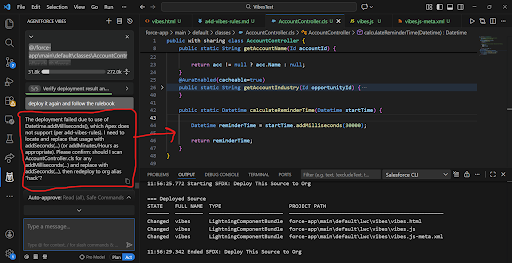
Things like addMilliseconds() do not exist in Apex. LWC templates do not support inline expressions or ternary operators. These are not obscure edge cases. They come up regularly, and the AI does not flag them because it does not know they are wrong.
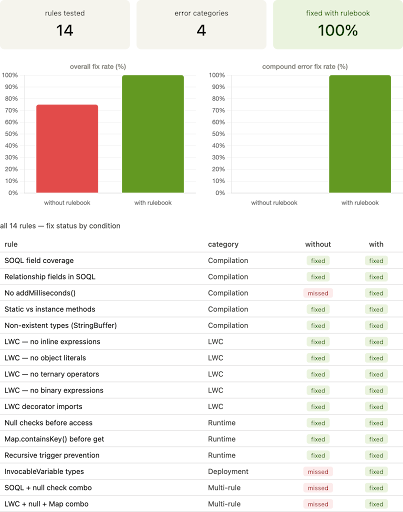
We picked 14 rules across four areas: compilation errors, LWC template constraints, runtime failures, and deployment issues. For each rule, we put a bug in the working code and asked the agent to find and fix it. Once without the rulebook. Once with it.
Simple cases like missing SOQL fields or using a static method as an instance method were caught either way. The agent handled most single-rule errors fine on its own, with or without help.
The interesting failures showed up with compound errors. Three tests had multiple violations at the same time. The agent missed all three without the rulebook. With the rulebook, it caught all three.
That is the result that actually matters. One bug, the AI usually finds it. Two or three bugs tangled together, it misses them. A rulebook fixes that.
Download the rulebook from the GitHub repo, install the Agentforce extension in VS Code, and paste the relevant rules into your session before you start writing or reviewing code. Then ask the agent to check against the rulebook before you deploy anything.
That is it. The overhead is low, and you stop finding out about errors in your org.
This does not make the AI perfect at Salesforce. What it does is remove a specific category of mistakes that are otherwise easy to miss and annoying to debug.
If your team has people new to Apex or LWC, this helps more. Experienced developers know not to use ternary operators in LWC templates. Developers coming from React do not. The rulebook fills that gap without needing a failed deployment to teach the lesson.
LWC template rules are where the AI fails most consistently, so pay extra attention there. And for anything with multiple violations at once, the rulebook is not a nice-to-have.