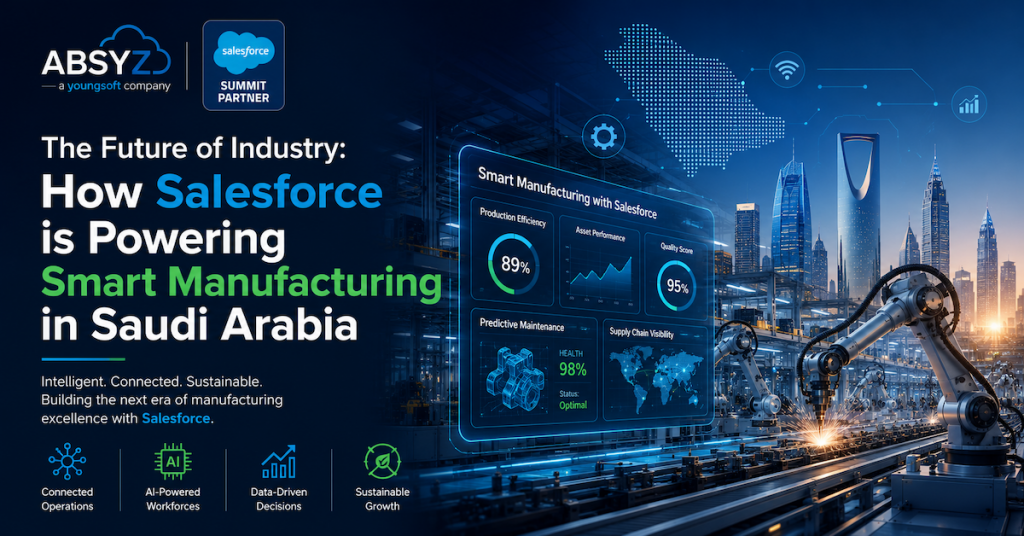
Saudi Arabia is in the midst of a historic economic and technological shift. Driven by the ambitious Vision 2030 framework, the Kingdom is rapidly diversifying its economy, moving away from reliance on hydrocarbons, and establishing itself as a global industrial powerhouse.
Central to this transformation is the rise of Smart Manufacturing—a sector that is evolving at lightning speed thanks to Fourth Industrial Revolution (4IR) technologies. With the government pushing to digitize thousands of local factories, the race to build smart, agile, and sustainable production ecosystems is officially on.
But advanced robotics, digital twins, and Industrial Internet of Things (IIoT) sensors are only part of the equation. To truly modernize, factories need connected commercial operations, real-time consolidated data, and seamless supplier experiences. This is where Salesforce, backed by a massive localized presence, is changing the game for manufacturers in Saudi Arabia.
In this comprehensive guide, we’ll explore the current state of smart manufacturing in the Kingdom, analyze Salesforce’s historical investments in Riyadh, and unpack how tools such as Salesforce Manufacturing Cloud, Data Cloud, and Agentforce are bridging the gap between the shop floor and the front office.
The Saudi Smart Manufacturing Landscape: Vision 2030 & Industry 4.0
Manufacturing is no longer limited to heavy machinery and manual production lines. Today, it relies on real-time data ingestion, predictive analytics, and automated decision-making. In Saudi Arabia, this transition is not just a commercial trend; it is a structured, state-backed national mission.
The Pillars Driving KSA’s Industrial Revolution:
- The National Industrial Development and Logistics Program (NIDLP): Launched to transform the Kingdom into a leading global industrial powerhouse and logistics hub. NIDLP acts as the infrastructure backbone, weaving 4IR technologies directly into the country’s manufacturing fabric.
- The Future Factories Program (برنامج مصانع المستقبل): This flagship initiative by the Ministry of Industry and Mineral Resources aims to digitally upgrade 4,000 traditional factories into smart, highly automated facilities. The program actively steers manufacturers away from low-skilled, manual labor and benchmarks digital maturity using the globally recognized Smart Industry Readiness Index (SIRI) methodology.
- The Saudi Industrial Development Fund (SIDF): To lower the financial barrier to entry, SIDF provides specialized loans and financial grants to factories adopting advanced Industry 4.0 technologies and smart software.
- The Saudi Green Initiative (SGI): Industrial digitalization is heavily tied to sustainability. Saudi factories are actively adopting IIoT and cloud-based software to monitor energy consumption, track carbon emissions, and reduce raw material waste, aligning with KSA’s net-zero carbon goals.
Market Outlook: The Digital Boom by the Numbers
The scale of this transition is reflected in the rapid market growth projected for the region:
Market Metric | 2025/2026 Value | Projected 2034 Value | Compound Annual Growth Rate (CAGR) |
KSA Smart Manufacturing Software Market | $1.3 Billion | $4.5 Billion | ~14.95% |
Saudi Arabia Industry 4.0 Market | $1.7 Billion | $4.9 Billion | ~12.31% |
Salesforce’s $500 Million Pledge to the Kingdom
Recognizing that Saudi Arabia is one of the world’s fastest-growing digital markets, Salesforce made a historic announcement at LEAP: a $500 million investment to accelerate local cloud adoption and AI innovation.
This is not a generic investment; it is a direct operationalization of Salesforce’s localized cloud architecture built specifically to meet the compliance, security, and cultural needs of Saudi enterprises.
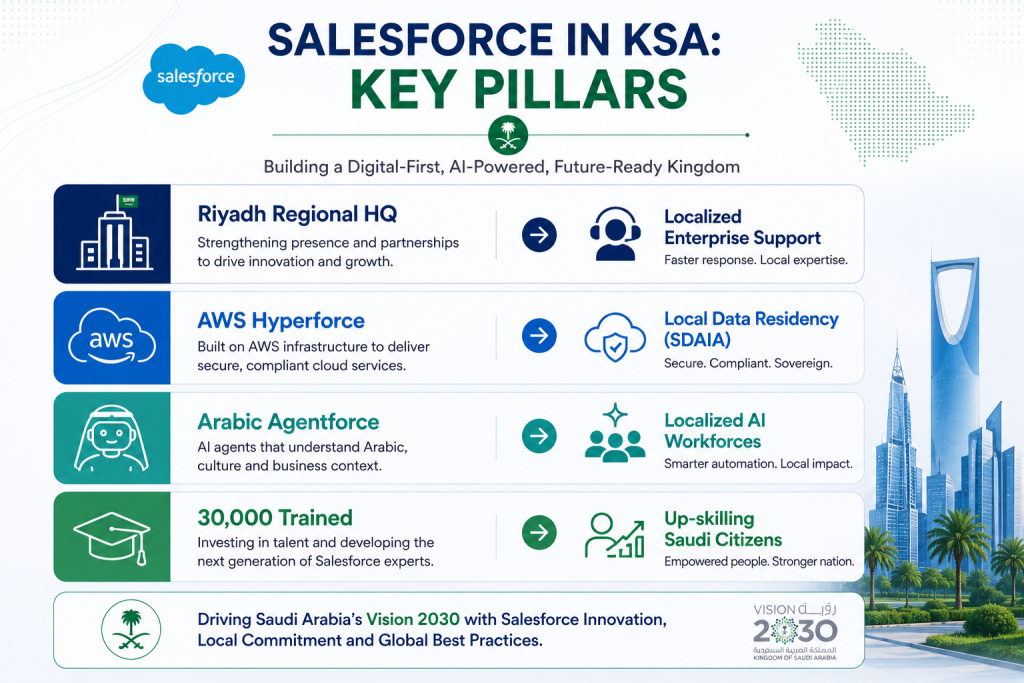
1. New Regional Headquarters in Riyadh
Salesforce established its official regional headquarters in Riyadh. Having localized executive presence means Saudi companies receive tailor-made support, region-specific product development, and strong alignment with local economic goals.
2. Hyperforce Availability on AWS KSA
For manufacturers working with defense, government infrastructure, or critical supply chains, data security and compliance are paramount. In partnership with Amazon Web Services (AWS), Salesforce brings Hyperforce to KSA. Hyperforce allows Saudi organizations to run their Salesforce environments locally on AWS public cloud infrastructure within the country. This guarantees absolute compliance with strict national data residency laws and regulatory frameworks enforced by the Saudi Data and AI Authority (SDAIA).
3. Agentforce with Native Arabic Support
Salesforce’s Agentforce platform, which enables the creation of autonomous AI agents, includes robust, comprehensive Arabic language support. This allows Saudi manufacturers to deploy AI workforces capable of managing supplier contracts, customer support, and dealer communications in the local language.
4. Upskilling 30,000 Saudi Citizens
To ensure a highly skilled workforce is available to manage these systems, Salesforce has committed to training and upskilling 30,000 Saudi citizens by 2030 in AI and cloud management, including partnerships with landmark organizations like Princess Nourah University to boost women’s participation in tech.
Bridging the Gap: Salesforce Manufacturing Cloud
While modern factories excel at automating their physical production lines (OT – Operational Technology), their business and commercial operations (IT – Information Technology) often remain siloed. ERP systems, legacy supply chain databases, and customer-facing teams rarely speak the same language.
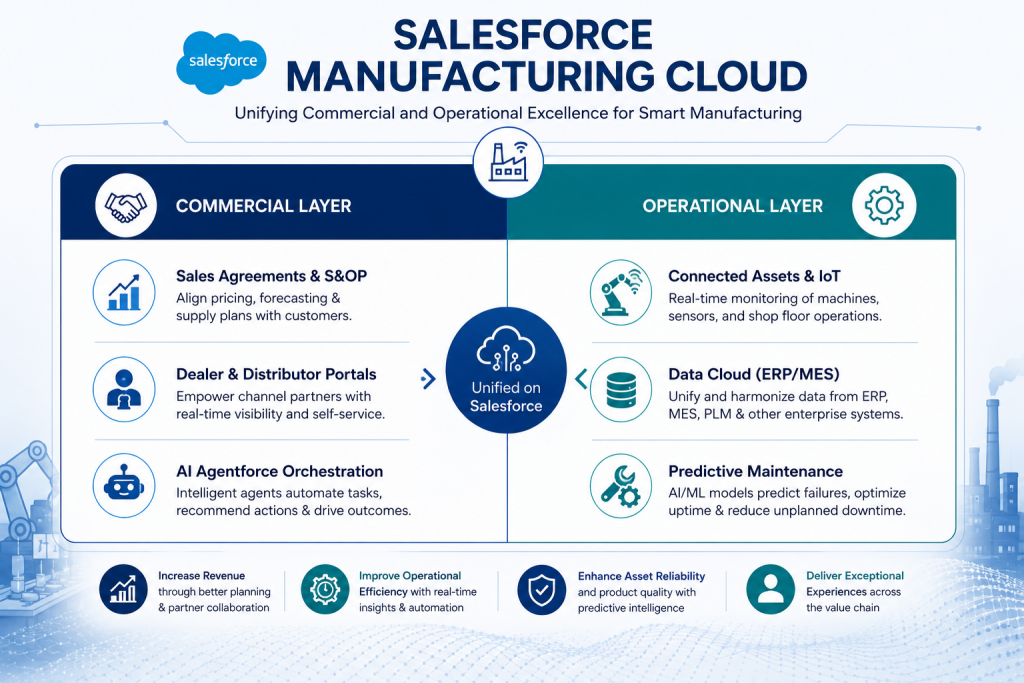
Salesforce Manufacturing Cloud acts as the central nervous system that unites the shop floor, the supply chain, and the sales team.
1. Unified Sales and Operations Planning (S&OP)
Traditional manufacturing often suffers from a major disconnect: sales teams close deals for products the factory floor can’t build, or factories overproduce inventory that sales can’t move. Manufacturing Cloud solves this with run-rate tracking and Sales Agreements. By pulling historical sales, active pipelines, and ERP capacity data into one dashboard, managers can continuously balance production run rates with real market demand, minimizing inventory holding costs.
2. Connected Assets for Manufacturing Cloud
Modern machinery is filled with sensors, but that telematics data is useless if it sits in a silo. With Salesforce’s Connected Assets suite, IoT telematics, machine status, and service history are unified into a single view.
- Predictive Maintenance: Instead of waiting for a machine on a production line to break down, Salesforce uses real-time IoT data to flag performance degradation and automatically schedule a field service technician for maintenance before downtime occurs.
- Real-time Performance Metrics: Connected Assets empowers service teams to monitor asset health directly in their CRM, enabling faster, data-backed recommendations.
3. Data Cloud: Unifying MES and ERP Silos
A typical smart factory operates on an ERP (Enterprise Resource Planning) system like SAP or Oracle, alongside an MES (Manufacturing Execution System) that tracks machine output. Using Salesforce Data Cloud, companies can ingest and harmonize high-velocity data from these disparate systems in real time. It transforms cold rows of transactional data into actionable customer profiles, allowing sales and support teams to see the precise fulfillment and shipping status of an order without logging into legacy back-office systems.
4. Frictionless Dealer and Distributor Management
In the GCC, direct-to-consumer models are rare in industrial setups; most manufacturers rely on extensive dealer and distributor networks. Manufacturing Cloud allows brands to build localized, secure self-service portals. Distributors in Riyadh, Jeddah, or Dammam can instantly log in to track their orders, raise warranty claims, update sales agreements, and view rebate structures. This eliminates endless email chains, lowers administrative overhead, and builds stronger partner relationships.
Agentforce: Autonomous AI on the Factory Floor
In the current era of industrial technology, simple chatbots are being replaced by autonomous AI agents. Powered by the Agentforce Atlas reasoning engine, these agents do not rely on basic, rigid scripts. They analyze real-time context, reference localized data in Data Cloud, and execute multi-step workflows to solve complex industrial issues.
Real-World Use Cases for Saudi Manufacturers:
- Instant Supply Chain Reconciliation: If a key supplier in Dammam experiences a delay, an Agentforce agent can automatically look up the delayed parts, check the impact on active sales agreements in Manufacturing Cloud, identify alternative local suppliers, draft a notification to affected clients, and present the options to the supply chain manager.
- Automated Distributor Support: Distributors can converse with an autonomous agent in Arabic to check regional inventory levels, process returns, or request expedited shipping. The agent handles the complete request securely, leaving human agents to focus on high-value business negotiations.
- Field Service Automation: When a connected field asset triggers an alert, the AI agent can analyze telemetry data, check spare part inventory levels in the ERP, open a work order, and assign the best-suited local field engineer with the exact tools needed.
The Roadmap: Implementing Salesforce for KSA Manufacturing
Embarking on an enterprise digital transformation can feel daunting. However, when aligned with Saudi Arabia’s Vision 2030, a structured implementation plan ensures maximum return on investment (ROI) and regulatory compliance.
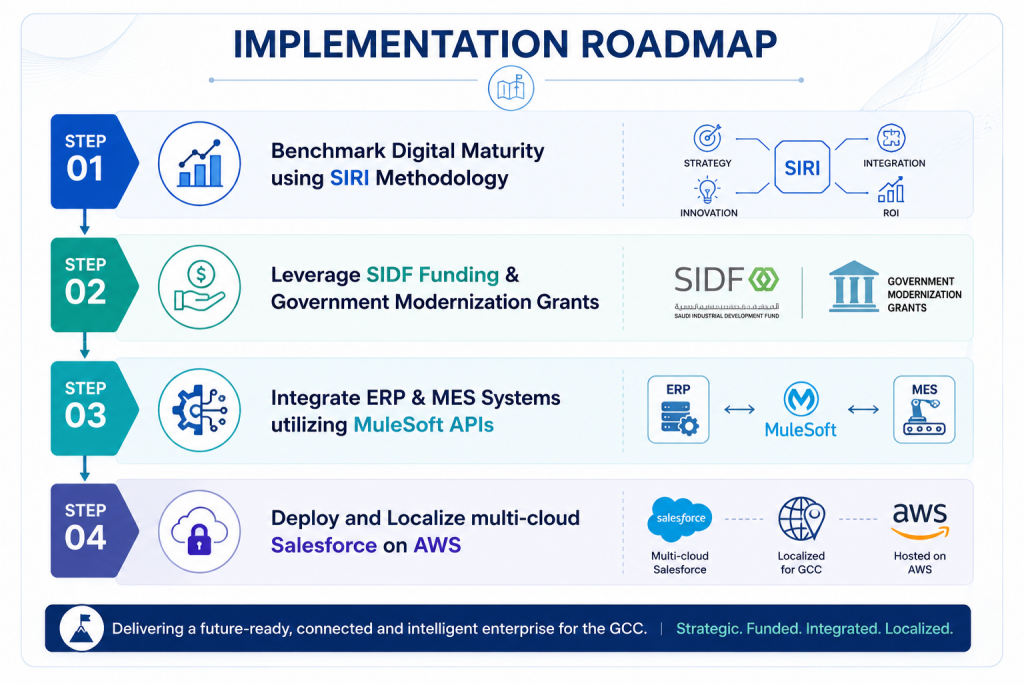
- Conduct a SIRI Assessment: Under the Future Factories Program, factories must benchmark their current standing. A Smart Industry Readiness Index (SIRI) assessment highlights precisely where operations lack connectivity, whether on the physical shop floor or in commercial S&OP.
- Apply for SIDF Grants: Do not leave money on the table. Use your digital roadmap and SIRI scores to apply for SIDF loans and digital modernization grants, significantly subsidizing your software and integration budgets.
- Design the ERP/MES Integration Architecture: Ensure your system architecture relies on robust middleware, such as MuleSoft, to connect Salesforce to major ERP platforms (such as SAP, Oracle, or Microsoft Dynamics) and MES software. Real-time, bidirectional data synchronization prevents data drift and keeps all teams aligned.
- Partner with a Certified Multi-Cloud Specialist: Implementing Salesforce at this scale requires deep, local knowledge of KSA regulations, cloud architecture, and industrial operations. Working with a certified, localized Salesforce Implementation Partner ensures a smooth, custom-tailored deployment to the Saudi business landscape.
The Smarter Road to 2030
The mandate for industrial companies across Saudi Arabia is clear: modernize, digitalize, or risk falling behind. Mega-projects like NEOM, the Red Sea Project, and growing government contracts require manufacturers to demonstrate unprecedented levels of operational maturity, environmental tracking, and digital agility.
By combining physical factory automation with the cloud-powered, AI-driven commercial intelligence of Salesforce Manufacturing Cloud, Saudi manufacturers can build resilient, highly connected, and future-proof enterprises that actively lead the Kingdom’s industrial renaissance.
Is your factory ready to lead the future of Industry 4.0 in Saudi Arabia?
If you are looking to align your manufacturing operations with Vision 2030, leverage local Hyperforce infrastructure, and harness the power of Salesforce AI, contact our team of certified multi-cloud implementation experts today to schedule a custom consultation.