Every year before Dreamforce, the Salesforce world turns its attention to what’s coming next. This year, the direction is no secret: the official theme is “Becoming an Agentic Enterprise,” and the September 15–17 agenda at Moscone will be wall-to-wall Agentforce, Data 360, and AI agents working alongside people at scale.
But in our conversations with Salesforce teams over the past few months, something interesting has shifted. The questions aren’t about features anymore. They’re about readiness.
Not “what will Salesforce announce?” but “will our org be able to use any of it?”
Across our recent engagements, the same five friction points keep surfacing — in enterprises and mid-market orgs alike, in mature implementations and young ones. The good news: every one of them can be meaningfully addressed in the weeks before Dreamforce begins. Here’s what we’re seeing, and what teams are doing about it.
1. Agentforce pilots that work in the demo, stall in the org
The pattern: a team stands up an Agentforce pilot, the proof of concept impresses everyone, and then it sits there. Not failed — just not scaled. When we dig in, the blocker is rarely the agent itself. It’s everything around it: unclear ownership of what the agent is allowed to do, no process for reviewing its actions, and business teams that were never brought into the pilot’s design.
The fix that fits before September: Run a scale-readiness review of your pilot. Define the agent’s decision boundaries in writing — what it can act on autonomously, what needs human approval, and who owns exceptions. Then expand the pilot to one adjacent team, not five. A pilot that survives its first handoff is worth ten that live in a sandbox. Arriving at Dreamforce with a scaling framework means the Agentforce 360 sessions become a shopping list instead of a wish list.
2. Data that was structured for reports, not for agents
Most Salesforce orgs have spent a decade optimizing data for dashboards — humans reading summaries. Agents need something different: clean, connected, well-described data they can act on. The gap shows up immediately when teams test agents against real records: duplicate accounts, free-text fields carrying critical logic, and integrations that sync on schedules agents don’t wait for.
The fix that fits before September: You don’t need a full data transformation before Dreamforce — you need a data readiness map. Pick the two or three objects your first agents will touch (cases, leads, orders — whatever matters most) and audit only those: duplicates, field completeness, and whether the meaning of each field is documented anywhere a machine could use it. This narrow audit typically takes days, not months, and it tells you exactly which Data 360 capabilities are worth your attention at the keynote.
3. Automation nobody fully understands anymore
Workflow rules built in 2018. Process Builder flows migrated halfway. Apex triggers written by a partner who’s long gone. When we run org reviews, we routinely find that no one person can explain what happens end-to-end when a record changes. That’s survivable in a human-driven org — people work around what they don’t understand. Agents can’t. An agent acting inside an org with tangled automation produces tangled results, at machine speed.
The fix that fits before September: Inventory your automation on the objects that matter most (the same ones from your data readiness map). Flag anything redundant, anything unowned, and anything that fires in an order nobody chose deliberately. You don’t have to remediate it all now — but a documented inventory turns “we think it works” into “we know what it does,” which is the actual entry requirement for the agentic era.
4. No baseline to prove what an agent delivered
Here’s a conversation we keep having: leadership approves an AI budget, an agent goes live, and three months later someone asks, “What did it actually change?” — and there’s no answer, because nobody measured the before. Case resolution time, lead response time, cost per ticket: if you don’t capture these now, you can’t attribute improvement later, and next year’s AI budget conversation gets harder.
The fix that fits before September: Choose three metrics your first agents should move, and snapshot them this month. That’s it. It’s the cheapest, fastest item on this list, and it’s the one that pays off most visibly — because when Dreamforce sessions showcase “measurable business outcomes,” you’ll have the denominators ready.
5. Teams evaluating what's new without knowing what they have
This is the meta-pattern underneath the other four. Dreamforce compresses a year of announcements into three days, and teams without a clear picture of their own org tend to adopt based on excitement rather than fit. Six months later, the org is heavier, not better. The teams that compound value year over year all share one habit: they assess before they adopt.
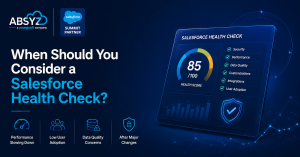
The fix that fits before September: A structured org health check — configuration, automation, data, integrations, adoption — gives you the “you are here” marker on the map. We’ve written separately about [when a Salesforce health check makes sense]({link to health check blog}); the short version is that the weeks before Dreamforce are the highest-leverage time of the year to run one, because everything announced on stage will be easier to evaluate against a known baseline.
Walking in prepared
None of these fixes requires a major program. A pilot boundary document, a narrow data audit, an automation inventory, three baseline metrics, and an org health check are each measured in days or a couple of weeks. Together, they change what Dreamforce is for you: less a firehose of announcements, more a menu you can order from with confidence.
The Agentic Enterprise is the destination Salesforce will describe on stage September 15–17. Whether your org can start the journey on the following Monday has now been decided.
If you’d like a second set of eyes on where your org stands before Dreamforce, talk to our team; we’ll tell you honestly which of these five apply to you.