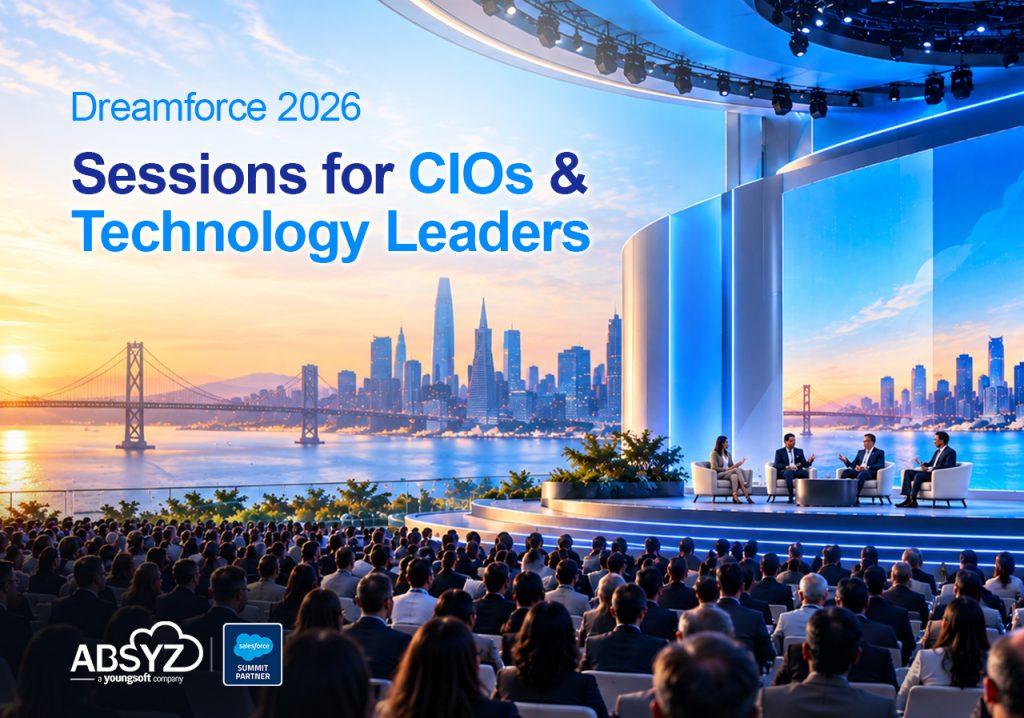
For most attendees, Dreamforce is about discovering what’s new. For CIOs and technology leaders, it needs to be about something more specific: deciding what’s worth betting the next budget cycle on. Dreamforce 2026 runs September 15–17 at Moscone Center in San Francisco, built around an “Agentic Enterprise” theme with 1,600+ sessions on the agenda — which means the hard part isn’t finding relevant content, it’s filtering out the noise and building a schedule that actually informs architecture, governance, and investment decisions.
This guide breaks down how CIOs and technology leaders should approach the Dreamforce 2026 session catalog, which categories of sessions are worth prioritizing, and where to find the deeper technical and governance conversations that don’t show up in the keynote highlight reel.
Why CIOs Should Approach Dreamforce Differently
Most Dreamforce marketing is aimed at admins, developers, and sales teams — and understandably so, since they make up the bulk of the audience. But Dreamforce has steadily built out content specifically for enterprise architecture and IT leadership, including a dedicated architect track and a relaunched Well-Architected Program offering updated evaluation criteria, frameworks, and expert consultations for enterprise architects and technical leads.
The practical implication: a CIO who plans a Dreamforce agenda the same way a sales rep would — sampling keynotes and product demos — will leave with inspiration but not much that’s actionable. The sessions worth prioritizing are the ones addressing architecture patterns, data governance, security, and AI oversight — the decisions that determine whether this year’s Agentforce enthusiasm becomes next year’s production reality.
Must-Attend Session Categories for CIOs & Technology Leaders
1. Executive and Opening Keynotes
The Dreamforce Opening Keynote with Marc Benioff and special guests remains the anchor for major product announcements and strategic direction. For CIOs, this is less about the spectacle and more about listening for where Salesforce is placing its next 12–18 months of platform investment — because that roadmap shapes what your organization should be planning architecture around.
2. Architect Track: Patterns, Not Just Product Pitches
The architect track is where Dreamforce gets genuinely technical. Expect sessions on agent architecture patterns, integration design for multi-agent systems, and real-world implementation case studies presented by practicing architects rather than product marketing teams. This is the track most likely to save your organization from architecture mistakes other companies have already made publicly.
3. AI Governance and the Security Keynote
Dreamforce ’25 introduced Salesforce’s first dedicated Security Keynote, and CIOs should expect that focus to deepen in 2026 as more organizations move Agentforce deployments from pilot into production. With industry estimates suggesting agent deployment failure rates as high as 67% when governance and data groundwork are skipped, sessions covering AI governance, human-in-the-loop design, and MCP (Model Context Protocol) permissioning deserve a place near the top of any CIO’s schedule — not as a compliance checkbox, but as the actual difference between an agent program that scales and one that stalls.
4. Data 360 and Data Architecture Sessions
Autonomous agents are only as reliable as the data grounding them, and Salesforce has been direct about this: its own 2026 Connectivity Benchmark Report found that 96% of organizations face obstacles leveraging their data for AI, with legacy architecture and disconnected systems as leading causes. Sessions focused on Data 360 architecture, identity resolution, and unified customer profiles are worth prioritizing for any CIO whose Agentforce roadmap is currently ahead of their data readiness — which, per that statistic, is most organizations.
5. Industry-Specific Executive Roundtables
Dreamforce runs smaller, capped-attendance roundtables organized by industry — financial services, healthcare, manufacturing, and others — where the conversation tends to be more candid than a breakout session with hundreds of attendees. These are typically where CIOs get the most honest peer insight: what actually broke during a rollout, what governance model worked, and what a comparable organization would do differently.
6. Partner-Led Thought Leadership Sessions
Alongside Salesforce’s own content, Dreamforce features sessions and workshops led by Salesforce consulting and implementation partners, offering a practitioner’s view shaped by dozens of real client engagements rather than a single organization’s experience. These sessions are worth building into a CIO’s schedule specifically because partners see failure patterns and success patterns across many implementations — a different, often more pattern-matched perspective than a single customer case study provides.
Spotlight: ABSYZ Speaker Sessions at Dreamforce 2026
Two sessions worth adding directly to your CIO agenda come from ABSYZ speakers Nitish Kumar and Jashuva Pilla, both presenting in the Architect / Agentforce / Agentic AI track — squarely in the territory this guide has been pointing CIOs toward: architectural judgment over feature enthusiasm.
Build, Buy, or Use an Agent: Choose the Right Path Nitish Kumar & Jashuva Pilla | Thursday, Sep 17, 3:00–3:20 PM PDT | Moscone West, L1 Forest, AgentExchange Theater
This is a direct answer to a question every CIO is currently fielding from their own teams: when should we write custom code, when should we buy an app, and when should we hand a workflow to an AI agent? The session offers a three-way decision framework and four diagnostic questions for determining whether a solution should be deterministic or agent-driven — plus, just as usefully, guidance on recognizing when real-world complexity breaks the framework and requires human architectural judgment instead. It’s a Theater session (first come, first seated, no reserved seating), so plan to arrive early.
Seven Ways to Set Up Agent Orchestration with Agent Fabric Nitish Kumar | Wednesday, Sep 16, 8:30–8:50 AM PDT | Moscone West, L1 Forest, Redwood Theater
This one goes straight at the governance question raised earlier in this guide. Agent Fabric is Salesforce’s connectivity, governance, and security layer for multi-agent systems, and this session walks through seven concrete settings to configure before an agent reaches production — Agent Scanners, Broker rules, and OAuth scopes to keep multi-vendor agents discoverable and bounded; LLM Gateway policies and per-team token budgets so no single agent can consume model capacity outside its allocation; and audit trail and observability hooks wired in before real users touch the system. For any CIO whose Agentforce program is further along on ambition than on governance, this is one of the more directly useful 20 minutes on the schedule.
Jashuva Pilla is also speaking in a few community-track sessions across the week — including Redefine Community in a World Where AI Has All the Answers (Wed, Sep 16) and Turn Community Connections Into Career Growth (Thu, Sep 17) — worth a mention if your Dreamforce agenda extends beyond pure architecture content into how AI is reshaping the broader Trailblazer community.
Building a CIO-Focused Dreamforce Agenda
A few practical tips for translating this into an actual schedule:
- Register early through the Dreamforce agenda builder. Architect track sessions, roundtables, and workshops have capped attendance and fill quickly — general keynotes do not.
- Balance keynotes with small-capacity sessions. Keynotes are useful for direction-setting; roundtables and architect sessions are where you get material you can act on.
- Leave deliberate gaps. The most useful conversations at Dreamforce often happen in the hallway between sessions, not in the sessions themselves — don’t over-schedule every hour.
- Bring your team’s actual blockers, not just curiosity. Sessions are more valuable when you’re testing your organization’s specific data, governance, or architecture questions against what’s being presented, rather than passively absorbing content.
Questions to Bring Into These Sessions
Whichever sessions make your final agenda, come with questions that push past the demo-stage answer:
- What does a production-grade agent architecture actually require in terms of monitoring and rollback, not just deployment?
- How are other organizations governing MCP tool access at scale, and who owns that governance internally?
- What does “good” data readiness look like before an agent program moves past pilot?
- Where has human-in-the-loop design actually prevented a costly agent mistake — not hypothetically, but in production?
- How are peer organizations budgeting for consumption-based AI pricing models compared to traditional per-seat licensing?
These are the questions that separate a Dreamforce trip that produces a keynote summary deck from one that produces an actual technology roadmap.
Building your Dreamforce 2026 agenda as a CIO or technology leader? Prioritize the architect track, the Security Keynote, and a few well-chosen partner sessions, like ABSYZ’s “Build, Buy, or Use an Agent” and “Agent Orchestration with Agent Fabric”; that combination tends to produce more usable material than a schedule built around the biggest names on the main stage.