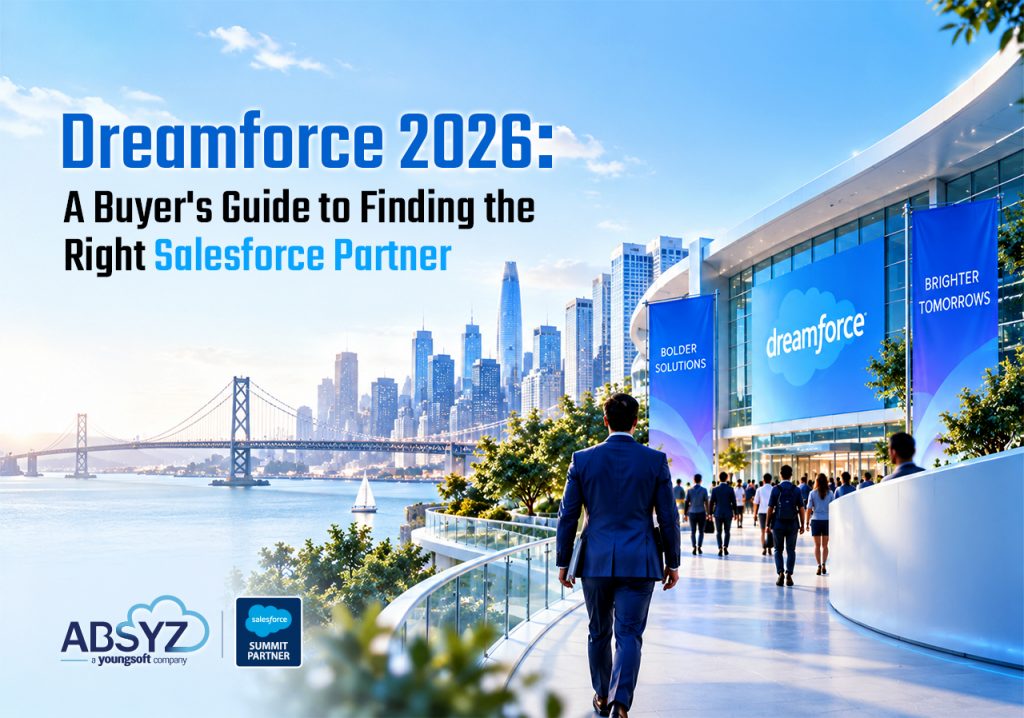
Every September, Dreamforce turns Moscone Center into the largest Salesforce partner marketplace in the world — thousands of Trailblazers, 1,600+ sessions, and a partner pavilion packed with firms all pitching some version of the same promise: we’ll get your Salesforce investment right. Dreamforce 2026, running September 15–17 under the “Agentic Enterprise” theme, raises the stakes further. With Agentforce, Data 360, and Claude-powered reasoning now central to the platform roadmap, the Salesforce partner you choose this year isn’t just executing a project plan — they’re shaping how your business adopts AI for the next several years.
That makes this less of a shopping trip and more of a buying decision, and buying decisions go better with a process. This guide walks through how to approach Salesforce partner selection like a buyer, not a booth visitor: what to define before you arrive, how to actually work the expo floor, which questions separate a real Salesforce consulting partner from a polished pitch, and how to turn a few good conversations into a shortlist you can act on.
Before You Go: Define What You're Actually Buying
The single biggest mistake buyers make at Dreamforce is walking the floor before they’ve defined the problem. “We need a Salesforce partner” isn’t specific enough to evaluate anyone against. Before you talk to a single Salesforce implementation partner, get clear on which of these you’re actually solving for:
- Net-new implementation — you’re standing up Sales Cloud, Service Cloud, or another product from scratch and need a team that can own discovery through go-live.
- Org rescue or cleanup — you have an existing org that’s grown messy, over-customized, or under-adopted, and need a partner comfortable auditing someone else’s work.
- AI and Agentforce buildout — your core CRM is stable, but you need a partner who understands Data Cloud readiness and can deploy agents responsibly.
- Ongoing managed services — you don’t need a project; you need an extension of your admin team for the long haul.
Each of these calls for a different kind of Salesforce consulting partner. A firm that’s excellent at greenfield builds isn’t automatically the right choice for untangling five years of undocumented automation, and vice versa. Write your scenario down in a sentence before Dreamforce starts — it will make every conversation on the floor sharper.
The Salesforce Partner Landscape at Dreamforce 2026
Not all Salesforce partners are built the same way, and Dreamforce is where that becomes obvious fast. Broadly, the partners you’ll meet fall into a few categories:
Partner Type | Strengths | Watch For |
Global systems integrators | Deep bench, multi-cloud experience, enterprise procurement fluency | Higher cost, junior staffing on delivery, and less Salesforce-exclusive focus |
Boutique / regional firms | Personal relationships, flexible scoping, faster response times | Limited bench depth for large, multi-workstream programs |
Pure-play Salesforce partners | Singular platform focus, often deeper certification density per consultant, faster ramp-up | Narrower scope outside the Salesforce ecosystem — confirm integration and industry range |
AI-first / Agentforce specialists | Strong on newer capabilities (Data Cloud, Agentforce, prompt design) | May be less tested on core CRM fundamentals — check their implementation track record, not just their AI pitch |
None of these categories is inherently “best.” The right fit depends on the scenario you defined above. A pure-play Salesforce consulting partner is often a strong match for mid-market companies that want a team fully fluent in the platform without paying for a multi-practice SI’s overhead — but only if their industry and integration experience lines up with your needs.
Salesforce Partner Selection: A Buyer's Checklist
Use this as a scorecard as you move through the expo floor and partner pavilion. For each Salesforce partner you meet, rate them across:
- Certification depth — architect and consultant-level credentials, not just headcount of certified staff.
- Relevant project history — ask for examples in your industry and your specific Salesforce cloud(s).
- Agentforce and Data Cloud maturity — a live production example beats a roadmap slide every time.
- Integration and data migration competency — how they’ve handled messy legacy data, not just clean greenfield builds.
- Delivery model transparency — onshore/offshore mix, and who specifically will staff your project.
- Post-launch support structure — hypercare, managed services, and admin enablement.
- Communication style — do they ask sharp diagnostic questions, or do they just nod along to your requirements?
Score each Salesforce partner selection criterion honestly, even for firms you liked personally. The goal is a shortlist grounded in evidence, not booth charisma.
Which Salesforce Partners to Meet at Dreamforce 2026
With hundreds of exhibitors, a random walk through the partner pavilion is a waste of time. A more deliberate approach:
- Pre-book meetings. Most serious Salesforce consulting partners will schedule 1:1 time in advance — reach out before the event rather than hoping for a good conversation at the booth.
- Attend partner-led breakout sessions, not just keynotes. These sessions show you how a partner actually explains a technical concept, which is a reasonable proxy for how they’ll explain it to your team mid-project.
- Ask who’s actually in the room. A partner’s sales lead at Dreamforce and their delivery team back home are often different people — try to meet at least one person who’d be hands-on in your engagement.
- Compare notes across categories, not just companies — talk to at least one global SI, one boutique, and one pure-play Salesforce implementation partner so your shortlist reflects a real range of delivery models, not just whichever booth had the best swag.
Firms like ABSYZ, a Salesforce Platinum Consulting Partner built entirely around Salesforce delivery, are worth including in that mix specifically because they represent the pure-play category — useful as a comparison point against larger, multi-practice integrators when you’re weighing depth of platform focus against breadth of services.
Red Flags in the Sales Conversation
A buyer’s guide isn’t complete without the warning signs. Be cautious of any Salesforce partner who:
- Can’t name a project that didn’t go smoothly, or deflects when asked about one.
- Pitch Agentforce or AI agents for every use case you describe, regardless of fit.
- It is vague about who will actually staff your project versus who’s in the sales meeting.
- Doesn’t ask about your data quality or your org’s existing health before proposing a solution.
- Treats post-launch support as an afterthought rather than a defined part of the offer.
These aren’t disqualifiers on their own, but a pattern of two or more is worth probing further before you move a firm onto your shortlist.
From Shortlist to RFP: Turning Conversations Into a Decision
Dreamforce conversations are a starting point, not a selection process. Once you’re back from San Francisco:
- Consolidate your scorecards across every Salesforce partner you met, while the conversations are still fresh.
- Narrow to 3–4 firms that scored well across certification, relevant experience, and communication fit.
- Send a structured RFP or scoping call request—reuse the same evaluation criteria to ensure responses are genuinely comparable.
- Request references specific to your scenario (net-new build, org rescue, AI buildout, or managed services) rather than generic case studies.
- Involve the people who’ll live in the system daily — sales ops, service leads, or admins — in at least one evaluation call before you sign.
A rushed decision made in the Dreamforce afterglow is exactly how mismatched Salesforce partnerships happen. The floor is where you gather signals; the weeks after are where you actually decide.
Where a Partner Like ABSYZ Fits In
If your scenario leans toward a pure-play Salesforce consulting partner, a team whose entire practice is built around Salesforce rather than a single product line within a larger IT firm, ABSYZ is a useful reference point. As a Platinum Consulting Partner with a 450+ person team spanning Sales Cloud, Service Cloud, Marketing Cloud, Commerce Cloud, CRM Analytics, and integration work across manufacturing, financial services, and other regulated industries, they represent the kind of focused delivery model worth benchmarking against the larger systems integrators also exhibiting at Dreamforce. Whether or not they end up on your final shortlist, comparing a pure-play Salesforce implementation partner against a global SI is exactly the kind of range this buyer’s guide recommends building into your Dreamforce conversations.
Building your Dreamforce 2026 meeting list? Use the scorecard above for every Salesforce partner you talk to; the firm that answers the hard questions well on the floor is usually the one that answers them well six months into the project, too.