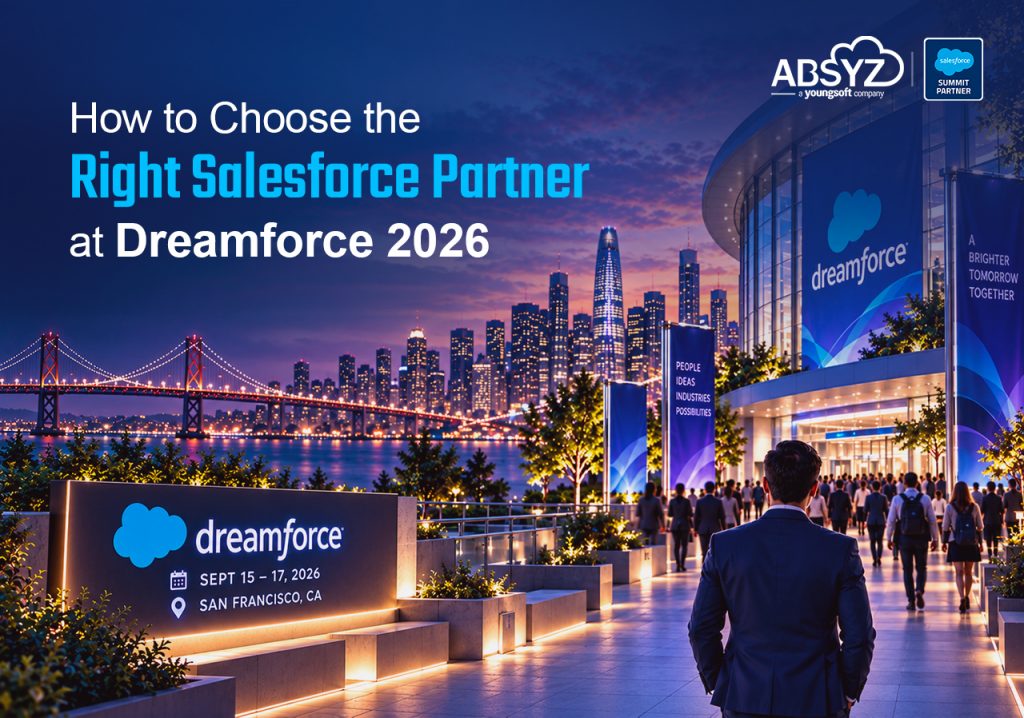
Dreamforce 2026 returns to the Moscone Center in San Francisco on September 15–17, and this year the conversation on the show floor won’t just be about new features. It’ll be about who can actually help you implement them. With 1,600+ sessions built around the “Agentic Enterprise” theme, Agentforce, Data 360, and AI-driven transformation are no longer optional line items on a roadmap; they’re the roadmap. And that shift raises a harder question than “which cloud do we buy next”: which Salesforce partner do we trust to build it?
Walk the Moscone floor, and you’ll pass hundreds of booths, all promising certified consultants, proven frameworks, and “end-to-end transformation.” Most of that pitch sounds identical by the second hour. The partner you choose, though, is arguably a bigger driver of ROI than the licenses you buy — a strong implementation partner can get you to value in months. At the same time, the wrong one can leave a six-figure Salesforce investment half-configured and unused a year later.
This guide breaks down exactly what to evaluate before you commit to a Salesforce partner, the questions worth asking in person at Dreamforce, and why it’s worth putting ABSYZ on your shortlist.
What to Evaluate in a Salesforce Partner
Before you get into specific capabilities, it helps to have a framework. Most Salesforce partner evaluations come down to five dimensions:
- Track record on projects like yours — not just “we’ve done Salesforce,” but Sales Cloud, Service Cloud, Marketing Cloud, Commerce Cloud, or industry-specific builds that mirror your use case.
- Certification depth versus certification count — a partner with 50 certified consultants spread thin is different from one with a smaller, senior team holding architect-level credentials.
- Delivery model fit — onshore, offshore, or hybrid, and whether that model matches your budget, timezone needs, and governance requirements.
- Cultural and communication fit — this sounds soft, but it’s often the actual reason projects stall. Can this team push back on a bad requirement instead of just building what’s asked?
- What happens after go-live — implementation is one project; the relationship after that is what determines whether your Salesforce org still makes sense two years from now.
Salesforce’s own partner tiers (Registered, Silver, Gold, Platinum, Summit) are a reasonable first filter. Still, the tier alone won’t tell you if a partner understands your industry or your AI roadmap. Treat it as a screening criterion, not a decision criterion.
Consulting vs. Implementation Capabilities
One of the most overlooked distinctions when choosing a Salesforce partner is the difference between a firm that can advise and one that can build, and whether you actually need both.
- Pure consulting partners are strong on strategy: process mapping, org design, change management, governance frameworks. They’re valuable when your Salesforce problem is really a business-process problem.
- Pure implementation partners are strong on execution: configuration, custom development, integrations, and data migration. They’re valuable when your strategy is already clear, and you need hands that can build fast without breaking things.
- Full-lifecycle partners do both, ideally with the same team carrying context from discovery through hypercare, so nothing gets lost in a handoff between a strategy firm and a build firm.
The mismatch to watch for: a partner that’s excellent at running workshops and producing beautiful roadmap decks, but whose delivery team is junior, outsourced separately, or unfamiliar with the recommendations the strategy team just made. Ask directly whether the people in the sales pitch are the people who will be in your sprints.
Salesforce + AI / Agentforce Expertise
This is the dimension that’s changed the most in the last 18 months, and it’s the one most partners are least equipped to prove. Agentforce isn’t a bolt-on chatbot — it’s a shift in how CRM data, automation, and reasoning models interact, and it demands a different skill set than traditional declarative Salesforce configuration.
When evaluating a partner’s AI and Agentforce capability, look for:
- Live implementations, not slideware. Ask to see an Agentforce agent they’ve actually deployed to production, including how they handled guardrails, escalation paths, and data grounding.
- Data readiness expertise. Agentforce is only as good as the data it reasons over. A partner who jumps straight to building agents without first assessing Data Cloud hygiene and integration quality is skipping the step that actually determines whether the agent works.
- Familiarity with the broader AI ecosystem. With Salesforce and Anthropic’s expanded Claudeforce partnership bringing Claude’s reasoning directly into the Salesforce platform, partners who understand how underlying models, prompt design, and enterprise governance interact will be better positioned to build agents that are both capable and trustworthy — not just technically impressive in a demo.
- A point of view on where not to use AI. A partner who recommends an agent for every workflow is optimizing for the sale, not for your outcome.
Data & Integration Capabilities
Salesforce rarely lives in isolation. It sits alongside ERP systems, marketing platforms, data warehouses, legacy databases, and, increasingly, Data Cloud pipelines that feed AI agents in real time. A partner’s integration competency is often the strongest predictor of whether your implementation remains stable as your tech stack grows.
Evaluate this by asking about:
- Middleware and API experience — MuleSoft, direct REST/SOAP integrations, event-driven architecture, and how they decide which approach fits a given use case.
- Data migration discipline — how they handle deduplication, data quality audits, and legacy system sunset planning, not just the technical move itself.
- Data Cloud maturity — whether they can architect unified profiles and real-time data flows that Agentforce and analytics tools actually depend on.
- Security and governance fluency — field-level security, sharing models, and compliance requirements specific to regulated industries.
Weak integration work doesn’t usually show up on day one. It shows up six months later as duplicate records, broken automations, and a support team that doesn’t understand why. Push for specifics on how a partner has handled integration failure, not just integration success.
Industry Experience
Generic Salesforce expertise gets you a functioning org. Industry-specific expertise gets you an org that reflects how your business actually operates — its compliance requirements, its sales motion, its definition of a “customer.”
A partner with real manufacturing, financial services, healthcare, or high-tech experience will recognize industry-specific patterns immediately: CPQ complexity for manufacturers with configurable products, KYC and case automation for financial institutions, or grant and funding workflows for research organizations. That recognition saves weeks of discovery and prevents the “generic CRM” trap, where a technically correct implementation still doesn’t fit how your teams sell, service, or fulfill.
When you ask about industry experience, ask for the honest edge cases too — a partner who can describe what went wrong on a similar project, and how they adjusted, is usually more credible than one with a spotless highlight reel.
Ability to Support Post-Implementation
Go-live is the beginning of the value curve, not the end of the engagement. Salesforce releases three major platform updates a year, business requirements shift, and AI capabilities are evolving faster than almost anything else in the ecosystem. A partner who disappears after launch leaves you exposed exactly when things start to matter.
Look for clarity on:
- Hypercare structure — how bugs and adoption issues are triaged in the weeks immediately after launch.
- Ongoing managed services — whether they offer flexible support retainers versus forcing you into a new SOW for every small change.
- Admin enablement — do they train your internal team to be self-sufficient, or do they quietly keep you dependent on billable hours?
- Release readiness — how they help you evaluate and adopt new Salesforce features (including Agentforce updates) without disrupting what’s already working.
The best partners treat post-implementation support as a continuation of the same relationship, not a separate transaction — because the org they built keeps evolving long after the project plan says “complete.”
Questions to Ask a Salesforce Partner at Dreamforce
Booth conversations are short, so make them count. These questions tend to separate substantive partners from polished sales pitches fast:
- “Can you show me an Agentforce agent you’ve deployed to production — not a demo — and what data grounding it uses?”
- “Who on your team will actually be staffed on my project, and what’s their certification level?”
- “What does your post-launch support model look like, and what’s not included?”
- “Tell me about a project in my industry that didn’t go as planned. What did you change?”
- “How do you approach data quality and integration before touching automation or AI?”
- “What’s your onshore/offshore delivery mix, and how do you handle timezone overlap?”
- “How do you decide when not to recommend an AI agent for a workflow?”
Bring the same questions to every booth. The consistency in answers — or lack of it — tells you more than any single conversation will.
Why ABSYZ Is Worth a Conversation
If you’re building this shortlist, ABSYZ deserves a spot. Founded in 2011 and now a Salesforce Platinum Consulting Partner, ABSYZ is a pure-play Salesforce firm — meaning Salesforce consulting, implementation, and support isn’t a division of a broader IT practice, it’s the entire business. That focus shows up in the details: a CMMI Level 3 process discipline, 450+ Salesforce, digital, and UI/UX consultants, and delivery experience spanning Sales Cloud, Service Cloud, Marketing Cloud, Commerce Cloud, CRM Analytics, and custom integrations across manufacturing, financial services, energy, and other regulated industries.
A majority-owned subsidiary of Youngsoft Inc. (Michigan), ABSYZ combines a US-based client relationship footprint with global delivery capacity out of Hyderabad and other offices — giving clients both the accessibility of a nearshore partner and the depth and cost efficiency of a dedicated global delivery team. Their project history includes CPQ transformations for manufacturers, Salesforce-powered KYC and case automation for financial institutions, B2B Commerce Cloud rollouts, and CRM Analytics builds for data-driven organizations — the kind of breadth that suggests a team comfortable with both the platform and the industry context around it.
If you’re evaluating partners at Dreamforce 2026 with Agentforce, Data Cloud, or a stalled implementation on your mind, a conversation with ABSYZ is a reasonable way to pressure-test your shortlist against a team that’s spent over a decade doing nothing but Salesforce.
Heading to Dreamforce 2026? Bring this checklist with you, and don’t settle for a partner who can only answer the easy questions.