
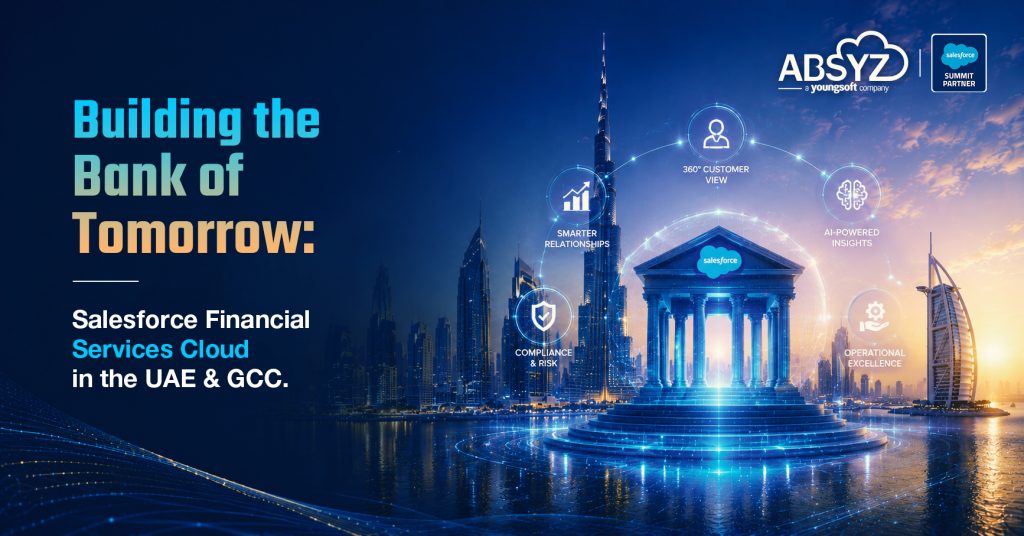
Banks and wealth managers across the UAE and wider GCC are under a specific kind of pressure: client expectations have shifted toward the instant, personalized digital experiences set by fintechs and global platforms, while the underlying infrastructure at most institutions is still built around legacy core banking systems that weren’t designed for that pace. The result is a widening gap between what clients expect at the front office and what internal systems can actually deliver.
Salesforce Financial Services Cloud (FSC) is increasingly the platform institutions in DIFC, ADGM, and across the region are turning to to close that gap — not by replacing core banking infrastructure, but by giving front-office, onboarding, and advisory teams a modern layer built specifically for financial services relationships, sitting on top of it.
The Middle East Banking Evolution: From Legacy Core to Customer-Centric Front Office
Core banking systems remain, for good reason, conservative and stability-focused — they’re built to handle transaction processing, ledgers, and regulatory reporting reliably, not to deliver the kind of relationship-driven, personalized experience clients now expect from their bank or wealth manager.
That’s created a clear separation of concerns across the region’s more digitally mature institutions: keep core banking systems doing what they do well, and layer a purpose-built CRM on top to handle everything client-facing — onboarding, relationship management, service, and advisory. Financial Services Cloud is built specifically for this front-office layer, with a data model designed around financial accounts, households, and relationships rather than the generic contact records a standard CRM offers.
For Chief Digital Officers and heads of retail banking evaluating digital transformation roadmaps, this front-office/core-banking split is usually the fastest, lowest-risk path to modernizing the client experience without a disruptive, multi-year core system replacement.
Accelerating Client Onboarding: From Weeks to Minutes
Client onboarding is one of the most visible friction points in regional banking — and one of the most consequential, since a slow or clunky onboarding process is often a prospective client’s first real interaction with the institution.
Manual KYC/AML verification, document collection across disconnected channels, and handoffs between compliance and relationship teams routinely stretch onboarding timelines to weeks. That delay isn’t just a client experience problem — it’s a real cost in lost business, particularly in wealth management and corporate banking, where prospective clients often have other options.
Integrating Financial Services Cloud with MuleSoft allows institutions to connect KYC/AML verification services, document management systems, and core banking platforms into a single automated workflow. Identity verification, sanctions screening, and document collection can run in parallel rather than sequentially, with status visible to both the client and the relationship team throughout the process. Institutions that have modernized this workflow are seeing onboarding timelines compressed from weeks to minutes or hours for straightforward cases. In contrast, more complex cases still benefit from far greater visibility and fewer manual handoffs.
Private Banking & Wealth Management: Personalization at Scale
For wealth management executives, the challenge is different but related: delivering the tailored, proactive advisory experience high-net-worth clients expect without requiring every interaction to be manually researched and prepared by a relationship manager.
Financial Services Cloud’s data model brings together a client’s full financial picture — accounts, holdings, life events, goals, and interaction history — into a single view, rather than scattered across separate portfolio management, CRM, and communication tools. This enables a few capabilities that matter directly to DIFC and ADGM-based wealth management firms:
- Household and relationship mapping, so advisors understand the full scope of a client relationship, not just an individual account
- Goal-based planning tools that connect a client’s stated objectives to actual portfolio construction and tracking
- Proactive alerts and next-best-action guidance, surfacing relevant conversations (a maturing investment, a life event, a portfolio drift from target allocation) before the client has to ask
- AI-assisted portfolio insights (via Agentforce and related capabilities) that help advisors prepare for client conversations faster, without replacing the advisor’s judgment on actual recommendations
The goal isn’t to automate advisory relationships — it’s to give advisors the context and tools to make every client interaction feel proactive and informed rather than reactive.
Navigating Regulatory Standards: CBUAE and DIFC Data Protection
Regulatory compliance isn’t a feature layered on top of a banking CRM in this region — it’s a foundational design requirement. Institutions operating under the Central Bank of the UAE (CBUAE) oversight or within the DIFC and ADGM’s distinct regulatory frameworks need systems that support compliance by design, not as an afterthought bolted onto a generic platform.
A few areas matter specifically:
- Data residency and governance — understanding where client and transaction data is stored and processed, and ensuring this aligns with CBUAE expectations and DIFC Data Protection Law requirements
- Audit trail and reporting — regulatory reporting requirements demand clear, traceable records of client interactions, consent, and decision-making, which need to be built into the platform’s data model rather than reconstructed after the fact
- Consent and data handling — DIFC’s data protection framework places specific obligations around client consent and data usage that need to be reflected in how client records and communications are structured
- Cross-border data considerations — relevant for institutions with clients or operations spanning multiple GCC jurisdictions, each with its own regulatory nuances
Getting this right requires a Salesforce implementation partner who understands these regulatory frameworks specifically, not just financial services CRM configuration in general — the two are related but distinct areas of expertise.
What This Looks Like in Practice
Before: A prospective wealth management client submits documents via email, waits days for compliance review, and receives no visibility into onboarding status in the interim.
After: The client uploads documents via a secure portal, automated KYC/AML workflows run in parallel through MuleSoft-connected verification services, and both the client and the relationship manager see real-time status updates.
Before: A relationship manager prepares for a client meeting by manually pulling data from separate portfolios, CRM, and communication systems.
After: A single Financial Services Cloud view surfaces the full client relationship, recent life events, and AI-assisted next-best-action suggestions ahead of the meeting.
Before: Compliance reporting is assembled manually across systems ahead of regulatory deadlines, with limited real-time audit visibility.
After: Audit trails and consent records are built into the platform’s data model, with reporting structured to align with CBUAE and DIFC requirements.
Getting Started
The institutions moving fastest on digital transformation in the UAE and GCC aren’t necessarily replacing their core banking infrastructure — they’re layering a modern, compliant, client-centric front office on top of it. Financial Services Cloud, implemented by a partner who understands both the platform and the region’s regulatory landscape, gives banks and wealth managers a way to close the gap between client expectations and operational reality.
If you’re evaluating how to modernize onboarding, advisory, or compliance workflows at your institution, we’d be glad to walk through what that could look like for your specific regulatory and operational context.
Book a consultation to discuss Salesforce Financial Services Cloud for your institution