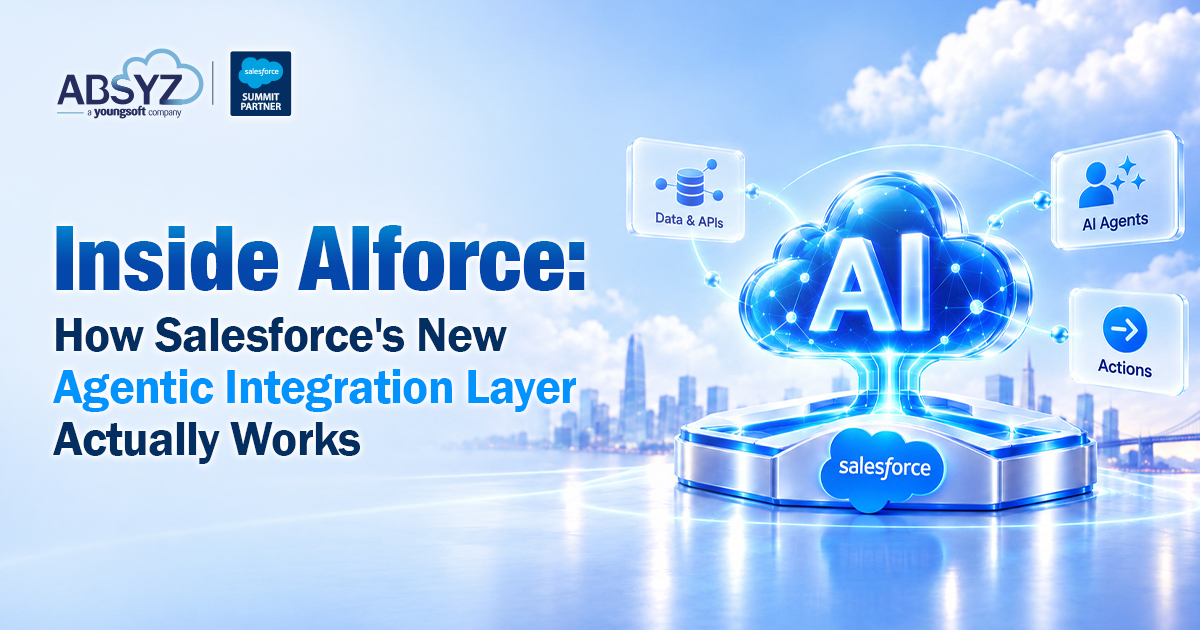
Enterprise AI conversations in the Gulf have shifted noticeably over the past year. The novelty of a chatbot answering FAQs has given way to a harder, more consequential question CIOs and CTOs across the region are now asking: can AI actually complete work autonomously — resolve a customer issue end-to-end, reroute a shipment, qualify a lead — rather than just assist a human in doing it? That shift, from copilots that suggest to agents that act, is what “agentic AI” actually means, and it’s the premise behind Salesforce Agentforce.
For enterprise transformation leaders across Dubai, Abu Dhabi, and the wider GCC, Agentforce represents a meaningfully different category of investment than the AI pilots most organizations ran over the past two years. Getting it right requires understanding not just what the technology does, but also what must be true of your data foundation and infrastructure for it to work reliably — and safely — in this region.
The Shift from Copilots to Autonomous Agents
Most enterprise AI deployed over the last two to three years falls into the “copilot” category — tools that draft an email a human then reviews, summarize a document a human then reads, or suggest a response a human then sends. Useful, but fundamentally assistive: a human remains in the loop for every action.
Agentic AI is a different proposition. An autonomous agent doesn’t just suggest a response to a customer inquiry — it resolves the inquiry, checks account status, processes a refund within defined parameters, and closes the case, escalating to a human only when it hits the edge of its defined authority. That distinction matters enormously for GCC enterprises dealing with complex, high-volume operations: a simple FAQ chatbot was never going to meaningfully reduce load on a contact center handling multilingual, multi-jurisdictional customer inquiries. An agent that can actually complete the transaction might.
This is also why agentic AI poses a greater real risk than a chatbot did — an agent taking autonomous action needs clear guardrails, defined escalation paths, and a reliable data foundation, which is precisely where a properly scoped implementation matters more than the underlying model’s raw capabilities.
Agentforce in Action: Where It Actually Applies
The most credible way to evaluate agentic AI for your organization is to look at specific, bounded use cases rather than a vague “AI transformation” mandate. A few applications are proving out well for enterprises in this region:
Customer support, where agents handle routine inquiries — order status, account questions, common troubleshooting — end-to-end, with defined escalation to human agents for anything outside their scope. Critically, for the GCC market, this needs to work fluently in both Arabic and English, often within the same conversation, which is a genuine test of an agent’s language handling beyond simple translation.
HR help desks, where agents field routine employee questions (leave balances, policy lookups, benefits enrollment status) that currently consume disproportionate HR team time relative to their complexity — freeing HR staff for higher-judgment work.
Supply chain re-routing, particularly relevant for logistics and manufacturing enterprises in the region, where an agent can monitor for disruptions and autonomously re-route shipments or flag alternatives within predefined business rules, rather than waiting for a human to notice and react.
Sales lead nurturing, where agents handle initial qualification, nurture prospects in their preferred language, and escalate genuinely sales-ready leads to human reps, rather than having reps spend time on early-stage qualification.
The common thread across all of these is that the agent operates within clearly defined boundaries on a specific, well-understood process — not as an open-ended assistant expected to handle anything thrown at it.
The Data Foundation: Why Data Cloud Matters More Than the Agent Itself
Here’s the part that gets underemphasized in most agentic AI conversations: an agent is only as good as the data it can access in real time. An agent that has to work with stale, incomplete, or siloed data will confidently make bad decisions, which is arguably worse than a chatbot that simply can’t answer.
This is why Agentforce implementations are built on Salesforce Data Cloud, using a zero-data-copy architecture — meaning the agent works with live data across systems without requiring data to be duplicated, batch-synced, or moved into a separate warehouse first. For enterprises with data spread across CRM, ERP, legacy systems, and third-party platforms (a common reality for established GCC enterprises with years of accumulated systems), this matters enormously:
- Real-time ingestion means an agent is working from current account status, inventory levels, or case history — not data that’s hours or days stale.
- Zero data copy reduces the governance and security surface area because sensitive data isn’t duplicated across additional storage layers.
- A unified data model means that an agent reasoning across a customer’s support history, purchase history, and account status is working from one coherent picture rather than stitching together disconnected sources.
For CIOs evaluating Agentforce, the honest first question isn’t “which use case should we start with” — it’s “how ready is our underlying data architecture for an agent to reason over it reliably.” Organizations with fragmented, poorly governed data will find that agentic AI amplifies that fragmentation into visible operational mistakes rather than smoothing it over.
Navigating Data Sovereignty: AI Workloads and UAE Infrastructure
Data sovereignty is a first-order consideration for any enterprise AI deployment in the UAE, not a secondary compliance checkbox. Regulated industries in particular — financial services, healthcare, government-adjacent entities — need clarity on where AI workloads actually run and where the underlying data is stored and processed.
A few things worth confirming directly with any implementation partner:
- Where inference actually happens — whether AI processing occurs within UAE-based data center infrastructure or is routed through infrastructure outside the region, and what that means for your specific regulatory obligations
- How Data Cloud’s architecture handles data residency — given the zero data copy approach, understanding exactly what data is accessed versus stored, and where
- Alignment with sector-specific requirements — a financial institution or healthcare provider will have materially stricter data sovereignty obligations than a retail enterprise, and the implementation needs to reflect that from the start.
- Vendor transparency — a partner who can’t clearly explain the data flow and residency implications of an Agentforce deployment isn’t ready to implement it responsibly for a regulated GCC enterprise
This is an area where the regional conversation — visible at events like GITEX, where AI sovereignty has become a central theme — is moving faster than generic global guidance, and it’s worth working with a partner who’s tracking the UAE-specific regulatory conversation directly rather than applying a one-size-fits-all global approach.
What This Looks Like in Practice
Before: A customer support team handles a high volume of routine, repetitive inquiries alongside genuinely complex cases, with no differentiation in how they’re triaged — leading to slow response times across the board.
After: An Agentforce agent resolves routine inquiries autonomously in the customer’s language of choice, escalating only genuinely complex cases to human agents — who now have more time to handle them well.
Before: AI pilots stall because the underlying data is fragmented across systems, and the AI tool ends up working from an incomplete picture, eroding trust in its outputs.
After: Data Cloud provides a unified, real-time data foundation, giving agents (and the humans overseeing them) confidence that decisions are based on current, complete information.
Before: Data sovereignty questions are raised late in an AI project, after architecture decisions have already been made, creating rework or compliance risk.
After: Data residency and sovereignty requirements are addressed at the start of implementation planning, with infrastructure decisions made accordingly.
Getting Started
Agentic AI represents a genuine step change from the copilot tools most GCC enterprises have already experimented with — but realizing that value depends on getting the fundamentals right first: a real data foundation through Data Cloud, clearly bounded use cases, and a clear-eyed approach to data sovereignty from day one. Enterprises that skip straight to deploying an agent without that foundation tend to see underwhelming, sometimes risky, results.
If you’re evaluating where Agentforce could apply in your organization, or want to assess how ready your current data architecture is to support it, we’d be glad to walk through what that could look like for your specific environment.
Book a consultation to discuss Agentforce for your organization