Artificial Intelligence has quickly moved from experimentation to execution.
Across industries, organizations are exploring how AI can improve customer experiences, automate operations, increase employee productivity, and accelerate decision-making. Within the Salesforce ecosystem, this shift is being driven by innovations such as Agentforce, Data Cloud, AI-powered automation, and intelligent customer engagement.
As a result, enterprises evaluating Salesforce consulting firms are increasingly asking a new question:
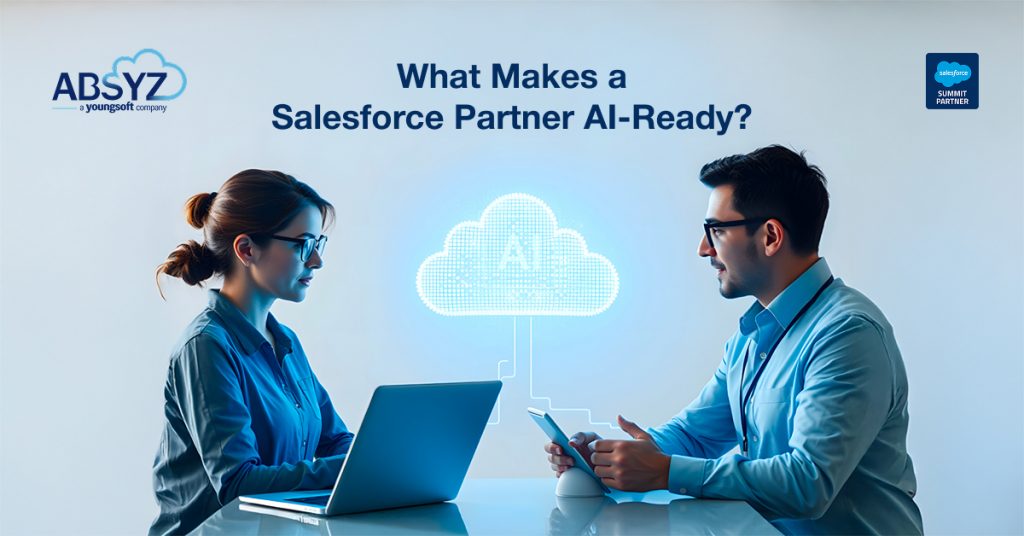
What makes a Salesforce partner truly AI-ready?
The answer goes beyond certifications, marketing claims, or simply having AI listed as a service offering.
An AI-ready Salesforce partner possesses the expertise, architecture capability, governance maturity, and practical implementation experience needed to help organizations successfully operationalize AI at scale.
This article explores the characteristics enterprises should evaluate when selecting an AI Salesforce consulting partner.
Why AI Readiness Has Become a Critical Evaluation Criterion
Traditionally, Salesforce partners were evaluated based on:
- Implementation experience
- Cloud expertise
- Certifications
- Industry knowledge
- Managed services capability
While these factors remain important, AI has fundamentally changed what organizations expect from their Salesforce ecosystem.
Today’s enterprises want to:
- Automate repetitive processes
- Improve service efficiency
- Deliver personalized customer experiences
- Generate actionable insights
- Enable intelligent decision-making
- Scale operations without proportional increases in headcount
Achieving these outcomes requires more than traditional CRM implementation expertise.
It requires AI readiness.
AI Readiness Starts with Agentforce Expertise
One of the clearest indicators of an AI-ready Salesforce partner is Agentforce expertise.
Agentforce enables organizations to build AI-powered experiences that can:
- Understand customer intent
- Generate contextual responses
- Automate business actions
- Support employees in real time
- Execute tasks across connected systems
Unlike traditional workflow automation, Agentforce introduces a new layer of intelligence into business operations.
Successful implementation requires expertise in:
- AI orchestration
- Workflow design
- Prompt engineering
- Data grounding
- Enterprise governance
- User adoption strategies
Partners with practical Agentforce experience are better positioned to help organizations move beyond AI experimentation and into operational deployment.
Data Cloud Expertise Is Non-Negotiable
AI is only as effective as the data supporting it.
This is why Data Cloud capability has become one of the most important indicators of AI readiness.
Before AI systems can generate meaningful outcomes, organizations need:
- Unified customer profiles
- Real-time customer data
- Data quality governance
- Identity resolution
- Consistent data models
- Cross-channel visibility
Without these foundations, AI initiatives often struggle to deliver reliable business value.
An AI-ready Salesforce consulting partner should demonstrate expertise in:
- Salesforce Data Cloud architecture
- Customer data unification
- Data activation
- Segmentation strategies
- AI-ready data governance
Organizations that overlook this capability often encounter challenges during AI implementation.
Enterprise AI Requires Strong Governance
Many AI initiatives fail not because of technology limitations but because of governance gaps.
Enterprise AI deployments require careful management of:
- Data access controls
- Compliance requirements
- Security frameworks
- Human oversight
- Escalation processes
- Auditability
- Responsible AI practices
A Salesforce partner may understand AI tools but still lack the governance expertise needed for enterprise-scale deployment.
An AI-ready Salesforce partner understands how to build governance into the implementation from the beginning rather than treating it as an afterthought.
This becomes particularly important in highly regulated industries such as healthcare, financial services, insurance, and manufacturing.
Multi-Cloud Architecture Expertise Matters
Enterprise AI rarely operates within a single Salesforce cloud.
Most organizations require AI workflows that connect data and processes across:
- Sales Cloud
- Service Cloud
- Experience Cloud
- Marketing Cloud
- Data Cloud
- External systems
- Third-party applications
This requires architectural expertise that extends beyond individual product implementations.
An AI-ready Salesforce consulting partner should understand how to design AI-powered experiences across complex enterprise ecosystems.
Without this capability, AI initiatives can become siloed and difficult to scale.
Practical AI Implementation Experience Matters More Than Theory
Many consulting firms discuss AI.
Fewer have implemented it successfully.
Enterprises should evaluate whether a Salesforce partner can demonstrate real-world experience in areas such as:
- AI-powered customer service
- Intelligent case routing
- AI-assisted sales workflows
- Automated knowledge generation
- Conversational customer engagement
- Predictive operational processes
Practical implementation experience often provides greater insight than theoretical AI knowledge alone.
Organizations benefit most from partners that have encountered and solved real-world implementation challenges.
AI Readiness Requires Business Process Understanding
Technology is only one part of a successful AI transformation.
The most effective AI initiatives are closely aligned with business objectives and operational workflows.
An AI-ready Salesforce partner should understand:
- Sales processes
- Service operations
- Customer journeys
- Revenue operations
- Compliance workflows
- Industry-specific business requirements
This ensures AI solutions are designed around measurable business outcomes rather than solely on technology deployment.
AI Talent and Certification Depth Are Important Indicators
Salesforce continues expanding its AI-focused certifications and competency programs.
Organizations evaluating Salesforce partners should assess certification depth across areas such as:
- AI Specialist
- Data Cloud Consultant
- Application Architect
- System Architect
- Agentforce-related competencies
While certifications alone do not guarantee success, they demonstrate investment in emerging capabilities and ongoing expertise development.
A strong AI Salesforce consulting partner typically maintains a blend of certified specialists, architects, consultants, and implementation experts.
The Importance of Change Management and Adoption
AI implementation is not solely a technology project.
Successful adoption requires people and processes to evolve alongside technology.
Organizations often underestimate:
- User training requirements
- Process redesign
- Governance changes
- Operational readiness
- Stakeholder alignment
An AI-ready Salesforce partner understands that implementation success depends on both technical deployment and organizational adoption.
This perspective often separates successful AI initiatives from unsuccessful ones.
How Enterprises Can Evaluate AI Readiness in a Salesforce Partner
When assessing an AI Salesforce consulting partner, enterprises should ask:
Do they have Agentforce implementation experience?
Do they possess Data Cloud expertise?
Can they demonstrate AI governance capabilities?
Have they delivered AI projects in production environments?
Do they understand multi-cloud architecture?
Can they align AI initiatives with business outcomes?
Do they have AI-focused certifications and competencies?
Can they support long-term optimization and managed services?
The answers provide a more accurate picture of AI readiness than marketing claims alone.
Why AI Readiness Will Define the Next Generation of Salesforce Partners
Salesforce is increasingly becoming the operational foundation for enterprise AI.
Organizations are no longer evaluating consulting partners solely on CRM expertise.
They are evaluating whether partners can help them:
- Operationalize AI
- Build intelligent workflows
- Unify customer data
- Improve employee productivity
- Scale automation
- Govern AI responsibly
As these priorities become more important, AI readiness will become one of the strongest differentiators among Salesforce consulting firms.
Why ABSYZ Invests in AI-Ready Salesforce Expertise
ABSYZ continues to expand its capabilities across:
- Agentforce implementation
- Salesforce AI consulting
- Data Cloud services
- AI-powered workflow automation
- Enterprise architecture
- Managed Salesforce services
- Multi-cloud implementation
With 450+ certified Salesforce professionals and 1,500+ certifications spanning AI, Data Cloud, architecture, and enterprise implementation, ABSYZ helps organizations build Salesforce ecosystems prepared for the next phase of AI-driven transformation.
As enterprise AI adoption accelerates, businesses increasingly require partners capable of delivering both technical expertise and long-term operational maturity.
Frequently Asked Questions
What is an AI Salesforce consulting partner?
An AI Salesforce consulting partner is a Salesforce consulting firm with expertise in AI implementation, Agentforce, Data Cloud, intelligent automation, governance, and enterprise-scale AI transformation.
What makes a Salesforce partner AI-ready?
AI-ready partners combine Agentforce expertise, Data Cloud capability, governance maturity, multi-cloud architecture knowledge, AI certifications, and practical implementation experience.
Why is Data Cloud important for AI initiatives?
Data Cloud provides the unified customer data foundation required for accurate AI-driven insights, automation, and customer engagement.
Does AI readiness require Agentforce expertise?
Yes. Agentforce is central to Salesforce’s AI strategy and plays a significant role in delivering intelligent customer and employee experiences.
How should enterprises evaluate AI capabilities in a Salesforce consulting firm?
Organizations should assess Agentforce experience, Data Cloud expertise, governance frameworks, certifications, architecture capability, implementation track record, and managed services maturity.