As organizations across Saudi Arabia accelerate digital transformation, customer data has become one of their most valuable strategic assets. Salesforce Data Cloud helps enterprises unify data across systems, power AI-driven experiences, and enable real-time decision-making. This guide explains how CIOs can evaluate, implement, and maximize the use of Data Cloud in the Saudi business landscape.
Introduction
Saudi Arabia is entering a new era of enterprise transformation.
Driven by Vision 2030, organizations across banking, healthcare, manufacturing, retail, telecommunications, education, logistics, and the public sector are investing heavily in digital platforms that improve customer engagement, operational efficiency, and business intelligence.
Yet many CIOs face a common challenge.
- Customer data exists everywhere.
- CRM.
- ERP.
- Marketing platforms.
- Commerce.
- Call centers.
- Mobile apps.
- IoT devices.
- Legacy systems.
- Third-party applications.
Instead of creating a single customer view, these systems often operate in silos, limiting an organization’s ability to deliver personalized experiences or leverage AI effectively.
Salesforce Data Cloud changes this equation.
Rather than replacing existing systems, Data Cloud creates a unified, real-time customer data foundation that enables organizations to activate trusted insights across every Salesforce application and connected ecosystem.
For Saudi CIOs planning long-term digital transformation, Data Cloud is increasingly becoming the foundation for AI readiness.
Why Customer Data Is the New Competitive Advantage
Rather than focusing solely on technology, start with the business challenge.
Today’s enterprise generates customer data from dozens of touchpoints. Marketing campaigns, websites, mobile apps, service interactions, ERP transactions, loyalty programs, social channels, connected devices, and partner ecosystems all contribute valuable information. Yet, when these systems remain disconnected, organizations struggle to answer fundamental questions:
- Who is our customer?
- What products do they own?
- What was their last interaction?
- Which channel do they prefer?
- Are they at risk of churn?
- What is the next best action?
Without a unified customer profile, personalization becomes inconsistent, analytics lose context, and AI models operate on incomplete information.
What is Salesforce Data Cloud?
Explain it in simple business language:
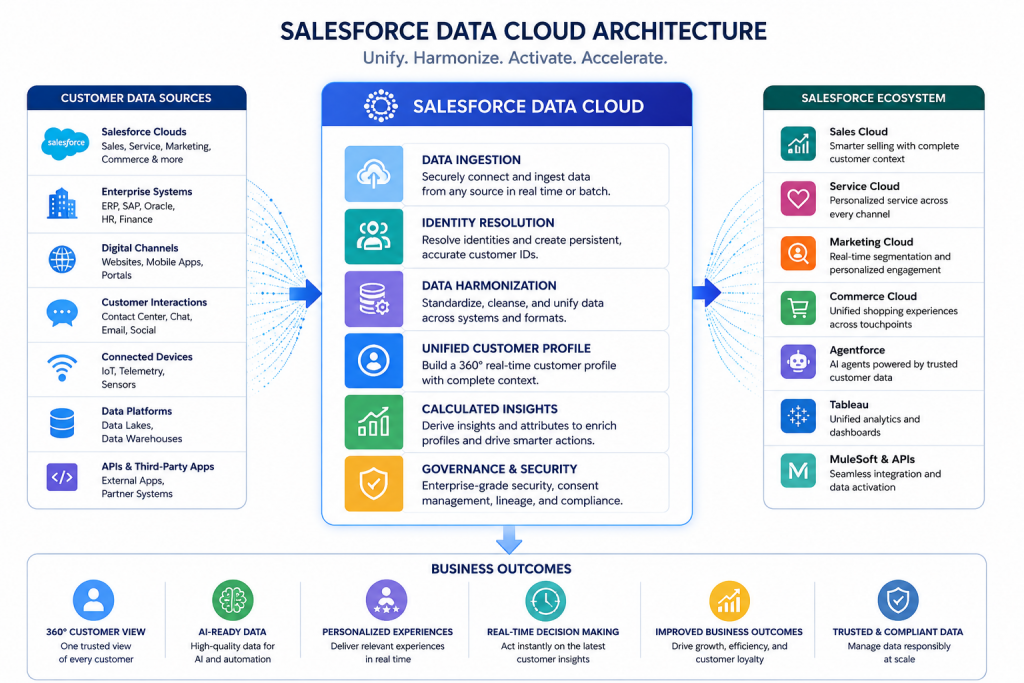
Salesforce Data Cloud is Salesforce’s hyperscale data platform that connects, harmonizes, and activates customer data from across an organization’s technology ecosystem—creating a real-time, unified customer profile that powers personalization, analytics, automation, and AI.
Then explain its four core functions:
Connect
Ingest data from Salesforce clouds, ERP systems, marketing platforms, websites, data lakes, IoT devices, and third-party applications.
Harmonize
Resolve duplicate identities, standardize records, and create a trusted, unified customer profile.
Activate
Make unified customer data immediately available across Sales Cloud, Service Cloud, Marketing Cloud, Commerce Cloud, Tableau, MuleSoft, and Agentforce.
Power AI
Provide high-quality, contextual data that enables more accurate AI-driven recommendations, automations, and customer interactions.
Why Data Cloud Matters for Saudi Arabia
Localize the discussion.
Saudi Arabia’s digital transformation agenda has increased the importance of connected customer experiences across both public and private sectors. As organizations modernize operations, fragmented data often becomes a barrier to delivering seamless services.
Explain how Data Cloud can support initiatives such as:
- Omnichannel citizen and customer engagement
- Personalized digital experiences
- Enterprise AI adoption
- Cross-functional collaboration
- Scalable analytics
- Trusted decision-making
Tie this to Vision 2030’s focus on digital innovation, without overstating regulatory or government mandates.
How Salesforce Data Cloud Works
Key Capabilities of Salesforce Data Cloud
Present these as business outcomes rather than feature lists.
- Real-time data ingestion
- Identity resolution
- Unified customer profiles
- Segmentation and audience activation
- Calculated insights
- Data harmonization
- AI-ready data foundation
- Cross-cloud activation
- Open integrations
- Enterprise-scale governance
Industry Use Cases in Saudi Arabia
Banking & Financial Services
Create a unified view of customer relationships across deposits, loans, wealth management, and service interactions to improve cross-selling, service quality, and risk visibility.
Healthcare
Connect patient engagement, appointment history, communication preferences, and service interactions to support more personalized care journeys.
Manufacturing
Combine distributor, dealer, partner, sales, and service data to improve forecasting, aftermarket support, and customer satisfaction.
Retail
Deliver personalized promotions, loyalty experiences, and omnichannel commerce using a single customer profile.
Public Sector
Improve citizen engagement by connecting service requests, digital portals, communication channels, and case management into a unified experience.
Data Cloud + Agentforce: A Powerful Combination
This is a major opportunity to differentiate ABSYZ.
Explain that AI agents are only as effective as the data they can access.
Without trusted customer data, AI generates generic responses. With Data Cloud, Agentforce can respond using real-time customer context, making interactions more relevant, personalized, and actionable.
CIO Considerations Before Implementing Data Cloud
Include a practical checklist:
Consideration
Key Question
Data Sources
Which systems contain customer data?
Data Quality
Is the data accurate and standardized?
Identity Resolution
How will duplicate records be managed?
Security
Who can access which data?
Governance
Who owns customer data?
Integrations
How will non-Salesforce systems connect?
AI Readiness
Is the data suitable for AI-driven use cases?
Scalability
Can the platform support future growth?
Common Implementation Challenges
Address issues such as:
- Poor data quality
- Siloed systems
- Unclear ownership
- Legacy integration complexity
- Underestimating change management
- Limited executive sponsorship
- Treating Data Cloud as only an IT project
Best Practices for Success
Recommend:
- Start with a high-impact use case.
- Define a customer data strategy.
- Establish governance early.
- Improve data quality before activation.
- Build reusable integration patterns.
- Measure business outcomes, not just technical metrics.
- Align business and IT stakeholders throughout the implementation.
The Future of Customer Data in Saudi Arabia
Discuss how customer data will increasingly serve as the foundation for:
- Generative AI
- Autonomous customer service
- Predictive analytics
- Hyper-personalization
- Digital government services
- Intelligent manufacturing
- Connected healthcare
- Real-time enterprise decision-making
Position Data Cloud as an enabler of these capabilities rather than an end in itself.
How ABSYZ Can Help
Keep this consultative:
At ABSYZ, we help organizations design and implement Salesforce solutions that connect data, streamline operations, and enable AI-driven customer experiences. From Data Cloud strategy and implementation to integrations, governance, Agentforce, and managed services, our consultants work with enterprises to build scalable customer data foundations aligned with long-term business goals.
Conclusion
Customer experience is no longer defined by individual interactions—it is shaped by how effectively organizations connect, understand, and activate their data. For CIOs in Saudi Arabia, Salesforce Data Cloud provides a modern foundation for breaking down data silos, enabling trusted AI, and delivering personalized experiences at scale.
As digital transformation accelerates across the Kingdom, organizations that invest in a unified customer data strategy today will be better positioned to innovate, adapt, and compete in the years ahead.
Frequently Asked Questions
What is Salesforce Data Cloud?
Salesforce Data Cloud is a customer data platform that unifies information from multiple sources to create real-time customer profiles that support personalization, analytics, automation, and AI.
How is Data Cloud different from a traditional CRM?
While a CRM manages customer relationships within its own application, Data Cloud connects data across Salesforce and external systems to create a single, unified customer view.
Can Salesforce Data Cloud integrate with non-Salesforce applications?
Yes. Data Cloud supports integration with a wide range of enterprise systems, including ERP platforms, marketing tools, data warehouses, and custom applications.
Why is Data Cloud important for AI?
AI systems perform best when they have access to accurate, current, and contextual data. Data Cloud provides that trusted data foundation, enabling more relevant insights, recommendations, and automated actions.
Who should consider Salesforce Data Cloud?
Organizations managing customer data across multiple systems—particularly in industries such as banking, healthcare, retail, manufacturing, and the public sector—can benefit from a unified data platform that supports both operational efficiency and AI-driven innovation.