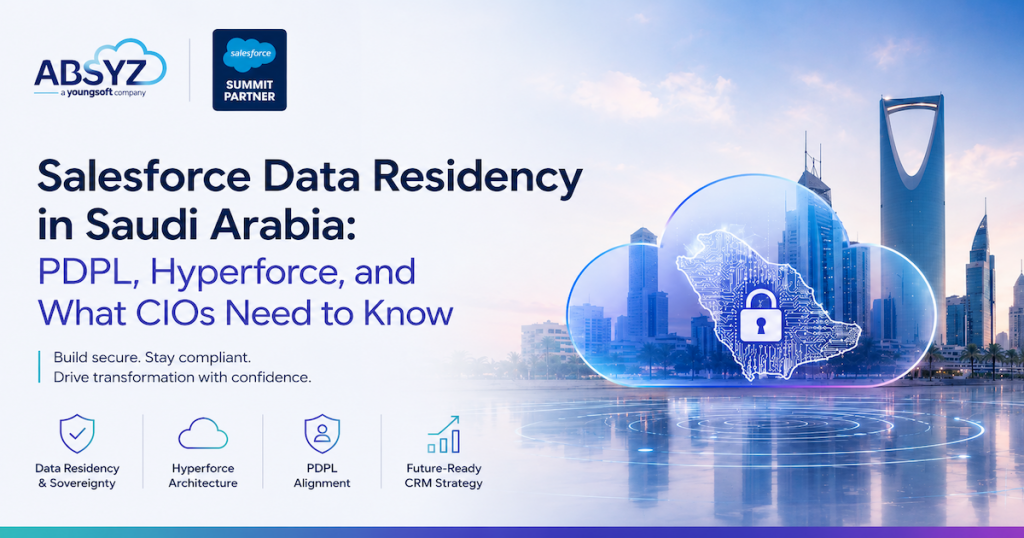
As Saudi Arabia accelerates digital transformation under Vision 2030, organizations must balance innovation with data governance. This guide explains how the Personal Data Protection Law (PDPL), Salesforce Hyperforce, and modern cloud architecture come together to help enterprises build secure, scalable, and compliant CRM environments.
Introduction
Saudi Arabia’s digital economy is evolving at an unprecedented pace. Enterprises across banking, healthcare, manufacturing, retail, telecommunications, and the public sector are modernizing customer engagement through cloud platforms like Salesforce.
However, digital transformation today is no longer measured solely by speed or innovation. It is equally defined by how organizations manage personal data, comply with evolving regulations, and establish trust with customers.
For CIOs evaluating Salesforce, one question frequently arises:
“Where does our customer data reside, and how do we align our Salesforce deployment with Saudi Arabia’s Personal Data Protection Law (PDPL)?”
The answer extends beyond simply selecting a cloud platform. It requires understanding data residency, cloud infrastructure, governance, security, and architectural decisions that support compliance objectives.
This article explores how Salesforce Hyperforce supports enterprise data residency strategies and the key considerations Saudi organizations should evaluate before implementing Salesforce.
Understanding Data Residency
Explain:
- Data residency
- Data sovereignty
- Data localization
Then include a comparison table:
Term | Meaning |
Data Residency | Physical location where data is stored |
Data Sovereignty | Data governed by the laws of the country where it resides |
Data Localization | Requirement to keep certain data within national borders |
Why Data Residency Matters in Saudi Arabia
Discuss:
- Vision 2030
- Cloud-first initiatives
- Growing enterprise cloud adoption
- Customer trust
- Regulated industries
- Cross-border operations
What is PDPL?
Cover:
- Purpose
- Scope
- Rights of individuals
- Responsibilities of organizations
- Cross-border transfers
- Security expectations
- Governance
Avoid presenting legal advice. Frame it as an overview and encourage organizations to consult legal/compliance teams.
Challenges CIOs Face
Examples:
Challenge 1
Can customer data remain within a preferred geography?
Challenge 2
How do integrations impact compliance?
Challenge 3
How should backups be handled?
Challenge 4
What about AI models?
Challenge 5
How do multiple Salesforce Clouds interact?
Enter Salesforce Hyperforce
Explain:
- Cloud-native architecture
- Public cloud infrastructure
- Regional deployment options
- Enhanced scalability
- Security
- Compliance capabilities
Avoid claiming Hyperforce is “hosted in Saudi Arabia” unless that deployment is confirmed for the customer’s use case.
How Hyperforce Supports Enterprise Data Residency Strategies
Instead of saying “PDPL compliant”
Say:
Hyperforce enables organizations to align their deployment strategies with organizational and regulatory data residency requirements through:
✓ Regional deployment options
✓ Encryption
✓ Identity controls
✓ Audit logging
✓ Secure infrastructure
✓ Operational resilience
Architecture Considerations
Area | CIO Questions |
Data Storage | Where is customer data stored? |
Integrations | Does data leave the region? |
APIs | Are external systems compliant? |
Identity | Who has access? |
Backup | Where are backups stored? |
AI | Which datasets power AI? |
Industry Considerations
Banking
Higher governance expectations
Healthcare
Patient privacy
Manufacturing
Supplier/customer records
Government
Citizen information
Retail
Customer loyalty data
Best Practices
- Conduct data discovery
- Classify sensitive information
- Define residency requirements
- Review cloud architecture
- Establish governance
- Monitor continuously
- Perform regular audits
Questions Every CIO Should Ask Before Selecting a Salesforce Partner
- Have you implemented Salesforce in regulated industries?
- How do you approach data residency planning?
- What governance framework do you recommend?
- How do integrations affect data movement?
- Can you support compliance documentation?
- How do you architect Hyperforce deployments?
How ABSYZ Can Help
Keep this consultative rather than sales-heavy:
At ABSYZ, we help organizations design Salesforce architectures that balance innovation, scalability, and governance. From implementation strategy and integration planning to Data Cloud, Agentforce, and managed services, our teams work with enterprises to build CRM environments aligned with their business and compliance objectives.
Conclusion
Reinforce that:
Compliance should be viewed as a design principle, not an afterthought. By understanding PDPL requirements, adopting sound governance practices, and leveraging Salesforce Hyperforce appropriately, Saudi enterprises can modernize customer engagement while maintaining confidence in how their data is managed.
Frequently Asked Questions
Is Salesforce PDPL compliant?
Salesforce provides security, privacy, and infrastructure capabilities to help organizations meet their compliance objectives. Whether an implementation aligns with PDPL depends on the customer’s configuration, governance, data flows, and legal obligations.
Does Salesforce store data in Saudi Arabia?
Organizations should verify the latest Hyperforce regional availability and product-specific deployment options with Salesforce, as infrastructure availability varies by product and region.
What is Hyperforce?
Hyperforce is Salesforce’s cloud infrastructure architecture built on leading public cloud providers, offering greater flexibility in regional deployment, security, and scalability.
Does PDPL prohibit cloud computing?
No. PDPL regulates how personal data is collected, processed, protected, and transferred. It does not prohibit the use of cloud platforms when deployed and governed appropriately.