Healthcare organizations are experiencing unprecedented transformation.
Patients expect personalized experiences. Providers are investing in digital engagement. Care coordination is becoming increasingly important. AI is changing service delivery, and healthcare organizations are under growing pressure to improve operational efficiency while maintaining compliance and patient trust.
As a result, Salesforce has become an important platform for healthcare organizations seeking to improve:
- Patient engagement
- Care coordination
- Service operations
- Provider relationships
- Referral management
- Digital experiences
- Patient communication
- AI-driven workflows
However, healthcare implementations differ significantly from traditional CRM projects.
This is why organizations increasingly search for the top Salesforce healthcare implementation partners.
The real challenge isn’t simply finding a Salesforce consulting firm.
It’s identifying a partner that understands both healthcare operations and modern Salesforce capabilities.
Why Healthcare Organizations Need Specialized Salesforce Partners
Healthcare environments are among the most complex industries to transform digitally.
Organizations often manage:
- Multiple patient touchpoints
- Care teams
- Referral networks
- Provider relationships
- Regulatory requirements
- Legacy systems
- Data privacy obligations
Healthcare projects frequently involve:
- Clinical operations
- Service centers
- Patient access teams
- Contact centers
- Provider networks
- Scheduling systems
- Electronic health records
Because of this complexity, organizations increasingly seek healthcare-focused Salesforce expertise.
Industry knowledge often becomes just as important as platform expertise.
The Salesforce Opportunity in Healthcare
Healthcare organizations use Salesforce to improve experiences across the entire patient journey.
Common use cases include:
Patient engagement
Providing proactive communication and personalized interactions.
Care coordination
Improving collaboration between teams and providers.
Contact center transformation
Delivering faster, more consistent patient support.
Referral management
Improving provider and partner relationships.
Patient acquisition
Supporting outreach and marketing initiatives.
Service operations
Reducing administrative burden and improving responsiveness.
As healthcare organizations continue investing in digital experiences, Salesforce has become a strategic transformation platform.
What Makes a Strong Healthcare Salesforce Implementation Partner?
Not every Salesforce partner is equipped to support healthcare organizations.
The strongest healthcare implementation partners typically combine several capabilities.
1. Healthcare Industry Experience
Healthcare workflows differ significantly from other industries.
Successful partners understand:
- Patient journeys
- Care delivery models
- Service operations
- Provider relationships
- Patient expectations
- Regulatory environments
Industry experience often helps accelerate:
- Discovery workshops
- Process design
- User adoption
- Change management
Organizations should ask:
- Have you worked with healthcare organizations?
- What healthcare use cases have you implemented?
- Can you share relevant examples?
2. Health Cloud Expertise
Health Cloud has become a key Salesforce solution for healthcare organizations.
Health Cloud enables:
- Patient profiles
- Care plans
- Provider relationships
- Care coordination
- Patient engagement
- Clinical workflows
Organizations evaluating healthcare implementation partners should understand:
- Health Cloud experience
- Healthcare accelerators
- Industry data models
- Patient engagement strategies
Health Cloud expertise is increasingly becoming a major selection criterion.
3. Compliance and Governance Understanding
Healthcare organizations operate in highly regulated environments.
Implementation partners should understand:
- Data privacy requirements
- Security frameworks
- Access controls
- Governance models
- Audit requirements
While compliance requirements vary across regions and organizations, governance expertise remains essential.
Strong partners incorporate governance considerations throughout implementation rather than treating them as an afterthought.
4. Patient Experience Expertise
Patient expectations continue to evolve.
Modern patients expect:
- Personalized communication
- Digital experiences
- Faster responses
- Self-service capabilities
- Omnichannel engagement
Salesforce enables organizations to improve:
- Appointment communication
- Service experiences
- Patient support
- Follow-up interactions
- Care coordination
Partners with customer experience expertise often help healthcare organizations deliver stronger outcomes.
5. Integration Expertise
Healthcare organizations frequently operate multiple systems.
Examples include:
- Electronic health records
- Scheduling systems
- Billing platforms
- Patient portals
- Contact centers
- Data warehouses
Successful implementations require expertise in:
- APIs
- Integration architecture
- Data synchronization
- Workflow orchestration
The ability to integrate Salesforce effectively often determines long-term success.
Why Data Cloud Is Becoming Important in Healthcare
Healthcare organizations often struggle with fragmented patient information.
Customer and patient data may exist across multiple systems.
Salesforce Data Cloud helps organizations:
- Build unified profiles
- Improve patient understanding
- Enable personalization
- Support analytics
- Improve engagement
Data Cloud also supports future AI initiatives by creating trusted, connected data foundations.
Organizations increasingly evaluate Data Cloud expertise when selecting implementation partners.
AI Is Transforming Healthcare Experiences
AI is rapidly becoming part of healthcare transformation strategies.
Common applications include:
- Service automation
- Patient engagement
- Knowledge assistance
- Workflow automation
- Contact center support
- Employee productivity
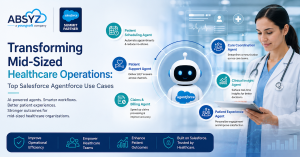
Technologies such as Agentforce and AI-powered workflows are enabling healthcare organizations to improve experiences while reducing operational complexity.
Partners with AI expertise can help organizations:
- Identify use cases
- Establish governance
- Implement workflows
- Support adoption
AI readiness is becoming an increasingly important evaluation criterion.
Questions Healthcare Organizations Should Ask Potential Partners
Before selecting a Salesforce implementation partner, healthcare organizations should ask:
What healthcare experience do you have?
What Health Cloud expertise exists within your team?
How do you approach patient experience transformation?
What AI and Agentforce capabilities do you offer?
What Data Cloud experience do you have?
How do you approach governance and security?
What integration expertise do you bring?
How do you support customers after implementation?
These questions often reveal the maturity and long-term capabilities of a consulting partner.
Emerging Healthcare Salesforce Trends in 2026
Several trends are shaping healthcare implementations.
AI-powered patient engagement
Organizations are investing in intelligent patient experiences.
Unified patient data
Data Cloud is becoming increasingly important.
Personalized communication
Organizations are improving outreach and engagement.
Digital front doors
Healthcare providers continue investing in digital experiences.
Workflow automation
Administrative efficiency remains a major priority.
Care coordination
Improving collaboration across teams and providers.
Organizations selecting implementation partners should evaluate whether those partners are prepared for these evolving priorities.
Characteristics of Top Salesforce Healthcare Implementation Partners
The strongest healthcare partners often combine:
Healthcare expertise
Health Cloud experience
Customer experience knowledge
Integration capability
Data Cloud expertise
AI readiness
Governance maturity
Managed services capability
Long-term strategic support
Healthcare organizations that evaluate partners across these dimensions often achieve stronger outcomes.
Why Long-Term Support Matters
Healthcare transformation does not end at go-live.
Organizations continue to evolve:
- Patient experiences
- Care models
- Digital channels
- AI initiatives
- Service operations
A strong implementation partner should provide:
- Managed services
- Enhancement support
- Optimization services
- Governance reviews
- AI readiness programs
Long-term partnerships often create greater value than implementation projects alone.
How ABSYZ Supports Healthcare Transformation
ABSYZ helps healthcare organizations modernize patient experiences and operational processes through:
- Salesforce implementation services
- Health Cloud expertise
- Data Cloud consulting
- Agentforce initiatives
- AI readiness programs
- Customer experience transformation
- Managed Salesforce services
With 450+ certified Salesforce professionals, 1,500+ certifications, and expertise across AI, customer data, and multi-cloud Salesforce implementations, ABSYZ helps healthcare organizations build scalable digital foundations designed for long-term growth.
Looking Ahead
Healthcare organizations are increasingly investing in:
- Digital engagement
- AI-powered experiences
- Patient personalization
- Unified data
- Operational efficiency
As these priorities continue to evolve, selecting the right Salesforce implementation partner becomes increasingly important.
The top Salesforce healthcare implementation partners in 2026 will not simply implement technology.
They will help healthcare organizations improve experiences, support care teams, leverage AI, and build more connected healthcare ecosystems.
Frequently Asked Questions
What should healthcare organizations look for in a Salesforce implementation partner?
Organizations should evaluate healthcare experience, Health Cloud expertise, integration capability, AI readiness, Data Cloud knowledge, and long-term support services.
Is Health Cloud important for healthcare organizations?
Health Cloud helps healthcare providers improve patient engagement, care coordination, and relationship management.
Why is Data Cloud becoming important in healthcare?
Data Cloud helps unify patient information, support personalization, improve analytics, and enable AI initiatives.
How is AI being used in healthcare Salesforce implementations?
AI supports patient engagement, service automation, employee productivity, workflow optimization, and intelligent customer experiences.
Why does industry expertise matter?
Healthcare workflows, regulations, and patient expectations differ significantly from other industries, making industry experience an important consideration.