Agentforce League : Session 02 (Agentforce Vibes) 20th Dec 2025
The Agentforce League session on 20th December 2025 brought together Salesforce professionals to explore how Health Cloud and Agentforce Vibes are redefining industry solutions and developer productivity, showcasing a powerful blend of patient-centric data modeling and AI-driven, context-aware development within the Salesforce ecosystem.
Introduction to Health Cloud
The session was led by Aditya Naag Topalli, Principal Developer Advocate, and Satya Sekhar Chegondi, Lead Developer Advocate, who walked through how Salesforce Health Cloud enables healthcare organizations to deliver structured, consistent, and patient-centric care. The discussion emphasized Health Cloud’s strong foundation in standardized data models and templates, designed to support scalable care delivery without compromising personalization.
A key focus of the session was the pre-configuration required before care delivery begins. Health Cloud encourages admins to define reusable building blocks that form the backbone of every care journey:
- Problem Definitions to capture both medical conditions (such as diabetes) and non-clinical barriers to care (mobility issues, lack of caregiver support.
- Goal Definitions that outline clear outcomes like condition control or patient education
- Action Plan Templates that define standardized steps, tasks, timelines, and interventions
This approach ensures that patients with similar conditions follow consistent care processes, while still allowing flexibility at the individual level.
These elements are brought together using Care Plan Templates, which act as reusable blueprints for treatment. Each care plan template:
- Maps previously defined problems to relevant goals
- Associates mandatory action plans and tasks
- Includes benefits and coverage considerations
When a care plan is applied to a patient, Health Cloud automatically generates the required goals, actions, and timelines, reducing manual effort and enforcing best practices across care teams.
The session also highlighted the rich patient experience available out of the box in Health Cloud through configurable record pages and standard components, including:
- A comprehensive patient timeline showing cases, care plans, and tasks
- Household and relationship management to identify caregivers and related accounts
- Medication tracking integrated with a global medicine registry (availability varies by region)
- Assessments and care observations to capture patient responses and monitor vitals such as blood glucose levels
Together, these capabilities provide care teams with a 360-degree view of the patient, enabling proactive care delivery, early identification of care gaps, and more informed clinical decisions.
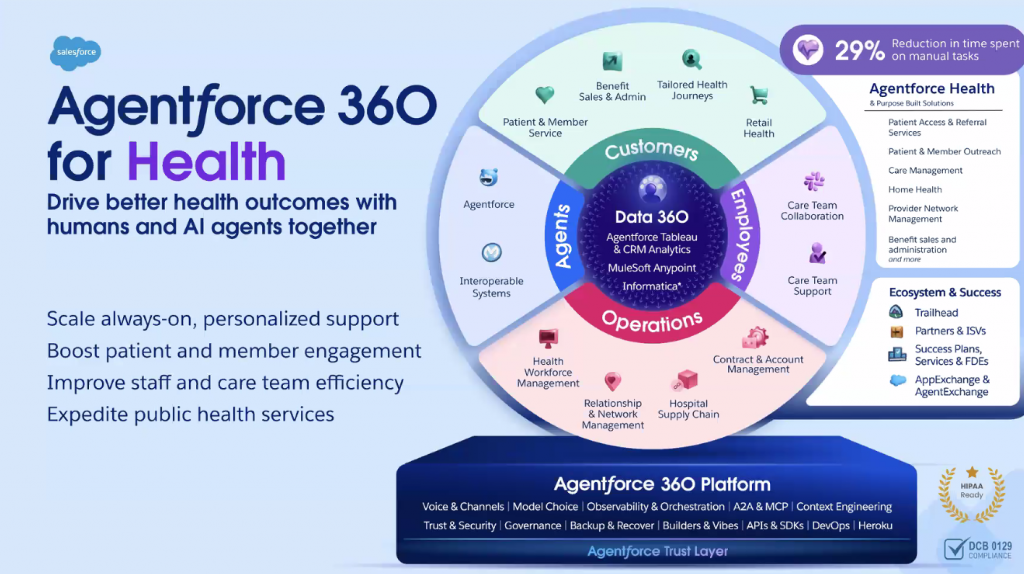
For more information, check out the following links:
Agentforce Vibes
During the session, the speakers demonstrated how Agentforce Vibes works hand in hand with Salesforce Health Cloud to deliver intelligent, agent-driven healthcare solutions. The focus was not just on concepts, but on how developers can practically use AI to build, govern, and extend Health Cloud functionality using Salesforce-native tools.
A key highlight was a live demo showing how Agentforce Vibes can be used to build functionality from scratch using natural language:
- An Apex class was generated end-to-end using Agentforce Vibes
- The class was created with full Salesforce context and best practices
- This Apex class was then reused as an Action inside an Employee Agent
- The agent leveraged this action to generate patient summary reports, demonstrating a real-world healthcare use case
This clearly showcased how Agentforce Vibes accelerates development while ensuring the output is immediately usable within agent workflows.
The session also went deeper into the Model Context Protocol (MCP), which forms the backbone of Agentforce Vibes. MCP acts as a standardized bridge between the AI model and Salesforce tooling, enabling secure and scalable interactions.
Key MCP capabilities discussed included:
- A single MCP client connecting to multiple tools
- Seamless access to Salesforce DX and org-level operations
- Centralized execution and governance
- Reduced complexity compared to managing multiple API integrations
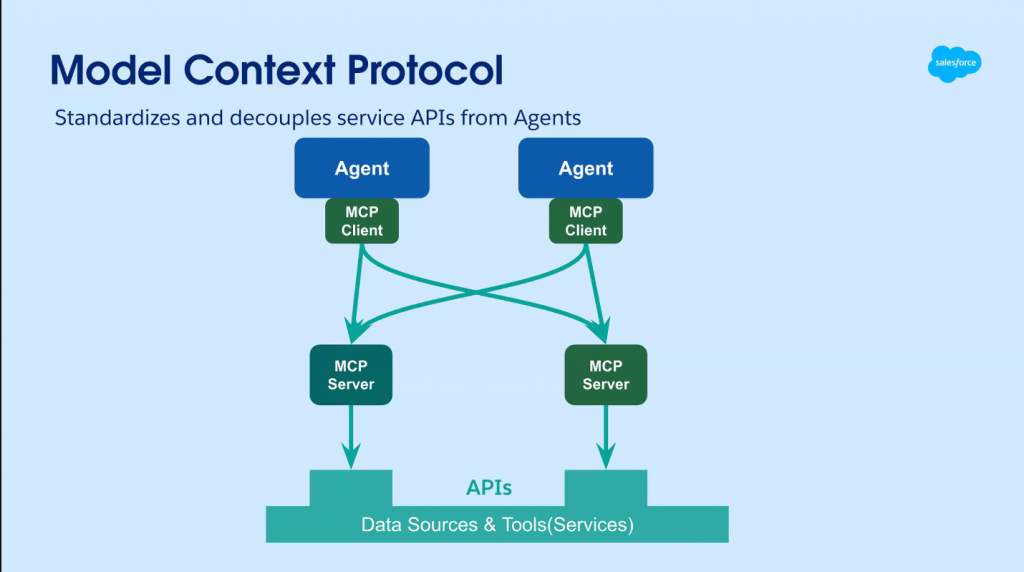
Developers can enable MCP servers directly from the Agentforce Vibes environment, where:
- Multiple MCP servers can be configured
- Servers can be enabled or disabled dynamically
Tool access can be controlled per server
This makes the setup flexible and adaptable across different projects and environments.
Another important area covered was rules-based development, which ensures consistency when using AI-generated code. Instead of hardcoding standards, developers can define rules in plain English, such as:
- Naming conventions for Apex classes and methods
- Requirements for Flow-invocable Apex
- Formatting and structural guidelines
Once configured, these rules are automatically applied every time Agentforce Vibes generates code, reducing review effort and enforcing team standards by default.
Finally, the session highlighted workflows in Agentforce Vibes, which allow developers to automate repetitive tasks and command sequences. With workflows, teams can:
- Chain multiple Salesforce DX or tool actions together
- Reuse common development processes
- Control execution using approval thresholds
Combined with Plan mode and Act mode, workflows ensure that developers always have visibility and control over what the AI is doing—balancing speed with safety.
Session recording:
https://www.youtube.com/watch?v=dYxW4rC_oh4
Author: Tejas Jain