Agentforce League : Session 01 (APEX & LWC) - 13th Dec 2025
The Agentforce League session on 13th December 2025 marked an exciting milestone for the Salesforce developer community, particularly for those exploring the rapidly evolving Agentforce ecosystem with a strong focus on Apex and Lightning Web Components (LWC). The session highlighted how Salesforce is shaping the agentic era and enabling developers to build intelligent, scalable, and industry-ready solutions.
During the session, the rapid growth of Agentforce was highlighted, showcasing its evolution into Agentforce 360, a platform designed to build trusted, contextual, and enterprise-ready agents that seamlessly collaborate with humans.
India was recognized as the largest Salesforce developer community globally, playing a significant role in building and scaling agentic enterprises. With hundreds of thousands of agents already built, the session emphasized the importance of structured enablement, hands-on learning, and industry-aligned challenges to support developers in this fast-moving ecosystem.
The session was led by:
- Aditya Naag Topalli – Principal Developer Advocate
- Satya Sekhar Chegondi – Lead Developer Advocate
Their combined insights set the tone for both conceptual understanding and practical implementation throughout the session

Consumer Goods Cloud as the Use Case
To ground Apex and LWC concepts in a real-world scenario, the session used Consumer Goods Cloud as the primary industry use case. A brief introduction covered how Consumer Goods Cloud helps organizations manage:
- Retail store hierarchies and in-store locations
- Visit planning and retail execution
- Promotions and product placement strategies
The focus was intentionally kept on the Retail Execution module rather than the more complex Trade Promotion Management (TPM), ensuring participants could concentrate on learning Apex and LWC while still understanding an industry-relevant data model.
The hands-on use case revolved around building a promotion creation wizard that allows users to:
- Create promotions at an account level
- Select products and apply discounts
- Choose applicable retail stores
This served as the foundation to demonstrate several powerful new platform features.
New Features Highlighted
State Management for LWC (Beta)
One of the most anticipated features showcased was State Management for Lightning Web Components, currently in Beta. This feature introduces a Redux-like pattern for managing shared state across components.
Key highlights include:
- Centralized state management using @lwc/state
- No more prop drilling between parent, child, and grandchild components
- Reactive state updates across all subscribed components
A simple and effective demo was shown:
- A Parent Counter Component displaying a number
- A Child Component automatically showing double the parent’s value
With atoms, computed values, and setters, developers can now cleanly separate data logic from UI logic, making complex UIs like multi-step wizards far easier to build and maintain.
For detailed implementation and examples, refer to the Shared State Manager Example
Apex Cursors – GA in Spring ’26
Another major highlight was Apex Cursors, going GA in Spring ’26. This feature introduces a powerful way to handle large data sets efficiently.
Key capabilities include:
- Use of Database.Cursor locator
- Fetch records using locator.fetch(position, numberOfRecords)
- Dynamically decide batch size at runtime
- Call the locator up to 10 times within a single transaction
Apex Cursors overcome traditional limitations of OFFSET queries and Batch Apex, making them ideal for scenarios like pagination, streaming large datasets, and UI-driven data retrieval.
For detailed implementation and examples, refer to the Apex Cursors Example
Run Relevant Tests (Spring ’26)
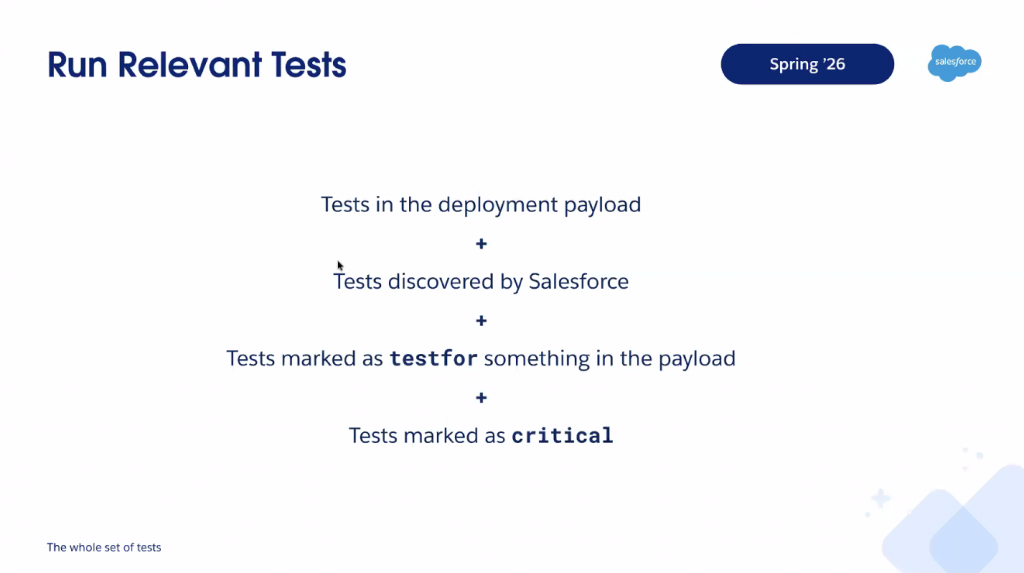
Salesforce is also enhancing deployment efficiency with Run Relevant Tests, scheduled for Spring ’26. This capability ensures that only test classes relevant to the deployment are executed, instead of running the entire test suite.
With the introduction of the testFor attribute in @isTest, developers can explicitly associate test classes with specific components or metadata. Additionally, the critical = true attribute ensures that essential test classes always run, regardless of the deployment scope.
Together, these improvements significantly reduce deployment time while maintaining high test reliability and confidence in production releases.
LWC Local Development Enhancements
Local development for LWC continues to improve with:
- Running Lightning development directly from the IDE
- Command example : sf lightning dev app
- Instant reflection of UI changes without full deployments
This greatly enhances developer productivity and shortens feedback loops.
For detailed implementation and examples, refer to the Preview Components with Local Dev
Lightning Types in Agent Chat Output
One of the most exciting advancements showcased in the session was the introduction of Lightning Types in Agent chat outputs. This feature allows Lightning Web Components (LWC) to be rendered directly inside Agentforce chat responses, transforming agent conversations from plain text into rich, interactive experiences.
Traditionally, agent responses were limited to text or static content. With Lightning Types, developers can now embed fully functional UI components—such as tables, cards, buttons, forms, and visual summaries—directly within the agent’s response. This enables agents to not only answer questions, but also present data and take action in a structured and intuitive way.
Key benefits include:
- Rich UI elements inside conversational flows
- Reusable LWCs across standard Lightning pages and Agent chats
- Context-aware responses driven by Salesforce data and permissions
- Improved user experience with reduced navigation and clicks.
For detailed implementation and examples, refer to the Lightning Types Reference
FormulaEval
Another notable feature discussed was FormulaEval, which allows developers to execute complex Salesforce formulas programmatically at runtime.
Salesforce formulas are heavily used across objects, flows, and validations. Earlier, the same logic often had to be reimplemented in Apex or JavaScript. FormulaEval removes this duplication by enabling direct execution of existing formulas, ensuring a single source of truth.
With FormulaEval, developers can reuse business logic, maintain consistency across UI, automation, and custom code, and simplify complex calculations such as pricing, discounts, and eligibility rules—making applications easier to maintain and less error-prone.
For detailed implementation and examples, refer to the FormulaEval Developer Guide.
Session recording:
https://www.youtube.com/watch?v=kCo3L27FjP0
Author: Tejas Jain