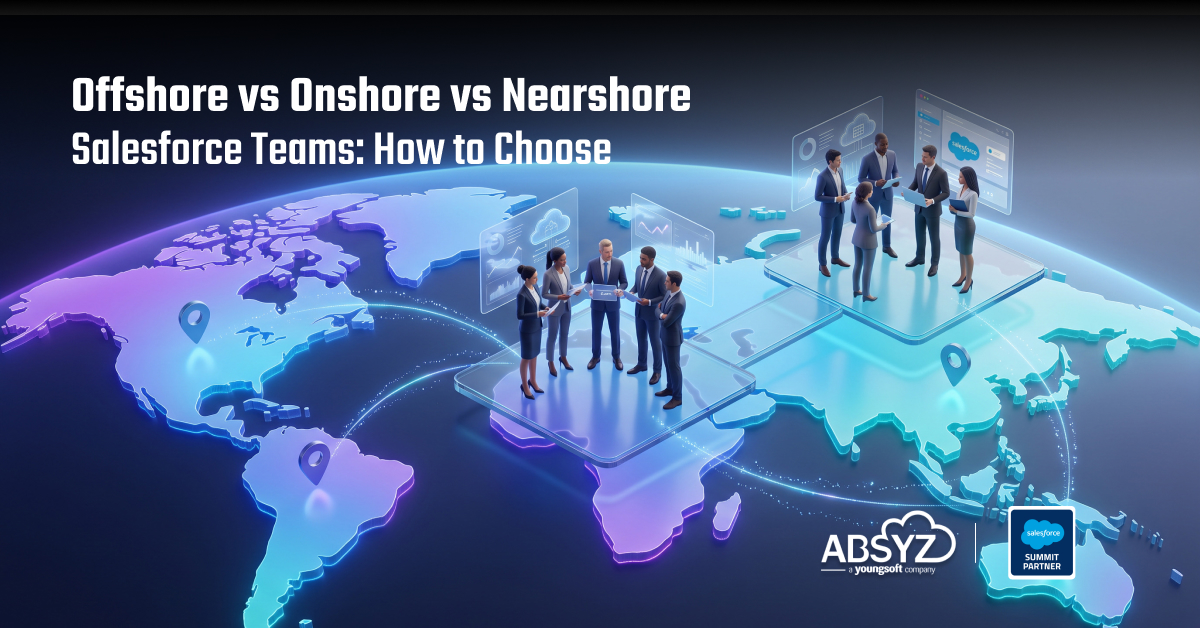
Choosing where your Salesforce team will be based is one of the first major decisions in any implementation, migration, or managed services engagement. It shapes your budget, your delivery speed, the risk you carry, and the day-to-day effort your own people spend managing the relationship.
There is no universally “best” model. Onshore, nearshore, and offshore each win in different situations, and most mature Salesforce programs end up combining them. This guide explains how each model works, where each one shines and struggles, and gives you a decision matrix to match the model to your project.
The Three Models in Plain Terms
Onshore means your Salesforce partner’s team works in your own country, usually in your time zone, under your local laws and business culture.
Nearshore means the team is in a neighboring or nearby country with a small time zone difference, typically a few hours at most. For a US company, that often means Canada or Latin America. For a UK or EU company, it often means other European countries.
Offshore means the team is in a distant country with a large time zone gap, commonly India for Western clients. Work is typically handed over at the end of one day and picked up at the start of the next.
The labels describe geography and time zone overlap, not quality. Strong and weak Salesforce teams exist in all three.
Side-by-Side Comparison
FACTOR | ONSHORE | NEARSHORE | OFFSHORE |
Typical cost | Highest | Moderate | Lowest hourly cost, with more coordination overhead |
Time zone overlap | Full | Strong, usually most of the working day | Limited; often a few hours or less |
Real-time collaboration | Easiest | Easy | Needs deliberate planning |
Talent pool depth | Varies by market; can be tight for niche skills | Growing varies by country | Typically, the largest, including niche and certified skills |
Ability to scale up or down | Slower and costlier | Moderate | Fastest and most flexible |
Follow-the-sun coverage | Not possible | Limited | Strong support and continuous delivery |
Cultural and language alignment | Highest | High | Depends on partner; needs active management |
Regulatory and data residency comfort | Simplest | Usually manageable | Needs careful review and contractual safeguards |
Management effort from your side | Lowest | Low to moderate | Moderate, falling as the relationship matures |
Treat this table as a general pattern, not a promise. Any individual partner can deviate from these norms, which is why partner quality matters more than geography alone.
When Each Model Makes Sense
Choose onshore when:
- The project depends on constant, real-time collaboration with business stakeholders, such as a heavy discovery or change-management effort
- You operate in a heavily regulated environment with strict data residency or personnel requirements
- Government, defense, or similar contracts require work to be done domestically
- The scope is small, and the coordination savings outweigh any rate difference
- Executive visibility and in-person workshops are central to success
Choose nearshore when:
- You want daily live interaction without the cost of a fully onshore team
- Your processes need same-day iteration, such as agile teams with daily stand-ups and quick feedback loops
- Your company culture strongly favors working in overlapping hours
- You want a middle path on cost and risk while testing the idea of a distributed team
Choose offshore when:
- You need to scale a team quickly, or access a large pool of certified Salesforce talent across clouds
- Cost efficiency over a long engagement matters, such as multi-year build, enhancement, and support programs
- Round-the-clock coverage or faster turnaround through follow-the-sun delivery is valuable
- Work is well-defined enough that clear specifications and documentation can drive delivery
- You are running managed services, ongoing administration, integrations, or a steady backlog of enhancements
The Hidden Variables That Decide the Outcome
Cost and geography get most of the attention, but these factors usually decide whether an engagement succeeds.
- How well you can define the work. Offshore and nearshore models reward clarity. If requirements are vague and change daily, the time zone gap makes confusion more expensive. If requirements are documented and prioritized, distance matters far less.
- Governance and communication rhythm. A written escalation path, a consistent meeting cadence, and shared tracking tools matter more than where anyone sits.
- Security posture. Whatever the location, confirm access controls, data handling, device and network policies, and the principle of least privilege inside Salesforce—review where data can be accessed from and what your contracts and regulators require.
- The partner’s delivery maturity. Look for a documented methodology, certified personnel, named leads, quality gates, and references from clients similar to yours. A mature offshore partner will often outperform an immature onshore one.
- Continuity and knowledge transfer. Ask how the partner handles staff turnover, documentation, and handover. This protects you in any model.
- Total cost, not hourly rate. A lower rate that needs more rework, more management time, or more clarification cycles may not be cheaper. Compare the cost to deliver an agreed outcome, not just the cost per hour.
Decision Matrix: Score Your Project
Score each statement from 1 (strongly disagree) to 5 (strongly agree) for your project. Then add up the columns that apply.
How to read it: If most of your high scores sit in the Onshore rows, start there. If they cluster around budget, scale, and coverage, an offshore-led model is likely a strong fit. A mix of both suggests a hybrid.
Project Statement | Recommended |
Requirements are still being discovered and change often | Onshore / Nearshore |
Stakeholders need frequent in-person or same-day sessions | Onshore / Nearshore |
Strict data residency or domestic-work rules apply | Onshore |
Budget efficiency over a long engagement is a top priority | Offshore |
You need to ramp a team up or down quickly | Offshore |
You need niche or multi-cloud certified skills | Offshore / Nearshore |
You want 24-hour coverage or overnight progress | Offshore |
Scope is documented and prioritized | Offshore / Nearshore |
You have an internal owner who can manage a distributed team | Offshore / Nearshore |
The Hybrid Model: Often the Best Answer
For many Salesforce programs, the real answer is “some of each.” A common pattern splits the work like this:
- Onshore: engagement leadership, business analysis, stakeholder workshops, solution architecture, and change management
- Nearshore or offshore: build, configuration, development, testing, integration, data work, and ongoing support
This approach keeps high-touch, relationship-heavy work close to your business while using a larger, more cost-efficient pool for delivery. The key is clear role definitions so everyone knows who owns decisions, who builds, and who reviews.
Questions to Ask Any Partner, Whatever the Model
- Who will actually work on our project, and what are their certifications and experience?
- How do you handle overlap hours with our team, and what is the escalation process?
- How do you protect our data, and what access controls do you apply in our Salesforce org?
- What does your handover and documentation look like at each stage?
- How do you handle attrition or replacement of key people mid-project?
- Can we speak to clients with similar needs who use the same model?
- How is quality measured and reported, and what happens when targets are missed?
Common Mistakes to Avoid
- Choosing a rate alone. The cheapest quote often leaves out coordination, rework, and management time.
- Skipping governance because “it’s just a small team.” Distributed teams need explicit rhythms from day one.
- Treating location as a proxy for quality. Evaluate people, process, and track record.
- Forgetting about your own side. Someone on your team needs to own priorities, answer questions quickly, and make decisions.
- Ignoring security and compliance until late. Bring your security and legal teams in early.
Bottom Line
Onshore buys you proximity and simplicity. Nearshore buys you a balance of overlap and cost. Offshore buys you scale, flexibility, and cost efficiency, in exchange for stronger planning and communication discipline. The right choice depends on how well-defined your work is, how much real-time collaboration it needs, what your security and compliance rules require, and what budget and timeline you are working with.
If you are weighing the options for a specific Salesforce project, start by scoring your requirements against the matrix above, then test your shortlist of partners against the questions in this guide. That combination will tell you far more than any single rate card.