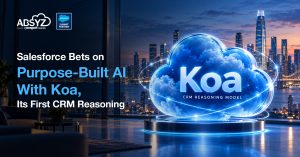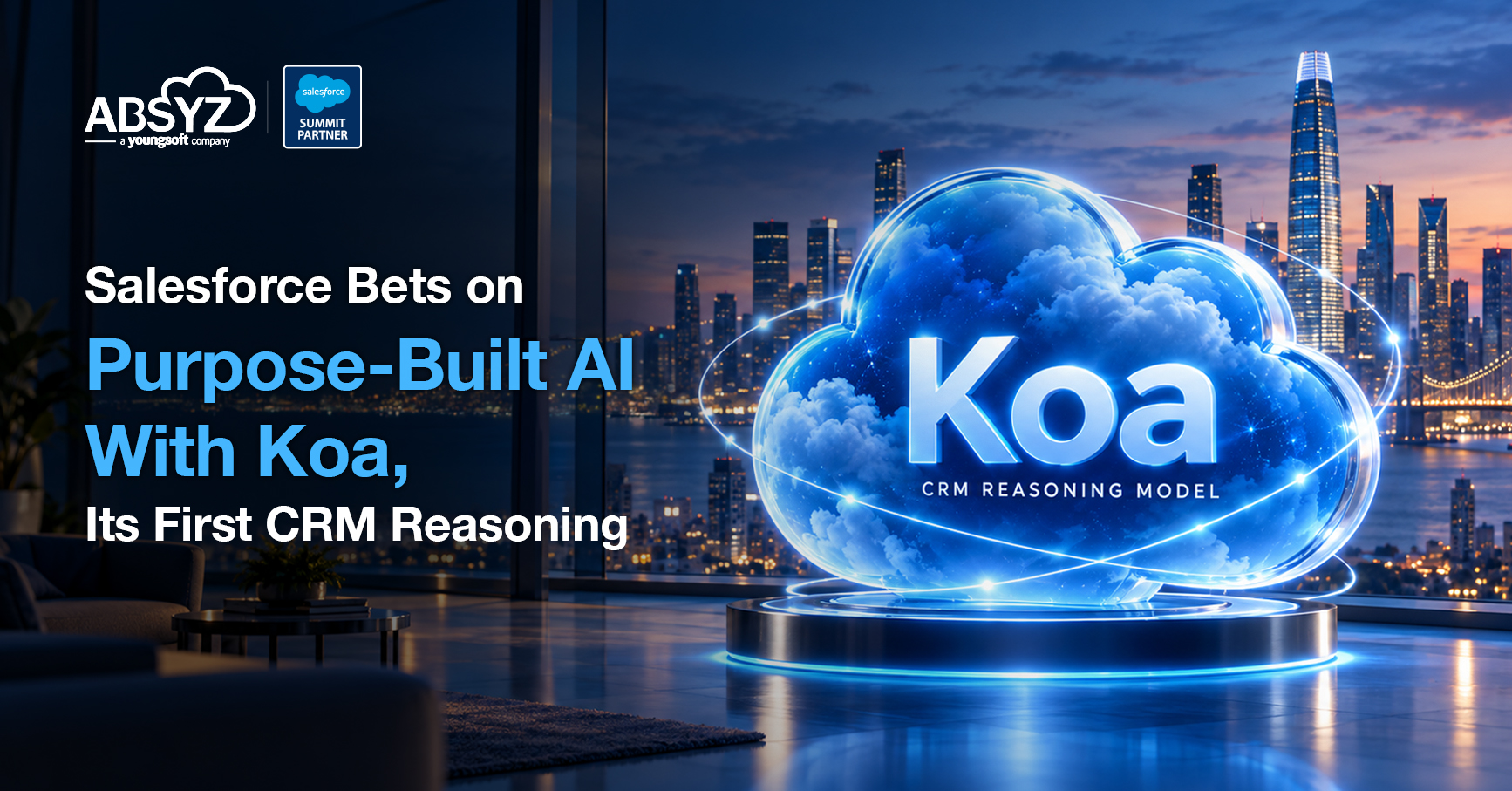
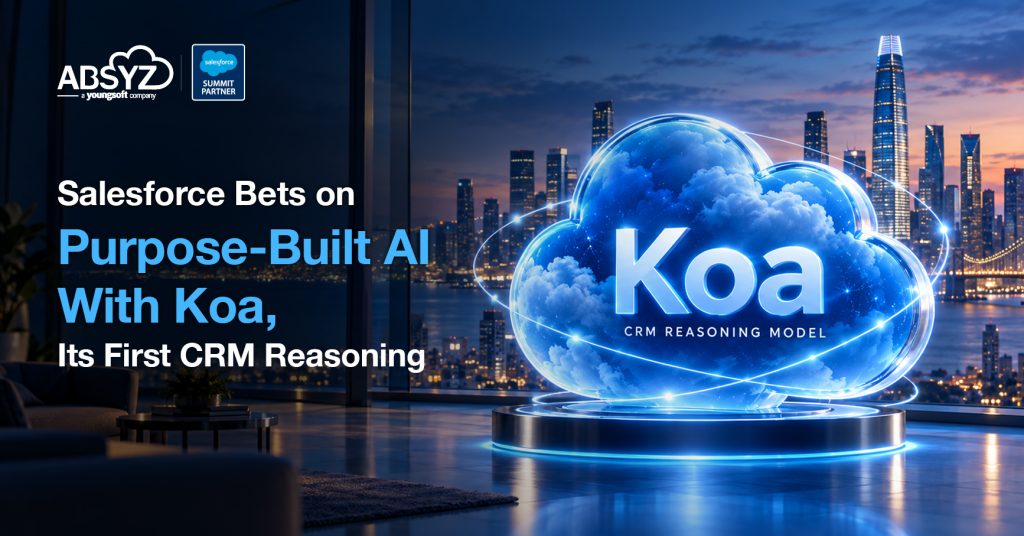
Salesforce and NVIDIA just gave enterprise AI a new name to know: Koa. Unveiled on September 15, 2026, Koa is Salesforce’s first CRM-specific reasoning model for Agentforce, built on top of NVIDIA’s Nemotron models. It’s a notable shift in strategy — rather than leaning entirely on general-purpose foundation models, Salesforce is now fielding a model trained specifically to understand how CRM work actually gets done.
Why a CRM-Specific Reasoning Model?
The pitch is straightforward: general-purpose models are broad, but enterprise workflows are specific. Koa was built by training NVIDIA’s Nemotron 3 Super model on a proprietary synthetic dataset designed to reflect enterprise knowledge accumulated over nearly three decades of CRM deployments.
The idea is to give the model an intuitive grasp of business logic: how a sales opportunity moves through a pipeline, how a service case is escalated, and how workflows shift across industries.
That specialization shows up in the numbers Salesforce is citing. According to the company’s own CRM benchmark, Salesforce says Koa already performs on par with or better than leading models while making significantly fewer mistakes on CRM-specific actions, such as updating an opportunity, routing a case, or scheduling a follow-up.
A key design choice: no customer data was used to train Koa. Its training corpus is entirely synthetic, built to simulate the reasoning, tool use, and decision-making skills that Agentforce agents need across the customer lifecycle. Salesforce also emphasizes that it keeps control of the model weights and runs both training and inference inside its own infrastructure, so customer data never has to leave that trust boundary during use.
How It Was Built
Under the hood, the training process combined multiple techniques. Salesforce modeled scenarios across more than a dozen industries, including manufacturing, financial services, healthcare, and travel, pairing personas with tasks and mapping out the exact sequence of actions and tool calls an agent would need to complete each one.
From there, the team applied supervised fine-tuning and reinforcement learning (specifically Group Relative Policy Optimization) using NVIDIA’s NeMo RL, NeMo Gym, and NeMo AutoModel tooling. The goal wasn’t just to get Koa to produce correct answers, but to have it learn the step-by-step actions required to achieve a business outcome.
Where Koa Is Already Running
Koa isn’t just a lab demo — it’s already live internally, powering a Slack agent that helps Salesforce employees find information and complete everyday tasks. It’s now expanding into pilot programs with several named customers, including 1-800Accountant, Baxter Credit Union, Engine, Formula 1, UChicago Medicine, and Xero.
The use cases vary widely. An accounting firm might lean on Koa to help agents work through tax rules and customer-specific circumstances. A credit union could use it to help members reason through goals like buying a home.
A business travel company wants a model that can handle the countless logistics of trip planning, rather than one that just sounds confident. And in healthcare, the emphasis is on coordinating the behind-the-scenes, multi-step processes so staff can spend more time with patients.
A Second Track: Mission-Specific AI for Government
Alongside Koa, Salesforce, and NVIDIA are extending this same “specialized, trust-boundary-controlled” model approach into Missionforce, Salesforce’s platform for government and regulated industries. The goal here is to let organizations with strict data and security requirements, think private clouds, classified networks, or fully air-gapped systems, train and deploy their own mission-specific models using NVIDIA’s open models and accelerated computing.
In practice, this means post-trained NVIDIA models will power agents within Missionforce Operations, a product built to digitize and automate government workflows such as procurement, supplier management, and logistics. These models would be trained on an organization’s own operational data and terminology, allowing agents to reason through back-office processes entirely within a customer’s own secure environment.
Availability
- Koa is currently available to select pilot customers within Agentforce, with general availability expected in winter 2026 for U.S. regions.
- Missionforce Operations is now generally available in U.S. regions, with post-trained NVIDIA models rolling out to select customers starting in October 2026.
The Bigger Picture
Koa fits a broader pattern this year: enterprise software vendors are moving past bolt-on AI copilots and toward models purpose-built around their own domain expertise and data. By pairing NVIDIA’s open Nemotron models with nearly three decades of accumulated CRM know-how, Salesforce is betting that specialization, not just scale, will be the deciding factor in whether AI agents can be trusted to actually execute enterprise work, not just talk about it.