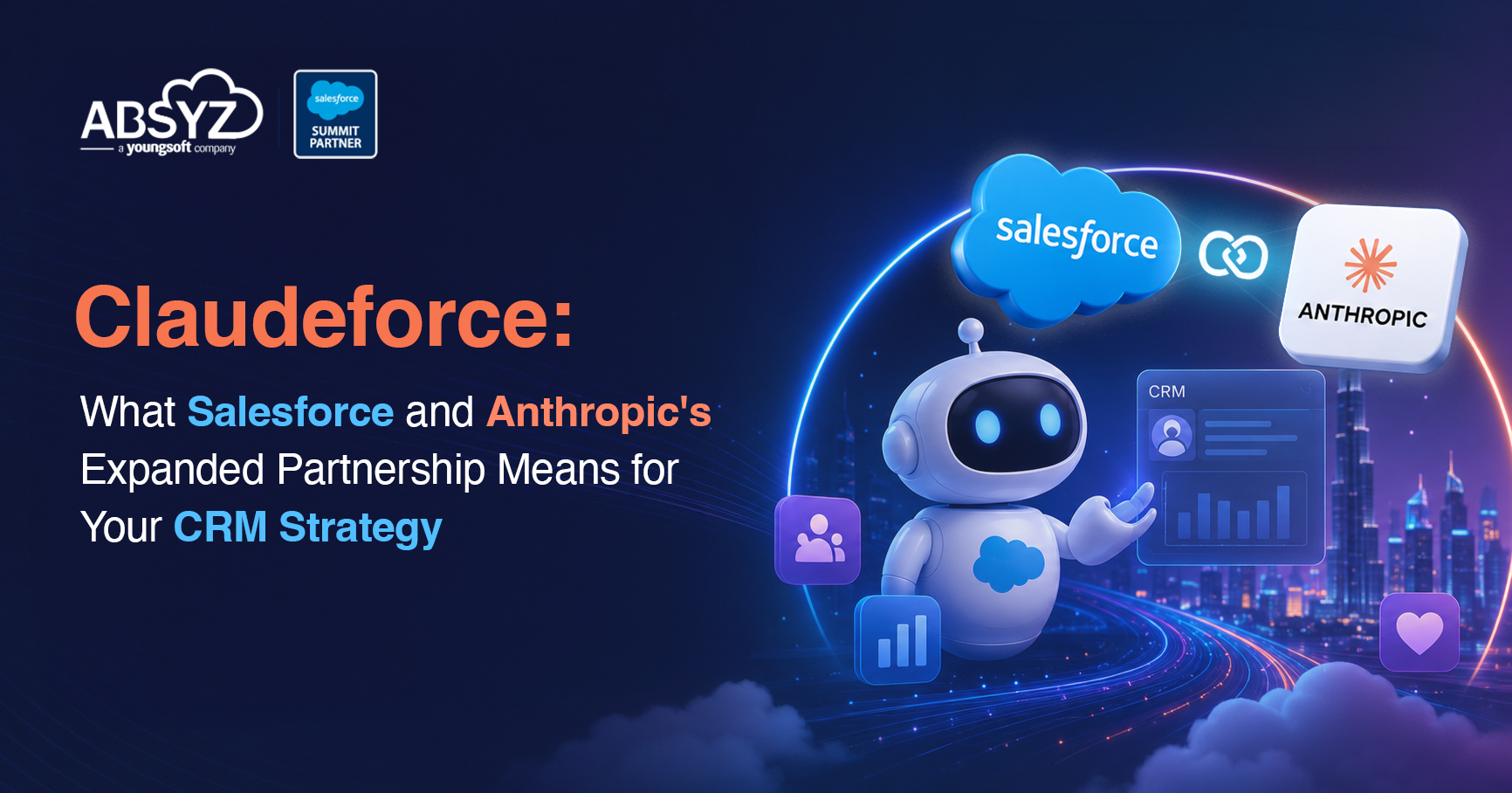
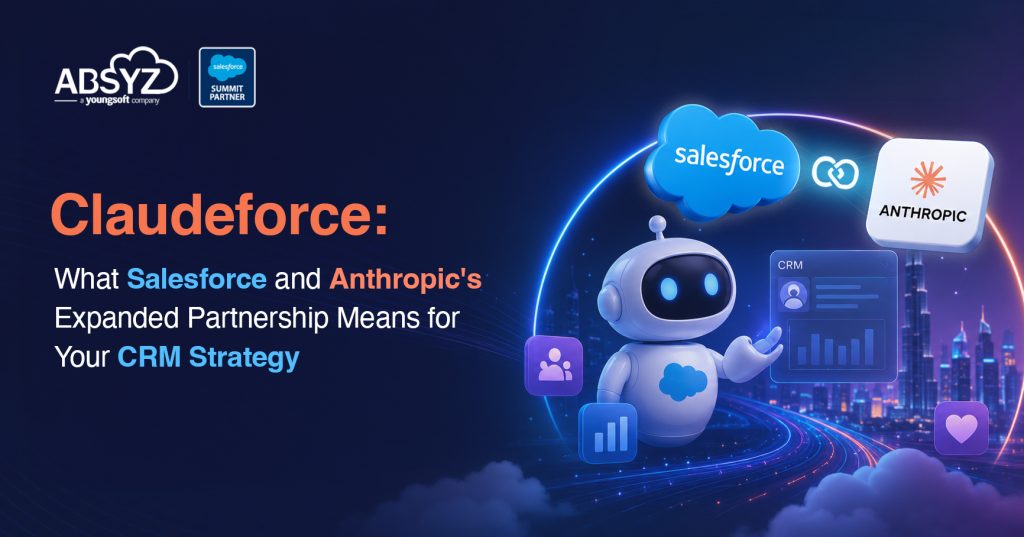
On August 26, 2026, during Salesforce’s Q2 ’27 earnings call, Marc Benioff and Dario Amodei shared a stage to announce Claudeforce, a significantly deepened partnership between Salesforce and Anthropic. Investors liked what they heard: CRM shares moved higher in after-hours trading. For anyone building on or investing in the Salesforce platform, though, the more interesting story isn’t the stock reaction; it’s what this partnership signals about where CRM and agentic AI are headed together, and what it means for your roadmap.
At ABSYZ, we spend our days helping clients get real business value out of Salesforce, and increasingly, from the AI layered on top of it. Here’s our take on what’s actually launching, why it matters, and how we think about it for organizations already running Salesforce today.
What's actually launching
The centerpiece of the announcement is Salesforce in Claude, a plugin that brings 37 prebuilt sales skills directly into the Claude interface and connects to live Salesforce data. Instead of opening the Salesforce app to prep for a meeting, check the health of a deal, or review the pipeline, sellers and agents can do that work conversationally, inside Claude itself.
Behind the scenes, the experience is powered by AIforce, Salesforce’s framework for exposing business data and workflows to AI agents through a combination of MCP servers, APIs, and CLI tools. The division of labor is straightforward: Claude supplies the reasoning and judgment, while Salesforce supplies the governed data, business logic, and trusted workflows needed to turn that reasoning into an action that’s actually safe to take on production data. Administrators configure authentication and permissions once, centrally, rather than per user or per connection.
For now, this is a pilot rollout to a select group of customers, not a general release.
This is an escalation, not a first encounter.
If it feels like Claude and Salesforce have already been dating for a while, that’s because they have. Claude has served as a foundation model inside Agentforce since late 2025, powering the Atlas Reasoning Engine and running by default inside Agentforce Vibes, Agentforce Coworker, and Agent Builder. What’s new with Claudeforce is the direction of the relationship: Salesforce data and workflows now flow into Claude, not just the other way around.
There’s also a narrative angle worth noting. Benioff has used the announcement to push back against “SaaSpocalypse” predictions — the idea that agentic AI will eventually make traditional SaaS interfaces unnecessary. His framing is that Salesforce remains essential not as the screen you have to open, but as the governed action layer beneath whichever AI interface you’re actually using. Whether that framing holds up as agentic interfaces mature is very much an open question, and one worth watching rather than taking at face value.
The technical story: how this differs from plain MCP
If you’ve already connected Claude to Salesforce through a generic, self-hosted MCP server, you might reasonably ask what Claudeforce adds. It’s a fair question, since AIforce is itself built on MCP servers, APIs, and CLI tools under the hood. The difference is in what sits on top of that plumbing:
- Raw MCP gives Claude general-purpose tools — SOQL queries, record CRUD, schema describes — and leaves Claude to improvise the workflow each time: figuring out the right objects, chaining calls correctly, and interpreting the results without a playbook.
- Salesforce in Claude ships 37 purpose-built skills engineered around specific sales motions, such as meeting prep, deal health review, and pipeline review. These skills combine Claude’s reasoning and agentic tool use with generative UI, rather than acting as a thin prompt wrapped around an API.
- Governance is centralized. Every action is routed through Salesforce’s existing business rules, and admins set up authentication and permissions once rather than per connection.
In short, think of raw MCP as the plumbing, and Salesforce in Claude as a finished, governed product built on top of that plumbing.
Why does this matter if you build on Salesforce?
A few implications stand out for architects, admins, and anyone responsible for a Salesforce org:
Governance becomes the real differentiator. As agentic tools get more capable, the risk isn’t that AI can’t take useful actions — it’s that it takes the wrong ones on production data without the right guardrails. Salesforce’s pitch here is explicitly about routing every action through enforced business rules, which is a direct answer to the governance anxiety that’s followed agentic AI into the enterprise.
Packaged skills change the build-vs-buy calculus. A library of 37 prebuilt sales skills is an opinionated, packaged capability — and it’s worth comparing honestly against what a custom Flow or Apex implementation would cost you to build and maintain. In some cases, the packaged skill will get you 80% of the way there faster; in others, your specific process will need custom work regardless.
MCP is becoming the integration backbone. AIforce’s reliance on MCP servers is a strong signal about where Salesforce’s integration architecture — and arguably the industry’s — is heading. Organizations investing in MCP-based integration patterns now are building toward where this is going, not just solving today’s problem.
How ABSYZ can help
This kind of shift rewards organizations that treat it as a strategic evaluation rather than just a feature to switch on. As a Salesforce implementation partner, we typically help clients work through questions like:
- Readiness assessment — Is your org’s data model, permission structure, and Flow/Apex footprint clean enough for a governed AI layer to reason reliably over them?
- Build-vs-buy analysis — Where does Salesforce in Claude’s 37 prebuilt skills genuinely fit your sales motion, and where does your process diverge enough to need custom skills, custom Flow, or custom Apex instead?
- MCP and integration architecture — If you’re already running custom MCP integrations, how do they coexist with a packaged product like Salesforce in Claude, and what’s your longer-term integration strategy as more of these connections show up across Claude, Salesforce, and Slack?
- Governance and permissions design — Centralizing authentication and permissions is only as good as the underlying permission model. This is a good forcing function for auditing and tightening that model before enabling agentic actions.
- Pilot program support — For clients on the Claudeforce pilot waitlist, we can help scope a pilot that answers real business questions rather than just kicking the tires.
The bottom line
Claudeforce is a meaningful step, but it’s an escalation of a relationship that’s been building since late 2025, not a brand-new one. The pilot-only rollout means most organizations have time to prepare rather than react. That time is best spent getting your data model, permissions, and integration architecture in shape — so that whenever Salesforce in Claude reaches general availability, or whatever comes after it, your org is ready to take advantage of it safely.
If you’re evaluating where Claudeforce fits into your Salesforce roadmap, or want a second opinion on your MCP and integration strategy, get in touch with ABSYZ. We’d be glad to help you think it through.