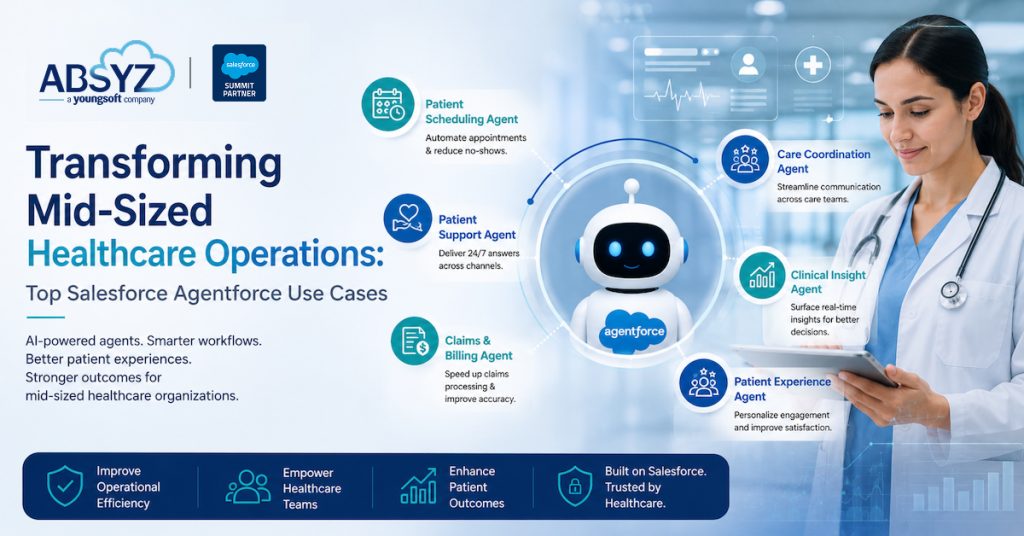
The United States healthcare system is currently navigating a period of unprecedented transformation and immense pressure. Mid-sized healthcare organizations, ranging from regional health systems and specialized clinical networks to mid-market payers and ambulatory care centers, are caught in a unique operational bind. They face the same stringent compliance demands, staffing shortages, and patient expectations as massive enterprise health systems, but often operate with leaner IT budgets and smaller administrative teams.
Administrative overload is reaching crisis proportions across the industry, with an alarming 87% of healthcare workers reporting that they work late each week to complete administrative tasks. Healthcare Agentic AI: Benefits & Use Cases | Salesforce IN This operational bottleneck inevitably detracts from what matters most: patient care and outcomes.
Enter Salesforce Agentforce for Health.
For mid-sized healthcare organizations already leveraging Salesforce—or those actively looking for a Salesforce partner to modernize their tech stack—Agentforce represents a monumental leap forward. Moving beyond basic automation or traditional generative AI, Agentforce introduces Agentic AI: intelligent, autonomous agents that can execute complex workflows, make real-time, data-driven decisions, and interact dynamically with patients and providers.
In this comprehensive guide, we will explore the most impactful Agentforce use cases for healthcare organizations, the critical technical prerequisites required for success, and why partnering with a certified Salesforce implementation expert is the non-negotiable key to unlocking its full ROI.
The Shift from Generative AI to Agentic AI in Healthcare
To understand the value of Agentforce, it is crucial to understand the distinction between Generative AI and Agentic AI.
Generative AI is exceptional at creating content—drafting an email, summarizing a clinical note, or generating a post-discharge instruction sheet based on a prompt. However, it requires human initiation and oversight for every action.
Agentic AI, the engine behind Agentforce, is autonomous. Agentic AI systems learn from real-world interactions and can respond dynamically to complex clinical and administrative situations. Healthcare Agentic AI: Benefits & Use Cases | Salesforce. These agents do not just generate text; they take action. They can evaluate a patient’s record, identify a gap in care, trigger outreach via SMS, schedule a follow-up appointment, and update the Electronic Health Record (EHR)—all without a human lifting a finger, operating within the strict guardrails and compliance protocols you define.
By acting as a “digital workforce” that works alongside your human teams, Agentforce for Health allows medical staff to provide better, faster treatment without adding to their workload. Early estimates suggest that healthcare teams could save up to 10 hours a week by using agents, and 61% of workers believe agentic AI would significantly boost their career satisfaction.
Top Agentforce Use Cases for Healthcare Organizations
For mid-sized healthcare companies in the US, the path to ROI lies in deploying Agentforce against the most resource-intensive, manual, and error-prone processes. Because Agentforce is built to integrate seamlessly with the Salesforce Health Cloud data model, which includes clinical objects such as Care Plans, Care Gaps, and Clinical Summaries, its potential applications are deeply embedded in clinical workflows.
Here are the most transformative use cases for Agentforce in the healthcare sector:
1. Intelligent Patient Follow-Ups & Care Coordination
Care continuity often breaks down after a patient leaves the clinic or hospital. Manual follow-ups via phone calls or emails are incredibly time-consuming for nursing staff and care coordinators. It is also an inconsistent process prone to human error, leading to missed guidance, delayed reporting of complications, and higher readmission rates.
The Agentforce Solution: Agentforce can completely transform post-visit follow-ups through intelligent automation. Autonomous agents can be configured to initiate follow-ups based on specific milestones—such as a post-discharge date, a completed procedure, or a care plan threshold.
Using unified patient data from Health Cloud, the agent can trigger multi-channel outreach (SMS, email, or WhatsApp) to check on the patient’s recovery. Furthermore, it enables two-way engagement. The agent can seamlessly collect patient feedback, flag potential issues such as adverse effects, and instantly escalate complex or high-risk cases to human clinicians, providing them with the full context of the conversation. This results in reduced readmissions, higher patient satisfaction, and freed-up clinical staff for high-value care.
2. Streamlined Benefits Verification and Prior Authorizations
In the US healthcare system, navigating payer benefits and securing prior authorizations is arguably the most frustrating administrative hurdle for both providers and patients. The manual back-and-forth between payers, providers, and patients delays care, causes patient attrition, and drives up overhead costs.
The Agentforce Solution: Agentforce serves as a 24/7 administrative assistant for revenue cycle and patient access tasks. When a provider prescribes a treatment or orders a specialized test, Agentforce can autonomously cross-reference the patient’s insurance data within Health Cloud.
Integrated benefits verification, appointment scheduling, and provider matching are powerful capabilities within the Agentforce ecosystem. Salesforce Prescribes Agentforce for Health to Speed Time to Treatment and Improve Outcomes with Digital Labor. An AI agent can ping clearinghouses or payer portals via MuleSoft integrations to verify eligibility in real time, compile the clinical documentation required for a prior authorization, and submit the request. If a claim is denied, the agent can identify the missing information and prompt the billing team with recommended next steps.
3. Revolutionizing Home Health & Remote Patient Management
Home health services and post-acute care are expanding rapidly as organizations seek to lower costs and patients prefer to recover at home. However, managing home health logistics—matching the right caregiver to the right patient, estimating costs, and ensuring adherence—is a logistical nightmare for mid-sized organizations.
The Agentforce Solution: Agentforce drastically reduces the burden on care coordinators and schedulers. An AI agent can autonomously review a patient’s referral and Health Cloud data to suggest relevant home care services based on their specific condition. It can even build quotes based on the patient’s insurance coverage details and automatically obtain patient approvals for recommended services and pricing. Home Health – Agentforce Use Case | Salesforce IN
By retrieving benefits data, creating quotes, and generating budget documents, the agent streamlines the entire home health intake process. This lowers operational costs, enhances patient adherence to home care plans, and increases caregiver efficiency by ensuring they are dispatched only when all administrative hurdles have been cleared.
4. Proactive Care Gap Outreach and Disease Management
Mid-sized healthcare networks and Accountable Care Organizations (ACOs) rely heavily on value-based care models, which means proactive health management is directly tied to revenue and patient outcomes. Identifying patients who are overdue for preventative screenings (like mammograms or colonoscopies) or chronic disease check-ups (like A1C tests for diabetics) is a massive data-mining task.
The Agentforce Solution: Because Agentforce agents built on Health Cloud can be grounded in a clinical context, an agent handling a care coordination workflow can see a patient’s active care gaps, their care plan status, and their upcoming referrals.
Instead of a medical assistant pulling weekly reports and dialing hundreds of numbers, an Agentforce AI can continuously monitor patient panels. When a care gap is identified, the agent proactively reaches out to the patient, educates them on the importance of the screening, and facilitates self-scheduling directly into the EHR/Salesforce platform. By identifying patients at risk of missing appointments or dropping out of care, care teams can intervene proactively, closing care gaps faster and improving overall population health metrics.
5. Seamless Referral & Case Management
For specialty clinics and mid-sized hospitals, referral leakage (when a patient goes outside the network for care) is a major source of lost revenue. Often, this happens because the referral process is slow, opaque, and requires multiple phone calls between different offices.
The Agentforce Solution: Agentforce can automate the end-to-end referral tracking process. When a primary care physician issues a referral, the AI agent can instantly ingest the referral data, extract the vital clinical information using intelligent document processing, and route the case to the most appropriate specialist based on availability, location, and insurance network. The agent can then automatically contact the patient to schedule the consult, keeping the referring provider updated every step of the way. Improving case resolution times by automating referral tracking converts manual, friction-heavy processes into smooth digital workflows.
The Prerequisites: Why You Can’t Just "Turn On" Agentforce
While the capabilities of Agentforike magic, implementing enterprise-grade AI in healthcare requires rigorous technical preparation. A common misconception among mid-sized companies is that Agentforce is a simple “plug-and-play” add-on.
The reality is quite different. Layering Agentforce on top of Salesforce Health Cloud is not the same project as a standard Agentforce deployment; the HIPAA compliance requirements and the clinical workflows involved make it a distinct implementation that requires a different preparation checklist.
Here are the critical prerequisites mid-sized organizations must address:
1. Robust EHR Integration (MuleSoft & FHIR APIs)
Agentforce agents are only as smart as the data they can access. If your Salesforce instance is siloed from your Electronic Health Record (EHR) system (like Epic, Cerner, or athenahealth), the AI will lack the clinical context needed to make safe, accurate decisions. Organizations that have built FHIR API integrations between their EHR and Health Cloud will have significantly richer agent grounding than organizations where Health Cloud contains only what the care team manually entered.
2. A Solid Health Cloud Data Model Foundation
The most common reason Agentforce implementations stall or underdeliver is an incomplete or messy underlying Health Cloud configuration. Health Cloud is uniquely designed to run on the “Person Accounts” model, treating each individual as simultaneously an Account and a Contact. Furthermore, your organization must be actively utilizing Health Cloud’s specialized clinical objects (Care Plans, Clinical Summaries, Health Conditions). If your data is living in standard Service Cloud objects (Cases, standard Contacts), Agentforce will function merely as a basic customer service bot, lacking true clinical awareness.
3. Data Security and HIPAA Compliance Configurations
Agentforce integrates robust data protection protocols, guaranteeing that all patient information is securely managed. However, deploying it requires a careful review of your Salesforce org’s sharing rules, field-level security, and shield encryption settings. Agents must be programmed with strict guardrails to ensure they never expose Protected Health Information (PHI) to unauthorized users or across unsecured channels.
Why Partnering with a Salesforce Expert is Critical for Your Agentforce Journey
For mid-sized US healthcare companies, navigating the complexities of AI readiness, EHR integrations, and clinical data modeling is rarely something an in-house IT team can handle alone. The gap between a basic chatbot and a highly autonomous, clinically grounded Agentforce deployment is determined entirely by how well your Health Cloud instance is architected.
This is exactly why engaging with a certified Salesforce implementation partner is not just recommended—it is a business imperative. Here is why:
- EHR Integration Expertise: Connecting legacy EHR systems to Salesforce via MuleSoft or FHIR APIs is highly complex. A specialized partner brings pre-built connectors, integration architectures, and deep knowledge of healthcare data standards (HL7/FHIR) to ensure data flows seamlessly and securely in real-time.
- Clinical Workflow Mapping: Implementing Agentforce is not a technology project; it is a clinical operations project. The right partner will map your unique patient journeys, administrative bottlenecks, and care team protocols, translating them into precise Prompts and Actions for your Agentforce agents.
- Compliance and Security Assurance: A seasoned healthcare Salesforce partner understands the nuances of HIPAA compliance within cloud environments. They ensure that your Agentforce implementation effectively uses the Salesforce Einstein Trust Layer, masking PHI and preventing your clinical data from being used to train external LLMs.
- Accelerated Time-to-Value: Mid-sized companies cannot afford years-long deployment cycles. By leveraging pre-built Agentforce for Health templates, proven best practices, and deep platform expertise, a consulting partner significantly reduces implementation timelines, helping you realize ROI faster.
Conclusion
The era of AI in healthcare has officially moved beyond novelty and into operational necessity. For mid-sized US healthcare organizations dealing with staff burnout and rising administrative costs, Salesforce Agentforce offers a lifeline. By deploying autonomous agents to handle patient follow-ups, benefits verification, home health coordination, and referral management, you can drastically reduce the administrative burden and refocus your teams on human-centric care.
However, realizing this vision requires more than just purchasing a license. It demands clean data, robust EHR integrations, and a flawlessly configured Health Cloud environment.
If your organization is ready to step into the future of healthcare with Agentic AI, the first step is assessing your data readiness. Reach out to a certified Salesforce consulting partner today to map out your unique Agentforce strategy, streamline your clinical workflows, and transform your patient experience.