The Gulf Cooperation Council (GCC) is currently the epicenter of one of the fastest and most ambitious digital transformations in history. Driven by national agendas like Saudi Arabia’s Vision 2030, the UAE’s National Strategy for Artificial Intelligence 2031, and Qatar’s National Vision 2030, regional enterprises are not merely adopting new technologies; they are rewriting the rules of economic competitiveness. The mandate for GCC businesses is clear: optimize operations, accelerate customer experience (CX) innovation, and establish digital-first business models that can scale autonomously.
As businesses strive to meet these targets, a fundamental shift is occurring in the artificial intelligence landscape. We are moving rapidly past the era of passive chatbots and predictive analytics into the age of the Agentic Enterprise.
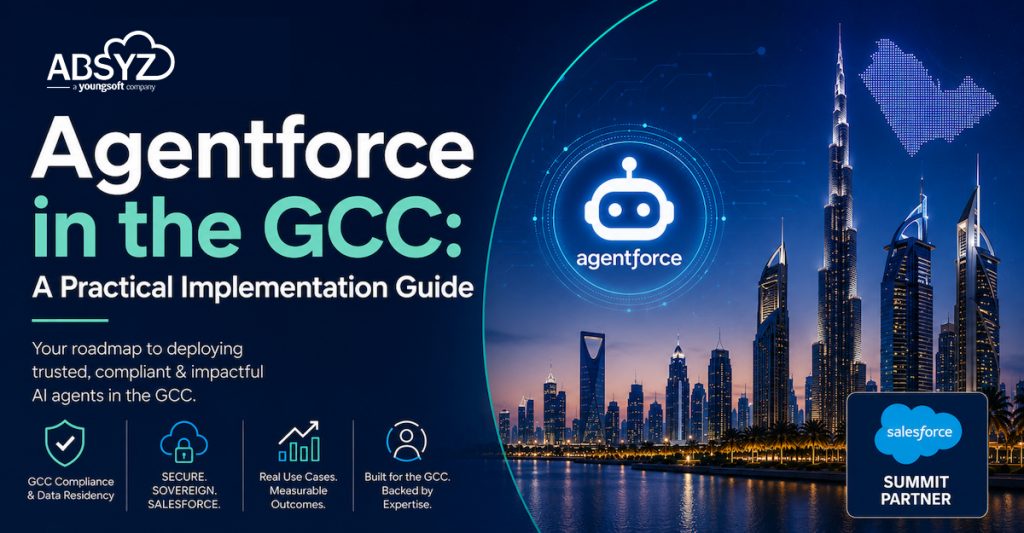
At the forefront of this revolution is Salesforce Agentforce, an enterprise-grade autonomous AI platform. With native Arabic language support and localized data residency via regional infrastructure, Agentforce enables GCC organizations to deploy digital workers that can reason, make decisions, and execute complex workflows without the traditional technical debt or cost premiums associated with custom-built AI.
This guide provides a comprehensive, practical, and architecturally sound blueprint for successfully implementing Salesforce Agentforce within GCC enterprises.
1. The Architectural Pillars of Salesforce Agentforce
To implement Agentforce effectively, it is essential first to understand its underlying technology and how it differs from traditional automation. Agentforce does not rely on rigid, pre-programmed decision trees. Instead, it uses a dynamic Reasoning Engine that mimics human problem-solving to complete complex tasks.
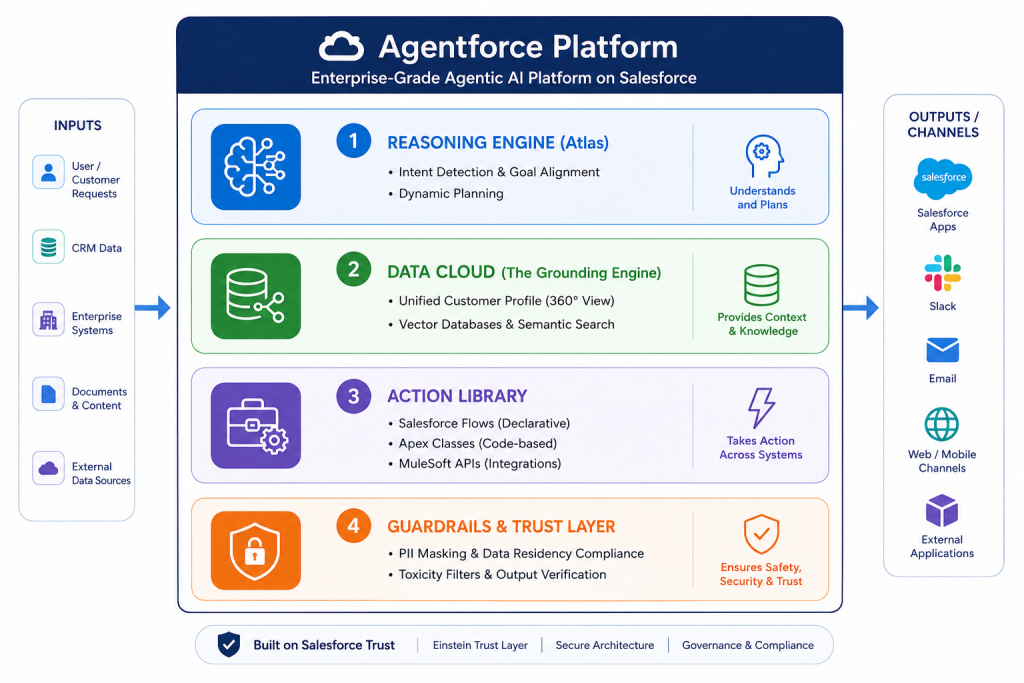
The platform is built on four core pillars:
A. The Reasoning Engine (Atlas)
At the heart of Agentforce is the reasoning engine, which uses a process of “Atlas” reasoning. When a user interacts with an agent, the engine:
- Interprets Intent: Analyzes the request, taking into account language, context, and history.
- Retrieves Context: Dynamically queries Data Cloud or CRM objects to understand the specific situation.
- Formulates a Plan: Decides which “Topics” (areas of expertise) and “Actions” (capabilities) are required to fulfill the user’s objective.
- Executes and Evaluates: Runs the actions, checks the outputs against built-in guardrails, and presents the finalized response or takes the automated step.
B. Grounding with Data Cloud
An agent is only as intelligent as the data it can access. True 360° Customer Visibility is achieved by anchoring Agentforce in Salesforce Data Cloud. Data Cloud harmonizes structured and unstructured data from disparate sources, ERP systems, legacy databases, website telemetry, and marketing interactions.
By grounding Agentforce in this unified profile, the agent avoids hallucination. It answers questions and acts based on real-time, verified customer data, using semantic search and vector databases to retrieve highly precise context.
C. Actions: The “Hands and Feet” of the Agent
Actions represent what the agent can actually do. Agentforce can initiate:
- Salesforce Flows: Launching automated, multi-step declarative workflows.
- Apex Code: Executing complex, custom transactional logic.
- MuleSoft APIs: Connecting to external legacy systems, core banking platforms, or local shipping carriers.
D. Guardrails and the Einstein Trust Layer
The Einstein Trust Layer serves as the compliance gatekeeper. It masks Personally Identifiable Information (PII) before sharing data with large language models (LLMs), screens for offensive content or toxicity, and guarantees that external LLMs do not retain regional corporate data for training purposes.
2. GCC Localization: Navigating Native Arabic Support
Historically, one of the biggest hurdles to deploying conversational or autonomous AI in the Middle East was language. Arabic is a rich, complex, and highly contextual language with numerous regional dialects. Standard translation layers often strip away cultural nuances, resulting in stiff, mechanical, or outright incorrect customer interactions.
Salesforce addressed this barrier by introducing native Arabic support for the Agentforce platforms, specifically the Service Agent and Employee Agent applications.
The Architectural Blueprint for Multilingual Success
Agentforce manages language variations natively through a structured multilingual framework. For GCC enterprises serving diverse populations (including both Arabic and English speakers), setting up multi-language agents involves several key components:
Component | Technical Implementation Method | GCC Best Practice |
Language Detection | Handled natively by the LLM or set explicitly via client metadata. | For Web/In-App Messaging (MIAW), use pre-chat forms to capture browser locale or user preference automatically. |
Contextual Grounding | Filters knowledge articles based on the detected user language. | Ensure your Salesforce Knowledge Base has high-quality, localized translations in both Modern Standard Arabic (MSA) and English. |
Prompt Engineering | System prompts are configured with specific linguistic and structural guardrails. | Write localized system instructions that outline tone rules (e.g., using polite, professional Arabic formatting suitable for Gulf corporate and government standards). |
Addressing the Dialectal Divide: MSA vs. Khaliji
When configuring Agentforce for the GCC, it is vital to balance Modern Standard Arabic (MSA)—the benchmark for formal writing, governmental communications, and legal transactions—with Khaliji (Gulf Arabic), which is commonly used in casual, everyday customer conversations across the UAE, Saudi Arabia, Kuwait, Qatar, Bahrain, and Oman.
To optimize the linguistic performance of your Agentforce deployment:
- Grounding via Localized Knowledge: Translate help articles, policy documents, and product manuals into high-quality MSA to ensure regulatory and operational compliance.
- Contextual Action Naming: Define Action and Topic descriptions in clear, unambiguous terms so that the semantic reasoning engine can easily map a customer’s conversational dialect to the correct technical workflow.
- Handling Dual-Language Inputs: GCC consumers frequently blend Arabic and English in single phrases (often referred to as “Arabizi” or code-switching). Agentforce’s underlying models are trained to parse these hybrid expressions, but validating customer input parameters during testing remains critical.
3. Compliance, Trust, and Data Sovereignty in the Gulf
For regulated industries in the GCC—such as banking, insurance, telecommunications, and healthcare—compliance with national data protection laws is a prerequisite for any technology deployment.
The Regulatory Landscape
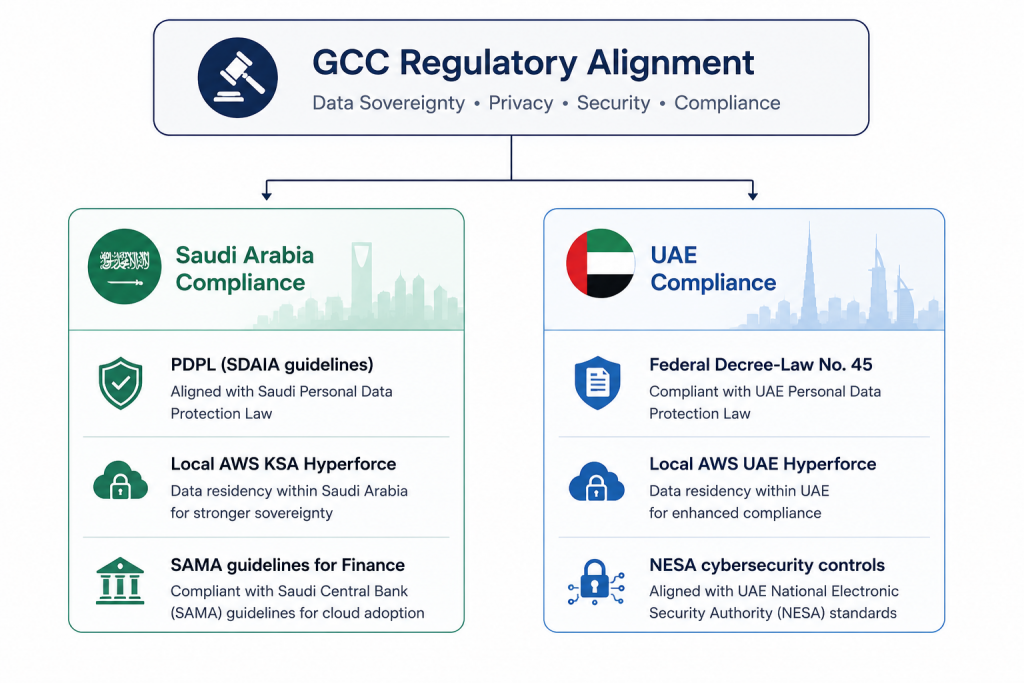
Implementing AI in the GCC requires strict adherence to local laws, including:
- Saudi Arabia’s Personal Data Protection Law (PDPL): Governed by the Saudi Data and AI Authority (SDAIA), PDPL enforces strict limits on transferring personal data outside the Kingdom without proper authorization and mandates local storage of critical datasets.
- UAE Data Protection Law (Federal Decree-Law No. 45 of 2021): Imposes stringent rules regarding consent, data minimization, and cross-border transfers.
- Sector-Specific Frameworks: Regulatory mandates from bodies like the Saudi Central Bank (SAMA) and the UAE National Electronic Security Authority (NESA) require highly auditable access controls and local processing pipelines.
The Hyperforce Solution
To meet these strict local residency rules, Salesforce has deployed Hyperforce across the Middle East through partnerships with major public cloud providers, such as Amazon Web Services (AWS).
With Hyperforce running locally in KSA and the UAE, enterprises can:
- Store and Process Data Locally: Ensure that customer profiles, chat histories, CRM cases, and transactional logs remain securely within national borders.
- Maintain Regulatory Alignment: Simplify compliance audits for internal legal teams and external regulatory bodies.
- Benefit from Public Cloud Elasticity: Scale performance seamlessly during peak regional periods (such as Ramadan, Eid shopping seasons, or national holidays) without compromising on low-latency data access.
Operational Security Architecture
Beyond physical data residency, your Agentforce design must enforce enterprise-grade security structures:
- Role-Based Access Control (RBAC): Restrict what information the agent can retrieve based on the user’s explicit profile permissions. If an employee interacting with an HR Agent does not have permission to view salary bands, the agent’s underlying retriever must automatically filter out that data from its reasoning process.
- Auditability and the Control Center: Every decision, path chosen, and action taken by an Agentforce digital worker is logged. This allows compliance officers to trace exactly why an agent approved a specific request or routed a case in a certain direction, providing complete operational transparency.
4. A 5-Phase Practical Implementation Blueprint
Moving from a conceptual understanding of Agentforce to a live, production-grade deployment requires a structured, value-driven methodology. Below is an enterprise-ready, 5-phase blueprint tailored for GCC organizations.
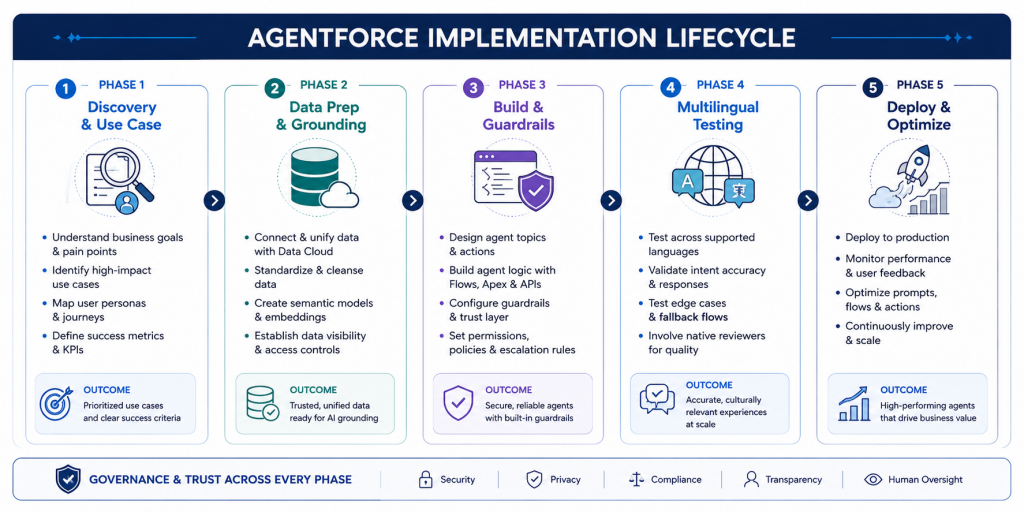
Phase 1: Discovery and High-Value Use Case Definition
The most successful AI deployments focus on business value rather than technology for its own sake.
- Form a Cross-Functional steering committee: Bring together IT leaders, Salesforce Architects, business unit owners, and compliance officers.
- Identify High-ROI Entry Points: Focus on high-frequency, relatively low-complexity tasks. Ideal initial use cases include customer service case deflection, automated internal HR queries, and transactional sales support (e.g., generating quote summaries or retrieving account histories).
- Document Success Criteria: Define clear target metrics, such as a 30% reduction in average handling time (AHT), 40% case deflection for routine FAQs, or an improved localized CSAT score.
Phase 2: Data Readiness & The Data Cloud Connection
Your agent is only as reliable as its underlying data repository.
- Connect Data Sources: Use Data Cloud connectors to ingest data from Salesforce CRM, legacy ERP systems, and external databases.
- Clean and Harmonize: Resolve duplicate customer profiles using Data Cloud identity resolution rules. Ensure there is a single, trusted “Golden Record” for every customer.
- Unstructured Data Ingestion: Ingest local knowledge bases, PDF manuals, and regional policy documents. Ensure these documents are properly translated, categorized, and tagged with appropriate metadata (such as language, region, and target audience).
Phase 3: Designing Topics, Actions, and Guardrails
This phase involves defining the boundaries of what your agent can discuss and what workflows it can execute.
- Define Topics: Topics represent the core categories of conversations your agent is authorized to handle (e.g., “Billing Inquiries”, “Order Tracking”, “Booking Management”).
- Assign Actions: Map specific Salesforce Flows, MuleSoft APIs, or Apex classes to each Topic. For instance, the “Order Tracking” topic should have access to an Action that calls the shipping provider’s local API.
- Establish Guardrails: Define strict boundaries using declarative “Never” rules. For example, specify: “You must never reveal internal partner discount margins to the customer” or “You must never discuss non-regional product availability.”
Phase 4: Multilingual Testing & Localized Quality Assurance
Before exposing your agent to customers, conduct rigorous QA using localized personas and dialectal testing.
- Develop Localized Persona Test Scripts: Create a suite of test inputs ranging from formal MSA to regional Gulf dialects.
- Validate Intent Mapping: Ensure that when a customer inputs a colloquial phrase like “Abgha ashof fatorati” (I want to see my bill), the reasoning engine correctly maps the request to the formal “Billing Inquiries” topic.
- Conduct “Red Teaming”: Actively attempt to bypass the agent’s guardrails. Test with highly sensitive questions, ambiguous phrasing, and dual-language inputs to ensure the Einstein Trust Layer correctly blocks or masks sensitive data.
Phase 5: Deployment, Monitoring, and the Agentforce Control Center
Once thoroughly validated, roll out the agent using a phased pilot strategy.
- Phased Rollout: Deploy the agent initially to a small, controlled customer segment or to internal staff as co-pilots.
- Monitor via Control Center: Use the Agentforce Control Center to track performance in real-time. Monitor KPIs such as:
- Intent Classification Accuracy: How often the agent maps queries to the correct Topic.
- Action Success Rate: The percentage of workflows completed without error.
- Escalation Rates: How frequently the agent needs to transfer the conversation to a human agent.
- Continuous Optimization: Analyze conversations where the agent struggled or transferred the user to a human agent. Use these insights to refine prompt templates, add missing knowledge articles, or create new targeted Actions.
5. High-Impact GCC Use Cases Across Industries
To illustrate the practical value of Agentforce, let’s explore three industry-specific deployment models designed for the GCC business environment.
Use Case 1: Islamic Banking & Wealth Management
Retail and Islamic banking institutions in the GCC must balance rapid customer service with strict compliance, Shariah guidelines, and personal data security.
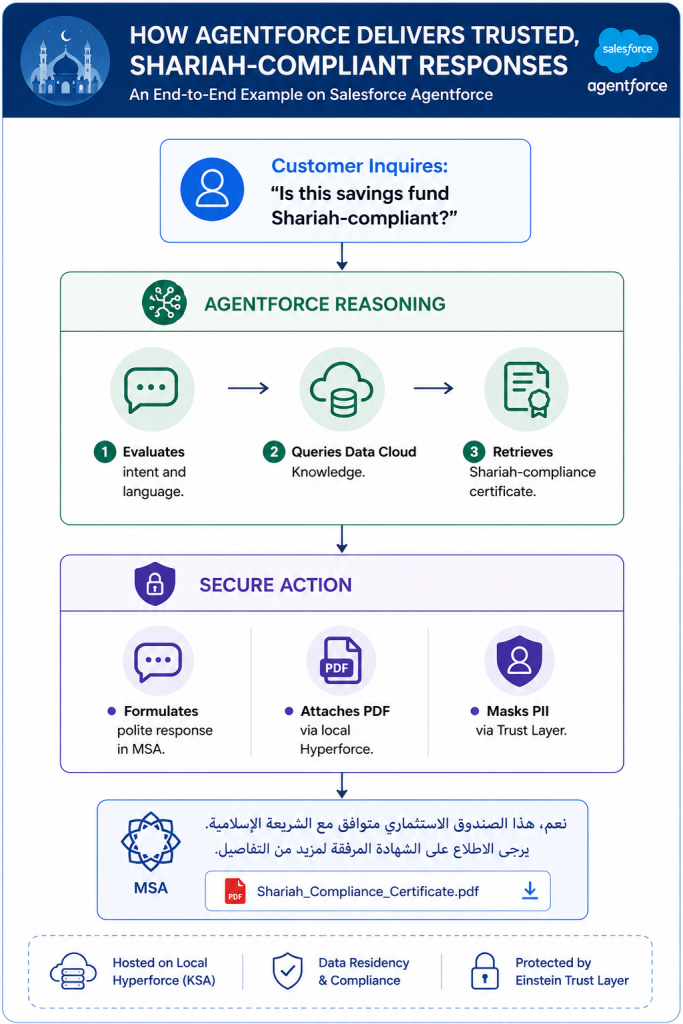
The Challenge: A high volume of customer queries about product features, profit-sharing ratios, Shariah compliance certificates, and branch locations, creating bottlenecks for human advisory teams.
- The Agentforce Solution: Deploy an autonomous Service Agent natively in Arabic and English, accessible via mobile apps and WhatsApp.
- Linguistic/Technical Setup:
- Ground the agent in Shariah board fatwas, product terms, and regulatory disclosure documents translated into formal MSA.
- Build Actions that connect to core banking APIs via MuleSoft to retrieve account balances or transaction details securely.
- Business Value: Up to 50% deflection of routine information requests, enabling certified wealth advisors to focus on high-value client consultations and relationship-building.
Use Case 2: Telecom & Public Utility Services
With massive subscriber bases and competitive landscapes, regional telecom providers must deliver instant, highly personalized support.
- The Challenge: Managing thousands of daily customer inquiries regarding bill payments, roaming packages, plan upgrades, and service outages.
- The Agentforce Solution: Create a high-capacity Service Agent integrated directly with the provider’s web portal and WhatsApp channels.
- Linguistic/Technical Setup:
- Configure pre-chat forms to identify the subscriber’s preferred language and regional dialect.
- Build declarative Salesforce Flows that enable the agent to process bill payments, provision data roaming packages, or reset router configurations in real time.
- Ground the agent with localized network coverage maps and FAQs.
- Business Value: Reduced customer handling times, 24/7 service availability in both English and Arabic, and a significant reduction in operational overhead for regional contact centers.
Use Case 3: Enterprise Internal IT & HR Helpdesks
In rapidly growing GCC conglomerates, internal support systems often struggle to keep pace with organizational expansion.
- The Challenge: IT and HR teams are spending excessive hours answering repetitive questions about company policies, leave balances, insurance coverage, and system access.
- The Agentforce Solution: Implement an Agentforce Employee Agent integrated directly with internal communication tools like Slack or Microsoft Teams.
- Linguistic/Technical Setup:
- Ground the agent in the company’s internal HR manuals, local labor law compliance guidelines, and IT troubleshooting guides.
- Create Actions that allow employees to request time off, check the status of salary slips, or open IT support tickets autonomously.
- Business Value: Instant support for employees across multiple regional offices, automated handling of routine internal queries, and more strategic capacity for IT and HR departments.
6. Key Metrics: Measuring Agentforce ROI in the Middle East
To build a sustainable AI roadmap, organizations must continuously measure and optimize their Agentforce implementations. Focus on these primary key performance indicators (KPIs):
1. Deflection and Resolution Metrics
- First-Contact Resolution (FCR) Rate: The percentage of interactions where Agentforce successfully solves the user’s issue without human intervention or transfer.
- Topic-Specific Deflection Rate: Tracking which topics (e.g., billing vs. troubleshooting) achieve the highest autonomous resolution rates. Use this data to identify which areas need improved grounding or additional Actions.
2. Conversational Quality and Customer Experience
- Dialectal Understanding Score: Analyze escalation rates for sessions initiated in regional dialects (e.g., Gulf Arabic) compared with Modern Standard Arabic (MSA). A high escalation rate for specific dialects indicates a need for better localized training data and conversational phrasing.
- Localized CSAT / CES (Customer Effort Score): Post-interaction surveys tailored to the regional market to measure satisfaction with the speed, accuracy, and tone of the agent’s responses.
3. Operational and Financial Efficiency
- Total Cost of Service Reduction: Comparing the cost of interactions handled by autonomous agents against those handled by human teams.
- Human Agent Capacity Uplift: Measuring the change in average handling times (AHT) and backlog volumes for human agents once Agentforce begins filtering out routine inquiries.
Embracing the Agentic Era in the GCC
The transition toward agentic AI represents a milestone in the digital transformation of the GCC. By removing traditional language and data residency barriers, Salesforce Agentforce offers regional organizations a practical, highly secure path to deploying autonomous digital workers.
Whether your goal is to enhance customer experiences, streamline internal operations, or build highly responsive digital services, the key to success lies in:
- Starting with a value-first, use-case-driven approach.
- Ensuring a robust, unified data foundation using Data Cloud.
- Enforcing strict compliance with regional data residency guidelines through local Hyperforce infrastructure.
- Investing in high-quality, localized Arabic grounding and testing workflows.
As the region continues to accelerate its digital ambitions, those who successfully integrate autonomous AI agents into their core operations will be uniquely positioned to lead, innovate, and scale in the modern Middle East. 2.6]