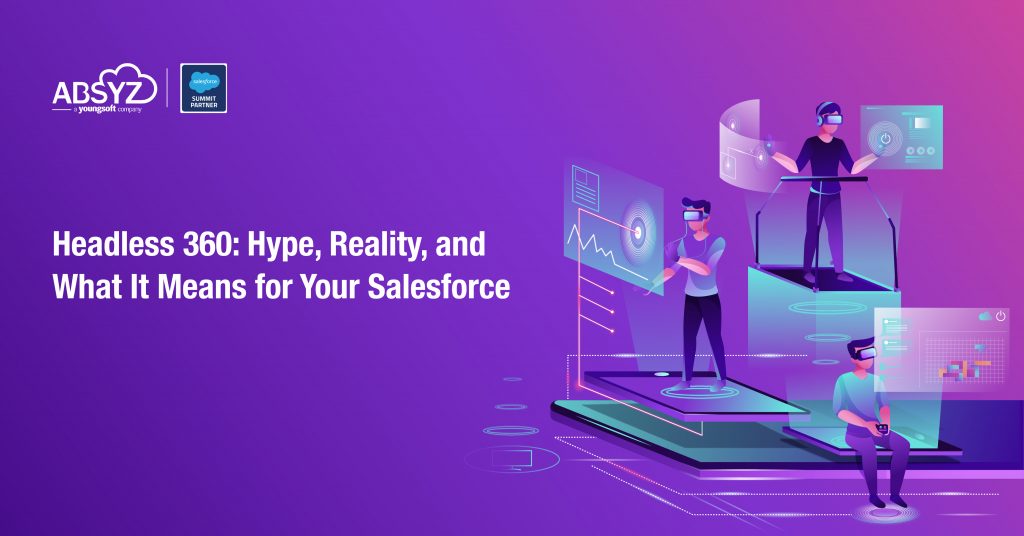
“Headless” has been a recurring theme in digital architecture conversations, initially within commerce, but now expanding across the broader Salesforce ecosystem.
With Salesforce’s evolution toward APIs, composability, and experience-led design, enterprises are increasingly exploring what can be described as a headless Salesforce architecture.
But for CIOs and architects, the key questions remain:
- Is this a real shift or just another architectural trend?
- Where does headless actually deliver value?
- And how does it impact long-term Salesforce investments?
This guide breaks down the hype, reality, and practical implications.
What Is Headless Salesforce Architecture?
At its core, a headless Salesforce architecture separates:
- Backend (Salesforce): Data, business logic, workflows
- Frontend (Experience Layer): Web, mobile, portals, apps
These layers communicate via:
- APIs
- Middleware
- Event-driven integrations
This allows organizations to build custom, flexible experiences without being constrained by native Salesforce UI.
What’s Actually Changing
1. Experience Is No Longer Tied to Salesforce UI
Customer-facing experiences are increasingly built using modern frontend frameworks (React, Angular, etc.), while Salesforce powers the backend.
Impact: Greater flexibility in designing differentiated digital experiences.
2. API-First Becomes Foundational
Salesforce capabilities are exposed through APIs, enabling:
- Faster integrations
- Modular system design
- Scalable architecture
Impact: Systems can evolve independently without disrupting the entire ecosystem.
3. Composable Architecture Becomes Practical
Organizations can now combine:
- Salesforce
- Third-party tools
- Custom-built applications
Instead of relying on a monolithic CRM setup.
Impact: Best-of-breed solutions tailored to business needs.
4. Data Unification Becomes Critical
Solutions like Data Cloud are increasingly used to:
- Unify customer data
- Enable real-time personalization
- Power AI-driven insights
Impact: Consistent, data-driven experiences across channels.
5. Integration Layer Becomes Central
Headless architectures rely heavily on:
- Middleware platforms
- API orchestration
- Event-driven systems
Impact: Integration is no longer a backend concern—it becomes a core architectural pillar.
The Short-Term Reality
Despite the benefits, adopting headless Salesforce comes with trade-offs:
- Increased implementation complexity
- Need for specialized skills (frontend, APIs, integration)
- Greater coordination across teams
- Ownership of the experience layer shifts beyond Salesforce
The Long-Term Impact
For organizations that implement it correctly, the benefits are significant:
- True omnichannel experience delivery
- Faster innovation cycles
- Future-ready, scalable architecture
- Stronger foundation for AI and personalization
What Has NOT Changed
Amid all the architectural evolution, some fundamentals remain constant:
- Clear business processes are still critical
- Salesforce remains the core system of engagement
- Integration discipline is essential
- Governance becomes even more important
The Downsides of Headless Salesforce
Headless is not always the right choice.
Potential challenges include:
- Overengineering without clear business value
- Higher upfront investment
- Fragmented ownership across teams
- Increased dependency on integration layers
Where Native Salesforce UI Still Makes Sense
Not every use case needs to be headless.
Native Salesforce UI remains ideal for:
- Internal teams (Sales, Service, Operations)
- Admin and configuration workflows
- Rapid deployments with minimal complexity
When Should You Consider Headless Salesforce?
Headless architecture is most effective when:
- Customer experience is a competitive differentiator
- Multiple digital touchpoints need to be unified
- There is a need for high flexibility and customization
- Existing systems require seamless integration
A Practical Approach: How Enterprises Should Adopt Headless
1. Start with High-Impact Use Cases
Focus on areas where experience and flexibility drive measurable value.
2. Adopt a Hybrid Architecture
Combine:
- Headless for customer-facing experiences
- Native Salesforce UI for internal operations
3. Strengthen API and Integration Foundations
Invest in:
- API strategy
- Middleware platforms
- Event-driven architecture
4. Build a Scalable Data Strategy
Ensure consistent and unified data across systems to support:
- AI
- Analytics
- Personalization
5. Scale with Governance
Introduce headless capabilities gradually, with:
- Clear ownership models
- Strong architectural oversight
The Strategic Shift: From CRM to Experience Platform
The real transformation is not about removing the frontend.
It’s about redefining Salesforce’s role:
From:
A system of record with built-in UI
To:
A composable, API-driven platform powering connected experiences
Conclusion: Hype vs Reality
Headless Salesforce is not just a trend—but it’s also not a universal solution. For CIOs and architects, the goal is not to “go headless.”
It’s to:
- Identify where it delivers value
- Balance flexibility with control
- Align architecture with business outcomes
If your organization is exploring composable Salesforce architectures, the key is not adopting headless everywhere, but adopting it where it drives measurable impact.
Author: Vignesh Rajagopal