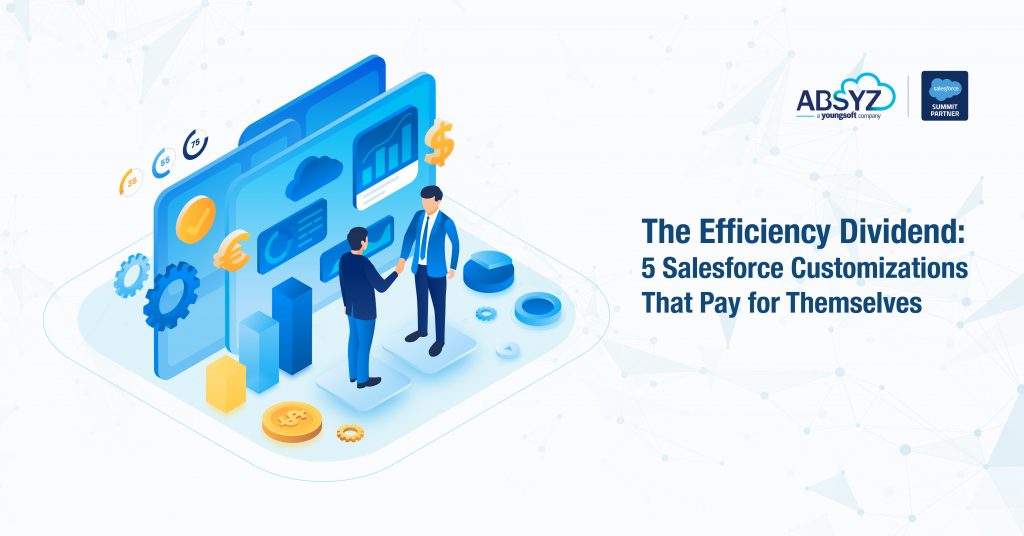
In high-cost labour markets like the US and UK, the “out-of-the-box” Salesforce experience often comes with a hidden tax: Manual Overhead. When your highly-compensated Account Executives spend 20% of their week on data entry, your CRM isn’t a tool—it’s a cost centre.
To achieve a true “Efficiency Dividend” in 2026, firms must move beyond standard configuration. We’ve identified five strategic customizations that shift the ROI needle by automating the “Middle Office” and reclaiming billable hours.
I. The Revenue Leakage Gap: Automated Contract Reconciliation
The Problem: Mid-cycle contract amendments (upsells, ramp-ups, or swaps) are the primary source of revenue leakage in SaaS and Service firms. Manual reconciliation between Sales Cloud and Finance often results in under-billing.
- The High-ROI Customization: A Unified Revenue Lifecycle Trigger. This custom logic ensures that any change to a “Closed Won” Opportunity automatically updates the related Subscription and Billing Schedule in real time.
- The US Premium Metric: Reducing “Days Sales Outstanding” (DSO) by an average of 12 days.
II. The Talent Gap: Agentic "Triage" Customizations
The Problem: In premium markets, hiring a Tier-1 Support Rep costs $60k–$80k+. Using that talent to answer “Where is my order?” is a poor allocation of capital.
- The High-ROI Customization: Agentforce Service Triage. Customize your Agentforce Dispatcher to handle intent-based routing. Instead of a basic “Round Robin,” the AI analyzes sentiment and complexity, solving 40% of cases autonomously.
- The ROI Factor: You don’t need to hire more staff to scale; you simply increase the “Agentic Capacity” of your existing team.
III. The Data Debt Gap: Zero-Copy Virtualization
The Problem: Data storage costs in Salesforce are notoriously high. US enterprises often pay thousands in “Storage Overage” fees to keep historical data accessible for compliance.
- The High-ROI Customization: Data Cloud Zero-Copy Integration. Rather than “Loading” data (ETL), you “Virtualize” it. Customize Salesforce to surface data from Snowflake or Google BigQuery as if it were a native object.
- The Saving: Eliminates the need for 3rd-party integration middleware (MuleSoft/Dell Boomi) for simple data viewing, saving $30k+ in licensing.
IV. The Performance Gap: The "Lean Apex" Refactor
The Problem: Legacy “Trigger Sprawl” leads to slow page loads. In the US, where “Time is Money,” a 3-second delay in page load correlates to a 10% drop in user adoption.
- The High-ROI Customization: Flow Trigger Administration Framework. Consolidate disparate Apex triggers into a single, high-performance Flow Orchestration layer.
- The ROI Factor: Reduced technical debt. Your internal team can now manage 80% of business logic changes without needing to hire an expensive outside developer for a “Code Deployment.”
V. The Opportunity Gap: Predictive Lead Scoring 2.0
The Problem: Standard Lead Scoring is reactive. In a competitive market, being the second company to call a lead is the same as being the last.
- The High-ROI Customization: Custom Propensity-to-Buy Models. Integrate external intent data (from 6sense or ZoomInfo) directly into a custom Einstein Prediction field.
- The Saving: Increases “Win Rates” by ensuring your highest-paid closers are only talking to the top 5% of your pipeline.
The Bottom Line: TCO vs. ROI
In 2026, Salesforce’s success is measured by Total Cost of Ownership (TCO) reduction. By implementing these five customizations, firms in premium GEOs aren’t just “fixing” their CRM—they are building a competitive moat through operational excellence.
Author: Vignesh Rajagopal