Introduction
There’s a moment in every Salesforce conversation where someone mentions “AI”, and the room splits. Developers think about Prompt Builder. Architects think about Data Cloud. Business leaders think about outcomes. Everyone is right. And everyone is looking at a different piece of the same elephant.
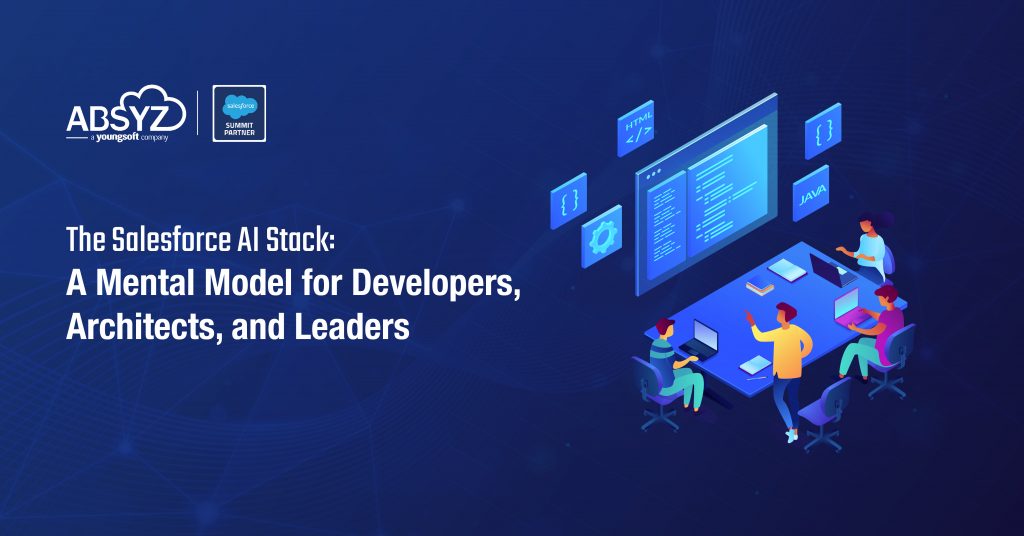
This blog is an attempt to draw the whole elephant. Not in exhaustive detail, but enough that you can place any Salesforce AI conversation in context. A mental model you can carry into your next meeting, sprint, or strategy session.
The Problem With Partial Views
Salesforce’s AI story has grown fast. Agentforce. Einstein. Data Cloud. RAG. BYOLM. Zero Data Retention. Each term makes sense in isolation. But without a unifying frame, it’s hard to see how they connect.
Developers ask: “Where does my code fit?” Architects ask: “What depends on what?” Leaders ask: “What’s actually happening under the hood?”
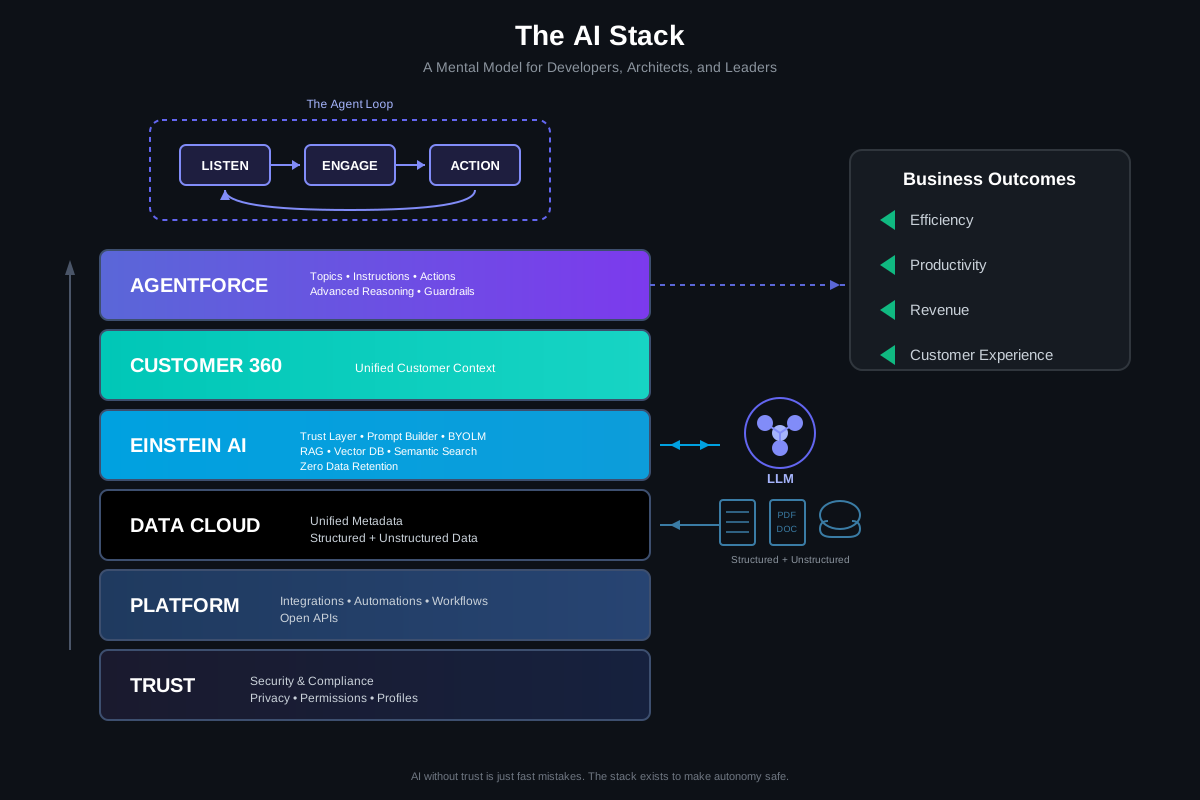
The answer is the same for all three. It’s a stack. Six layers, each enabling the one above it, helping leaders feel confident in AI decisions.
The Six Layers
Think of this as a building. You can’t add a roof before the walls are in place. And you can’t have walls without a foundation.
1. Trust (The Foundation)
Everything starts here. Security. Compliance. Privacy. Permissions and profiles.
This isn’t glamorous work. But it’s the reason enterprises choose Salesforce over building their own AI systems. Trust isn’t a feature. This is the foundation on which the entire stack stands, enabling safe and compliant AI deployment.
If you’re a developer, this is why your code runs inside guardrails. If you’re an architect, this is the constraint that shapes every design decision. If you’re a leader, this is what lets you say “yes” to AI initiatives without losing sleep, knowing trust underpins everything.
2. Platform (The Plumbing)
We have Integrations, automations, workflows & Open API, and to run them all, we need a platform which is coherent with each other.
This layer is where Salesforce connects to everything else. Internal systems. External services. Custom logic. It’s the plumbing that moves data and triggers actions. Developers live here. This is where Apex runs, where Flows execute, where APIs get called. Architects design here. This is where integration patterns get decided.
For leaders, this layer is invisible when it works. And very visible when it doesn’t.
3. Data Cloud (The Memory)
Unified metadata. Structured and unstructured data. “Awareness” and “Activation.”
Data Cloud is where Salesforce creates a single view of everything. Customer interactions. Transaction histories. Documents. Conversations. All of it, indexed and accessible.
Architects care deeply about this layer. It’s where data modelling decisions compound. Get it right, and the AI layers above have rich context to work with. Get it wrong, and you’re feeding garbage to your agents.
For developers, Data Cloud is the source of truth for your code queries. For leaders, it’s the reason your AI can actually “know” your customers.
4. Einstein AI (The Intelligence)
This is where the AI actually lives. Prompt Builder. Einstein Trust Layer. RAG with Vector DB and Semantic Search. BYOLM (Bring Your Own LLM). Zero Data Retention.
A few things worth noting here.
The Einstein Trust Layer sits between your prompts and the LLM. It masks sensitive data, enforces policies, and ensures nothing leaks where it shouldn’t. This is Salesforce’s answer to the “but what about our data?” question.
RAG (Retrieval-Augmented Generation) connects the LLM to your business data. The AI doesn’t just generate text. It retrieves relevant context first, then generates. This is why your agent can answer questions about specific accounts, not just generic knowledge.
BYOLM means you’re not locked into one model. You can bring external LLMs into the stack. Zero Data Retention means your data isn’t used to train those models.
Developers build here. Architects govern here. Leaders approve budgets here.
5. Customer 360 (The Context)
This layer unifies everything into a single customer view. It’s not a product. It’s the outcome of all the layers below working together.
When an agent “knows” a customer, it’s because Customer 360 assembled that knowledge from Data Cloud, enriched it through Einstein, and made it accessible in real time.
For leaders, this is the promise delivered. Architects can use the validated integration pattern. For developers, this is the context object you query.
6. Agentforce (The Autonomy)
Topics. Instructions. Actions. Advanced Reasoning. Guardrails.
This is the top of the stack. Autonomous agents that can listen, engage, and act. Not just chatbots. Agents that execute multi-step workflows, make decisions within boundaries, and escalate when needed.
The keyword is “guardrails.” Agentforce doesn’t give AI free rein. It provides AI autonomy within constraints. Topics define what an agent can discuss. Instructions describe how it should behave. Actions define what it can do. Guardrails define what it must never do.
For developers, this is where configuration for agent behaviour is done. For architects, this is where design meets policy. For leaders, this is where efficiency gains become real.
The Loop That Ties It Together
At the very top of the architecture sits a simple loop: Listen → Engage → Action.
The agent listens to customer input. It engages with context from the layers below. It takes action within the guardrails defined.
This loop only works when all layers beneath it are solid. Trust enables Platform. Platform feeds Data Cloud. Data Cloud powers Einstein. Einstein informs Customer 360. Customer 360 gives Agentforce the context it needs to act intelligently.
Remove any layer, and the loop breaks.
The Takeaway
AI without trust is just fast mistakes. AI without data is just a hallucination. AI without guardrails is just risk.
Salesforce built this as a stack, not a feature. Understanding that the stack is the first step in building on it well. Next time someone mentions Agentforce, Einstein, or Data Cloud, you’ll know where it fits. And more importantly, you’ll know what it depends on.
Conclusion
That’s the mental model. Six layers. One loop. Now you know where everything fits.
Author: Gella Sangamesh Gupta