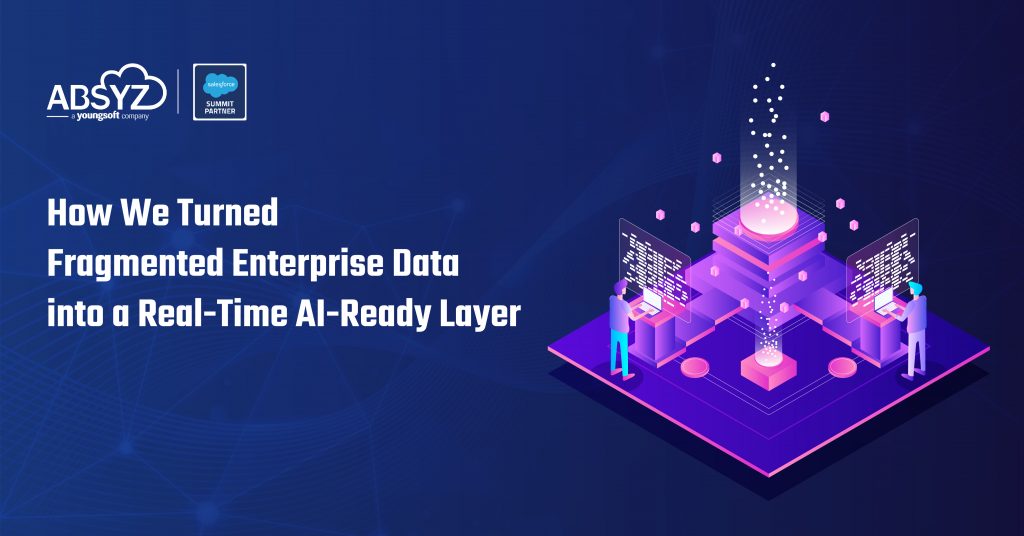
The Problem Wasn’t lack of data. It Was Too Much of It in the Wrong Places.
By the time most enterprises start talking seriously about AI, they already have years of data.
- Sales data in CRM.
- Service data in ticketing systems.
- Customer data in marketing tools.
- Operational data sitting in ERPs, data warehouses, or spreadsheets.
On paper, this looks like a goldmine.
In reality, it’s a liability.
When data is fragmented, delayed, and inconsistently defined, AI doesn’t get smarter — it becomes unreliable. And that’s exactly where most organizations get stuck.
They don’t fail to adopt AI because the models aren’t good enough.
They fail because their data foundation was never built to support real-time decisioning.
What “Fragmented Data” Really Looks Like Inside Enterprises
Fragmentation isn’t just a technical problem. It’s an operating reality.
What we typically see:
- Customer profiles that differ across teams
- Service systems are unaware of the sales context
- Marketing signals disconnected from actual revenue
- Reporting is built on snapshots, not live data
- AI pilots constrained by incomplete inputs
Teams compensate with:
- Manual reconciliation
- Spreadsheet overlays
- Assumptions instead of insight
- Endless “data validation” cycles
The result?
Decisions slow down. AI initiatives stall. Confidence drops.
Why Traditional Data Consolidation Doesn’t Solve the Problem
Most enterprises try to fix this by “centralizing” data.
They build data lakes.
They add BI layers.
They integrate more systems.
But consolidation alone doesn’t create intelligence.
What’s missing is activation.
A real AI-ready data layer isn’t just:
- Centralized
- Cleaned
- Structured
It’s contextual, real-time, and actionable.
That’s a fundamentally different design goal.
The Shift: From Data Aggregation to Data Activation
The breakthrough happens when organizations stop asking:
“Where should this data live?”
And start asking:
“Where should this data be used?”
That shift changes everything.
Instead of building data for reporting, the focus moves to:
- Enabling decisions inside workflows
- Supporting AI-driven actions
- Making context available at the moment of execution
This is where a real-time data layer becomes essential.
How We Approached Building a Real-Time, AI-Ready Data Layer
When we work with enterprises on this problem, our approach is deliberate and pragmatic—not theoretical.
1. We Started With Decisions, Not Data
Before touching architecture, we identified:
- Where decisions were slowing down
- Which teams lacked context
- Which processes were most error-prone
- Where AI could realistically add value
This prevented over-engineering and kept the scope tied to business impact.
2. We Unified Data Around Context, Not Systems
Instead of syncing everything, we focused on:
- Customer identity resolution
- Event-level signals (actions, changes, triggers)
- Relationships between entities, not just records
Using platforms like Salesforce Data Cloud, data was unified in a way that preserved meaning — not just structure.
The goal wasn’t “one big database.”
It was one consistent view of reality.
3. We Made Data Available Where Work Actually Happens
The biggest mistake organizations make is keeping data locked in dashboards.
We embedded data directly into:
- Sales workflows
- Service consoles
- Case resolution flows
- Automation logic
- AI agents and copilots
This changed behavior immediately. Decisions no longer required context-switching. AI outputs became trusted because they were explainable. Teams stopped relying on offline workarounds.
4. We Designed the Layer for AI, Not Just Analytics
An AI-ready data layer must:
- Refresh in near real time
- Maintain clear ownership
- Support explainability
- Respect governance boundaries
- Be resilient to partial data
This is especially critical when enabling:
- Predictive recommendations
- Automated case handling
- Agentic AI workflows
- Cross-functional automation
Without this foundation, AI becomes a demo — not a capability.
What Changed After the Data Layer Was in Place
Once the real-time data layer was live, the shift was visible almost immediately:
- Faster service resolution due to contextual insights
- Better sales prioritization without manual scoring
- Fewer data disputes across teams
- AI models producing consistent, trusted outputs
- Reduced reliance on manual reporting
- Clearer ownership of data and decisions
Most importantly, AI no longer feels risky. It became operational.
The Bigger Realization: Data Architecture Is a Leadership Decision
What this journey reinforced is something many enterprises underestimate:
Data architecture is not a technical choice. It’s an operating model decision.
- If data is slow, AI will be slow.
- If data is fragmented, AI will be fragile.
- If data lacks ownership, AI will lack trust.
No amount of tooling fixes that.
ABSYZ POV: AI-Readiness Starts With Data Maturity
At ABSYZ, we don’t treat data modernization as an IT project.
We treat it as:
- A prerequisite for AI
- A foundation for automation
- A multiplier for business velocity
Our work focuses on helping enterprises:
- Unify data without disrupting operations
- Design real-time data layers that scale
- Prepare Salesforce and enterprise systems for AI execution
- Move from insight to action without friction
Because AI doesn’t transform businesses.
Data readiness does.
The Bottom Line
Enterprises don’t struggle with AI because the technology isn’t ready.
They struggle because their data was never designed to keep pace with the speed of decisions.
When fragmented data becomes a real-time, AI-ready layer:
- Decisions accelerate
- Automation becomes safe
- AI becomes trustworthy
- Scale becomes sustainable
That’s when AI stops being a promise — and starts being an advantage.
Author: Vignesh Rajagopal