Introduction
For decades, organizations competed on product quality, operational efficiency, and price.
Today, those advantages are becoming increasingly difficult to sustain.
Products can be replicated. Prices can be matched. Even innovative business models eventually attract competitors. Yet one differentiator continues to separate market leaders from everyone else—the experience they create for customers.
Whether opening a bank account, accessing healthcare, applying for government services, purchasing industrial equipment, or interacting with a retailer, customers expect every engagement to be seamless, intuitive, and personalized. These expectations are no longer shaped solely by competitors within the same industry; they are influenced by every exceptional digital interaction people experience in their daily lives.
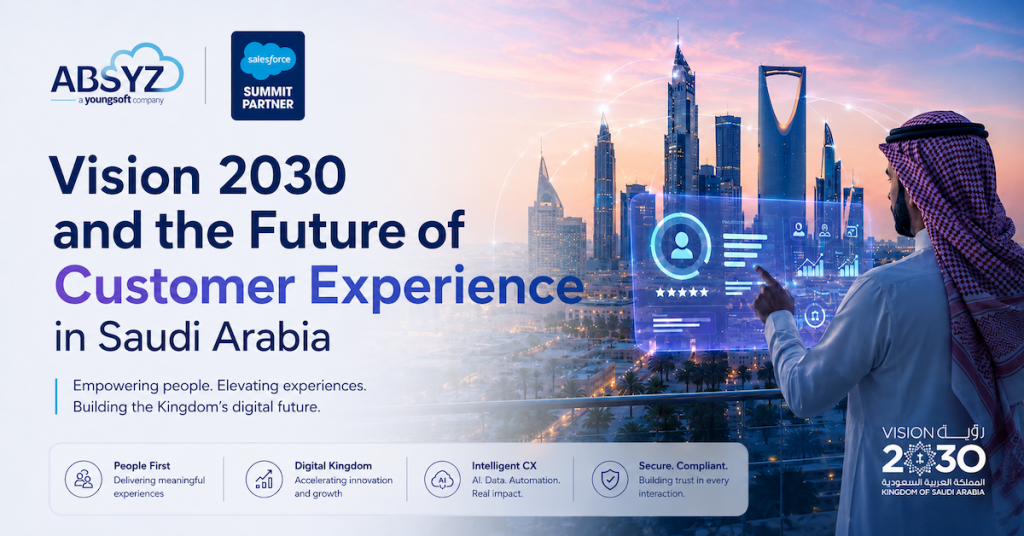
In Saudi Arabia, this shift is occurring alongside one of the world’s most ambitious transformation agendas.
Vision 2030 is not simply accelerating economic diversification or digital adoption. It is reshaping how organizations think about customer engagement, operational excellence, innovation, and long-term competitiveness. As businesses modernize and industries evolve, customer experience is emerging as one of the clearest indicators of organizational maturity.
For business leaders, the question is no longer whether digital transformation is necessary. The more pressing question is whether their organizations are evolving quickly enough to meet the expectations of an increasingly connected, digital-first customer.
Customer Experience Has Become a Leadership Agenda
Customer experience was once considered the responsibility of marketing or customer service teams.
That assumption no longer holds.
Today, every customer interaction is shaped by decisions made across the organization—from technology investments and operational processes to data governance, supply chain efficiency, and workforce collaboration. As a result, customer experience has become a strategic concern for executive leadership rather than a functional initiative.
Organizations with strong customer experience capabilities often benefit from:
- Higher customer retention and loyalty
- Stronger brand differentiation
- Faster revenue growth
- Greater operational efficiency
- Better employee productivity
- Increased resilience during periods of change
This explains why customer experience is increasingly discussed in boardrooms alongside digital transformation, AI, cybersecurity, and enterprise modernization.
Executive Insight
A single interaction no longer measures customer experience. It is the cumulative outcome of every system, process, and decision that influences how customers engage with an organization.
Vision 2030 Is Raising Customer Expectations
Vision 2030 has accelerated investment across sectors, including financial services, healthcare, manufacturing, tourism, logistics, education, and public services. Alongside these investments comes a broader shift in customer expectations.
People increasingly expect services that are:
- Available digitally and on demand
- Personalized to individual needs
- Consistent across channels
- Fast, transparent, and intuitive
- Accessible through self-service when appropriate
- Supported by intelligent automation
This evolution extends beyond consumer-facing organizations. Enterprise customers, partners, suppliers, and citizens are also expecting faster responses, greater transparency, and more connected experiences.
Organizations that continue to rely on fragmented systems, manual processes, or disconnected customer journeys risk creating an experience gap that widens over time.
The Experience Gap
One of the biggest challenges facing organizations today is the growing disconnect between what customers expect and what many enterprises are currently equipped to deliver.
Customer Expectations | Organizational Reality |
Instant responses | Multiple manual approvals |
Personalized engagement | Fragmented customer data |
Omnichannel interactions | Department-specific systems |
Real-time updates | Delayed reporting |
Seamless digital journeys | Disconnected customer touchpoints |
Proactive communication | Reactive service models |
Closing this gap requires more than deploying new technology. It requires organizations to rethink how they are structured, how information flows across teams, and how customer outcomes are prioritized.
Executive Insight
Most customer experience challenges are symptoms of organizational complexity rather than technology limitations.
Three Shifts Defining the Next Decade
Organizations preparing for the future of customer experience are adapting to three interconnected shifts.
Shift 1: Digital-First Engagement
Customers increasingly begin and complete their journeys through digital channels. Whether researching products, requesting services, or resolving issues, they expect frictionless digital experiences that remain consistent across every touchpoint.
Digital is no longer an alternative channel; it has become the primary experience.
Shift 2: Data as a Strategic Asset
Customer interactions generate valuable insights, yet many organizations struggle because this information remains distributed across CRM platforms, ERP systems, marketing tools, service applications, and legacy technologies.
Leading organizations are treating customer data as a strategic business asset rather than an operational by-product.
Unified, trusted data enables better decisions, more relevant interactions, and stronger relationships.
Shift 3: AI Moves from Experimentation to Everyday Operations
Artificial intelligence is rapidly becoming embedded in customer engagement.
Rather than replacing human expertise, AI increasingly supports employees by providing recommendations, automating routine tasks, summarizing interactions, and enabling faster decision-making.
However, the effectiveness of AI depends entirely on the quality of the data and processes that support it. Organizations that invest in trusted data foundations today will be significantly better positioned to realize the long-term value of AI.
Why Digital Transformation Projects Often Fall Short
Despite significant investment, many transformation initiatives fail to deliver the expected business outcomes. The reasons are rarely technical.
Common challenges include:
- Technology implemented without redesigning customer journeys
- Data is fragmented across business units
- Limited executive alignment
- Weak change management
- Unclear ownership of customer outcomes
- Legacy processes carried into new platforms
- Success is measured through implementation milestones rather than customer value
Technology can accelerate transformation, but it cannot compensate for organizational misalignment.
Executive Insight
Successful transformation is less about deploying new platforms and more about redesigning how the organization creates value for customers.
A Customer Experience Maturity Framework
Organizations typically evolve through several stages of customer experience maturity.
Maturity Level | Characteristics | Executive Question |
Reactive | Disconnected systems, inconsistent service | Are we solving issues only after they arise? |
Digitized | Individual processes automated | Have we improved efficiency without improving the overall experience? |
Connected | Shared customer data and integrated channels | Can every team work from the same customer context? |
Intelligent | AI, automation, predictive insights | Are we anticipating customer needs rather than reacting to them? |
Adaptive | Continuous optimization and innovation | Can we evolve as customer expectations continue to change? |
Progressing through these stages requires coordinated investments in people, processes, governance, and technology, not isolated digital initiatives.
The Technology Foundation of Exceptional Customer Experiences
While customer experience is ultimately a business strategy, technology provides the capabilities needed to execute that strategy consistently and at scale.
Leading organizations typically invest in capabilities such as:
- Unified customer data
- Cloud-based CRM platforms
- Enterprise integration
- AI-driven automation
- Advanced analytics
- Workflow orchestration
- Omnichannel engagement
Rather than operating as independent systems, these technologies work together to create a connected customer ecosystem.
Platforms such as Salesforce enable organizations to unify customer information, streamline workflows, automate routine processes, and deliver personalized experiences across sales, service, marketing, and commerce. When combined with capabilities such as Data Cloud, MuleSoft, Tableau, and Agentforce, these provide a scalable foundation for customer-centric transformation.
Technology alone, however, is only one part of the equation. Its value depends on the clarity of the organization’s strategy, the quality of its data, and the effectiveness of its operating model.
Five Questions Every CIO Should Be Asking
As organizations prepare for the next phase of digital transformation, technology leaders should challenge themselves with five fundamental questions:
- Are we organized around customer journeys or internal departments?
- Do we have a trusted, unified view of our customers across every touchpoint?
- Can our data support AI-driven decision-making and personalization?
- Are our technology investments delivering measurable customer outcomes?
- Can our organization adapt as quickly as customer expectations evolve?
These questions often reveal opportunities that traditional technology assessments overlook.
Looking Ahead
Customer expectations will continue to evolve. Organizations will increasingly need to anticipate needs before customers express them, personalize interactions in real time, and continuously improve experiences based on data-driven insights.
AI will become more embedded in everyday operations. Customer journeys will become increasingly predictive. Digital ecosystems will become more interconnected. Organizations that invest early in strong customer data foundations, governance, and adaptable operating models will be better positioned to respond to these shifts.
For Saudi Arabia, Vision 2030 provides the momentum for this transformation. The organizations that benefit most will be those that view customer experience not as a technology initiative, but as a long-term business capability.
How ABSYZ Can Help
At ABSYZ, successful customer transformation begins with business outcomes rather than technology choices.
We work with organizations to modernize customer engagement by aligning strategy, data, processes, and technology. Whether the objective is CRM modernization, AI enablement, unified customer data, or enterprise automation, our consultants help design scalable Salesforce-powered solutions that support sustainable growth and meaningful customer experiences.
Conclusion
Vision 2030 is redefining the future of business in Saudi Arabia, but its most enduring impact may be on customer expectations. As digital services become more connected, intelligent, and personalized, organizations must rethink how they create value across every interaction.
The organizations that lead the next decade will not simply be those that adopt the latest technologies. They will be the ones who redesign their business around customer outcomes, treat data as a strategic asset, and embed intelligence into every meaningful interaction.
Technology will remain an important enabler, but sustainable competitive advantage will come from the ability to combine strategy, execution, and customer-centric thinking into experiences that build trust, loyalty, and long-term value.