Let me start with a simple question.
Have you ever paused to think about what actually happens after you click the “Buy Now” button?
Whether you’re purchasing a product online, calling customer care to track your shipment, or selecting a flexible delivery date and time – today’s buying experience feels seamless. Over the years, business owners and digital transformation leaders have continuously optimized this journey to make it faster, simpler, and more customer centric.
But is it really that simple behind the scenes?
Not quite.
What appears effortless to the customer is supported by a carefully coordinated backend process. The moment an order is placed, multiple teams, systems, and dependencies come into play. The complexity varies depending on the nature of the product or service. A digital subscription may activate instantly, while a physical product might require manufacturing, packaging, logistics coordination, and installation scheduling.
Someone – or more accurately, some system – must design and control this entire sequence of activities.
This end-to-end execution process is called Fulfillment.
The Two Pillars of Fulfillment
When we look deep into the Fulfillment process it actually builds upon 2 strong pillars.
Order Decomposition: Breaking down of this entire fulfillment process into structured, smaller tasks. In simple words, it identifies all the internal teams that need to perform specific tasks.
Order Orchestration: The process of planning, sequencing, and coordinating these tasks so that each task executes in correct order while respecting dependencies between systems.
For example:
- Installation may require inventory confirmation first.
- Billing activation may occur only after service provisioning.
These dependencies are represented through execution flow arrows within the orchestration plan.
Before diving deeper into these two, it is important to understand how products are classified in an enterprise order management context.
Commercial Product
This is the product that the customer actually purchases. It represents the complete, sellable offering visible in the quote, cart, or order confirmation.
Technical Product
These are the underlying components, services, or tasks required to deliver the commercial product. Without them, the offering cannot be fulfilled. They may include provisioning steps, hardware assembly tasks, configuration activities, integrations, or third-party service activations.
In simple terms:
- The Commercial Product is what the customer sees and pays for.
- The Technical Products are what the organization executes internally to make that promise a reality.
Understanding this distinction is fundamental before exploring how Salesforce Revenue Management Dynamic Order Orchestration coordinates these moving parts in a scalable and intelligent way.
Let’s See It in Action
For better understanding purpose let’s take example of a simple Home Security bundle product.
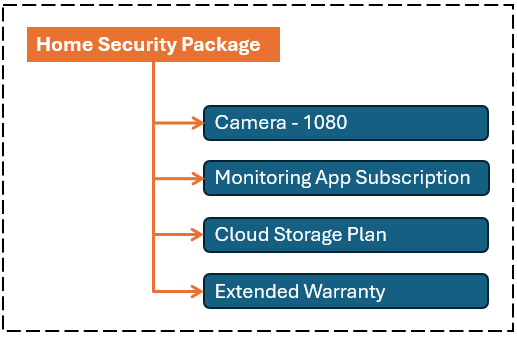
From the customer’s perspective, these are all part of a single commercial product.
However, for the company delivering the service, fulfilling this order may require coordination across multiple backend systems, such as:
- Inventory Management
- Service Installation
- Subscription Management
- Warranty Management
- Billing
This is where Dynamic Order Orchestration becomes extremely valuable.
Lets look at how ARM DRO is used to simplify this complex process.
The diagram below illustrates how a customer order flows through DRO’s two-phase process:
📝 Customer Order Sales order submitted | 🔄 Decomposition Break into tasks | ⚙️ Orchestration Execute in sequence | ✅ Fulfillment Order complete |
Note: Order decomposition is not mandatory for order orchestration
Phase 01 : Decomposition:
Step01: Create required technical products
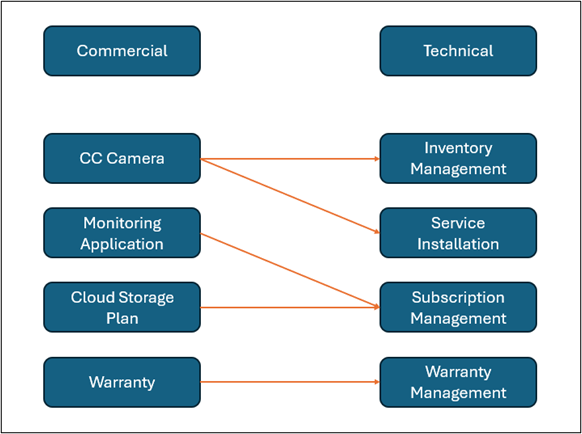
Step02: Map commercial products to related technical products
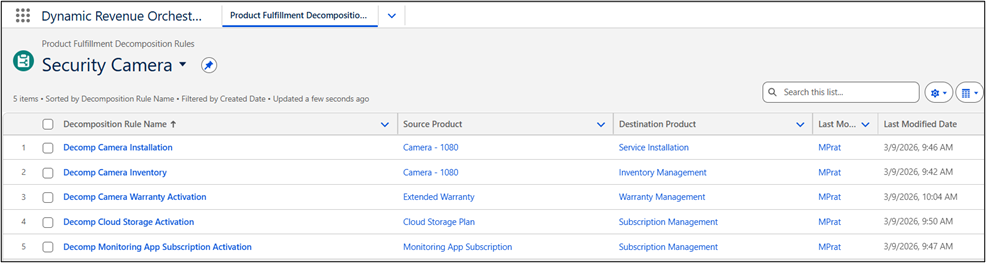
Phase 02 : Orchestration:
Step 01: Create and Setup Orchestration Workspace
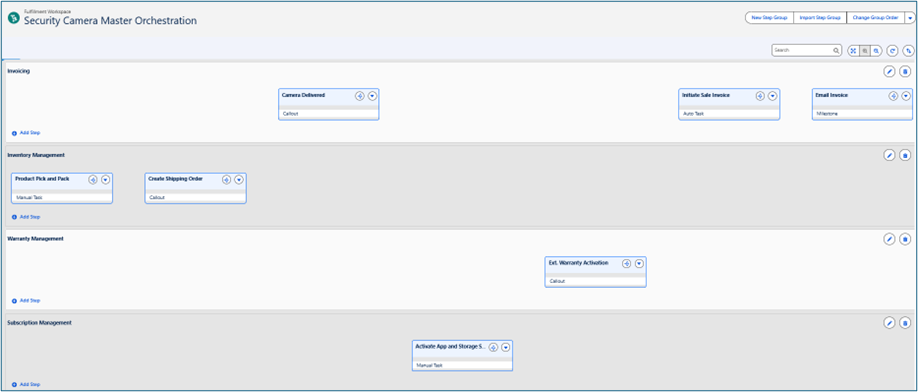
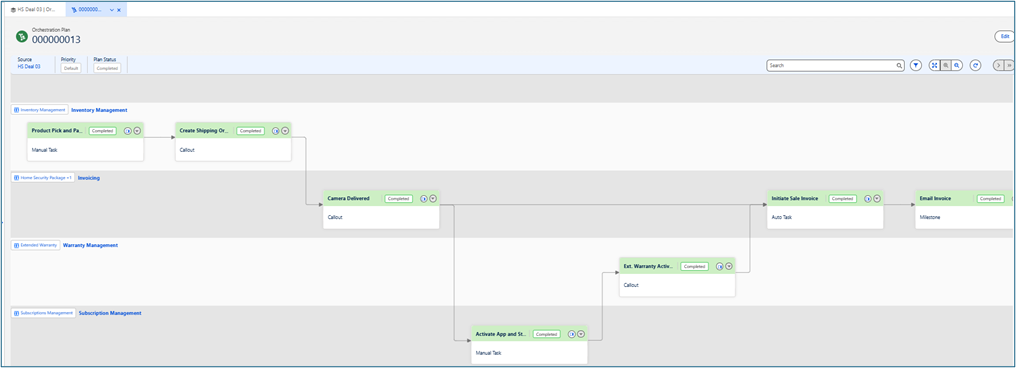
Step 02: Setup Dependencies (execution Flow / Order) (Notice the arrows)
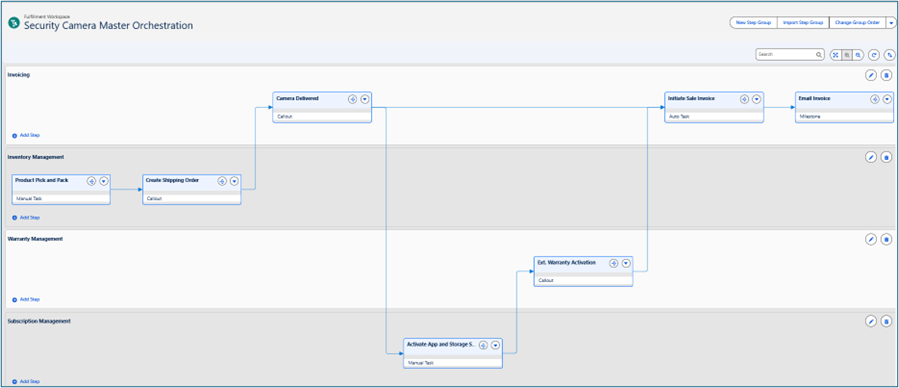
That is it. A simple orchestration is in place for the Home Security package product.
Every time when a successful order is created for the Home Security Package product, the system automatically initiates the Orchestration process.
One of the major benefits of DRO is visibility.
Business and operations teams can monitor:
- Decomposed order lines
- Orchestration execution plans
- Fulfillment progress
This visibility helps organizations track order fulfillment in real time and proactively manage delays or exceptions.
Decomposed Lines
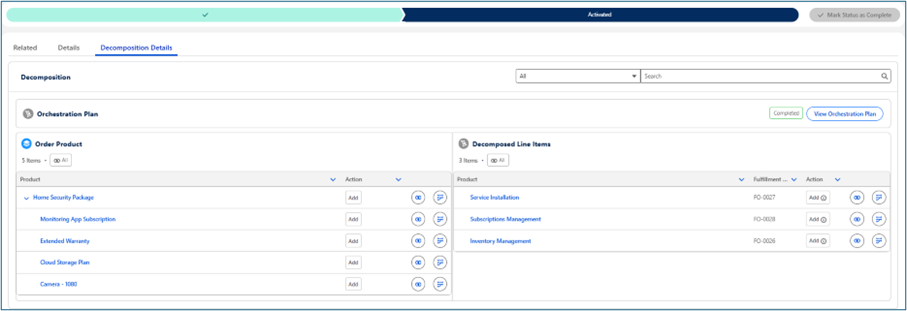
Orchestration Plan View
How Fulfillment Worked Before Dynamic Orchestration
For many years, enterprises successfully delivered complex products without relying on modern orchestration engines. However, the underlying processes were often complex and heavily dependent on IT teams.
Once an order was created, multiple systems had to coordinate through integrations and data exchanges. These integrations were often tightly coupled and difficult to modify.
Although this approach worked, it lacked flexibility and made it difficult for businesses to adapt quickly to changing requirements.
Two common architectural patterns that businesses followed before the modern dynamic orchestration are Custom-Coded and Middleware-Led.
Business Capability | Custom-Coded Orchestration | Middleware-Led Orchestration |
Ownership of fulfillment process | Fully controlled by IT teams through custom code | Managed by integration teams using middleware platforms like MuleSoft or SAP CPI |
Speed of launching new offers | Slow – requires development and testing cycles | Slow – requires integration changes and coordination |
Ability to change fulfillment steps | Difficult – every change requires code updates | Possible but complex – integration flows must be modified |
Visibility into order progress | Limited visibility for business teams | Partial visibility spread across multiple systems |
Scaling to support more products | Increasingly complex as product catalogue grows | Better than custom code, but integration-heavy |
Handling exceptions or delays | Often manual and dependent on IT support | Requires coordination between multiple teams |
The Shift to Dynamic Order Orchestration
Modern Dynamic Order Orchestration (DRO) addresses these challenges by giving businesses greater control, visibility, and flexibility in managing fulfillment processes.
Before (Traditional Fulfillment) | Now (Dynamic Orchestration) |
Fulfillment logic controlled mainly by IT teams | Business teams can configure fulfillment flows |
Product launches required development cycles | New offers can be introduced faster through configuration |
Fulfillment depended on multiple disconnected systems | Orchestration centrally manages the entire fulfillment journey |
Limited visibility into fulfillment progress | Real-time order status and transparency |
Exception handling required manual intervention | Automated handling of dependencies and process issues |
I hope now you get some understanding on what Dynamic Order Orchestration is.
Conclusion
Dynamic Order Orchestration is transforming how enterprises manage complex fulfillment processes.
By separating commercial products from technical execution and enabling configurable orchestration flows, ARM Dynamic Revenue Orchestration empowers businesses to deliver products faster, with greater transparency and operational control.
Instead of relying on rigid, code-heavy fulfillment systems, organizations can now adopt flexible, scalable, and business-driven orchestration models that enhance both operational efficiency and customer experience
Author: Manasa Pratap Budati