Most Agentforce implementations fail because the system behind the agent is not thought through.
An AI agent is only as strong as the structure supporting it. When topics are vague, actions are loosely defined, or data is unstructured, the result is predictable. You see inconsistent responses, broken workflows, and low adoption.
When implemented correctly, Agentforce becomes a reliable execution layer that connects conversations to real business outcomes. This guide walks through how that happens in practice. It focuses on how systems are built, tested, and made to work in real-world scenarios.
Think in Systems, Not Just Agents
Before building anything in Agentforce, shift the perspective.
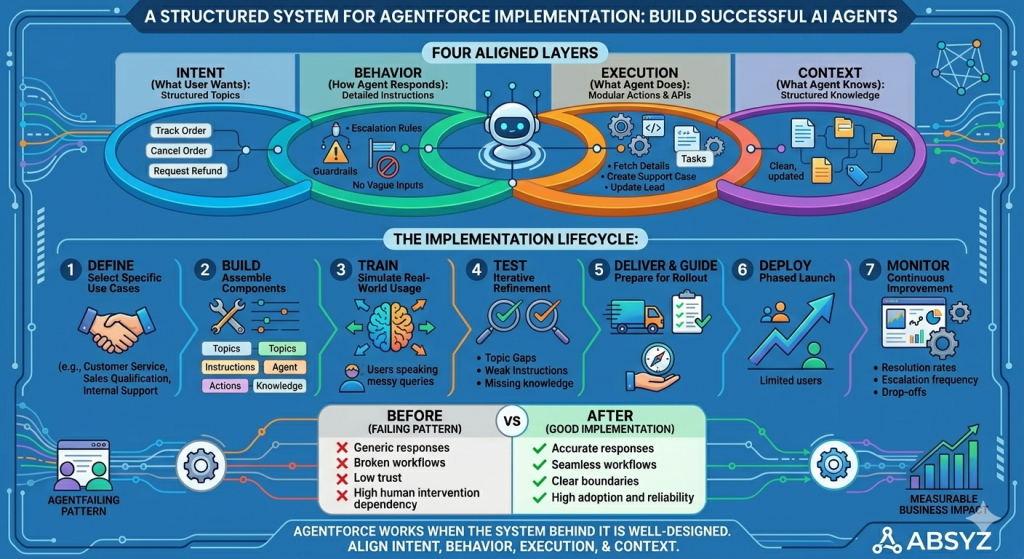
You are building a system made up of four connected layers:
- Intent or what the user wants
- Behavior, or how the agent responds
- Execution, or what the agent does
- Context, or what the agent knows
Every successful implementation is a clear alignment among these four layers. When something breaks, one of these layers is usually weak or disconnected.
Breaking Down the Core Components
At the center of Agentforce is the agent, but the agent depends on how well the surrounding components are designed.
1. Topics: Where Intent Becomes Structured
Topics are where most implementations either succeed or fail. If a topic is too broad, the agent struggles to interpret intent. If it is too fragmented, the experience feels disjointed. The goal is clarity with the right level of specificity.
For example, instead of defining a general support topic, break it into:
- Track order
- Cancel order
- Request refund
This removes guesswork and improves accuracy.
2. Instructions: Where Behavior Gets Defined
This is where you define how the agent behaves.
A strong instruction set answers questions like:
- When should the agent escalate
- What should it avoid saying
- How should it handle unclear inputs
For example, if a user asks about order status without verification, the agent should re-prompt or redirect instead of sharing information. These decisions are documented in instructions and directly impact the user experience.
3. Actions: Where Conversations Become Outcomes
Without actions, Agentforce stays conversational. With actions, it becomes operational.
An action could involve:
- Fetching order details
- Creating a support case
- Updating a lead
- Triggering a workflow
Actions should be precise, testable, and reusable.
If an action is too complex, it becomes fragile. If it is too narrow, it creates duplication.
The most effective approach is to design actions like clean, modular APIs.
- Knowledge: Where Accuracy Comes From
The agent retrieves information from the knowledge layer.
Accuracy depends on how well this layer is structured.
Uploading large volumes of content rarely works. Effective implementations focus on:
- Clean and updated content
- Proper tagging and categorization
- Alignment with specific use cases
A disorganized knowledge base leads to poor responses.
Define: Start with the Right Use Cases
Implementation starts with clarity.
Instead of trying to automate everything, focus on specific use cases where Agentforce can deliver immediate value.
Examples:
- Customer service: Order tracking, refunds
- Sales: Lead qualification, meeting scheduling
- Internal: Employee support queries
Each use case should map clearly to:
- A topic
- One or more actions
- Supporting knowledge
Strong definitions reduce complexity later.
Build: Assemble the System Correctly
Once use cases are defined, the system is built.
This involves:
- Creating topics without overlap
- Writing detailed instructions
- Configuring actions and integrations
- Structuring knowledge for retrieval
This is where most gaps surface.
For example:
- Missing APIs
- Weak workflows
- Incomplete data
Agentforce exposes backend inefficiencies faster than most systems.
Train: Where the Agent Learns Reality
Training is where the system becomes reliable.
Users do not interact in perfect sentences. They:
- Use incomplete queries
- Mix multiple intents
- Phrase the same request differently
Training should simulate this.
Test:
- Variations of the same query
- Ambiguous inputs
- Edge cases
Every failure points to a gap:
- Topic misalignment
- Weak instructions
- Missing knowledge
Iterative refinement improves accuracy.
Deliver: Prepare for Real-World Usage
Before full rollout, the system needs controlled delivery.
This includes:
- Validating all actions and integrations
- Testing escalation flows
- Ensuring guardrails are working
At this stage, the goal is stability.
The system should behave predictably across scenarios.
Guide: Enable Users to Work with the Agent
Even the best agent needs user alignment.
This involves:
- Setting expectations on what the agent can handle
- Providing fallback paths
- Aligning internal teams on when to intervene
Guidance improves adoption and reduces friction.
Deploy: Roll Out in Phases
Deployment should not be immediate or wide.
A phased approach works best:
- Start with a limited use case
- Release to a small group
- Observe real interactions
Real-world usage reveals patterns that testing cannot.
Monitor: Turn Insights into Continuous Improvement
Once live, monitoring becomes critical.
Track:
- Resolution rates
- Escalation frequency
- Drop-offs in conversations
- Response accuracy
Each signal connects back to a component.
For example:
- High escalation → weak instructions
- Poor responses → knowledge gaps
- Confusion → topic overlap
Continuous refinement is what drives long-term success.
What Good Implementation Looks Like
Before | After |
Generic responses | Accurate, context-aware responses |
Broken workflows | Seamless workflow execution |
Low trust in the agent | Clear boundaries and escalation |
High human intervention dependency | High adoption and reliability |
Where Implementations Break
Most failures follow a similar pattern:
- Too many use cases were introduced early
- Weak topic definitions
- Overcomplicated actions
- Limited training
- No feedback loop
These issues reduce accuracy and adoption. A structured and iterative approach helps avoid them.
The bottom line
Agentforce works well when the system behind it is well-designed.
When intent, behavior, execution, and context align, the agent becomes predictable and scalable.
This is when the shift happens.
From an experimental setup to an operational layer, from basic automation to measurable business impact
That is what a strong Agentforce implementation looks like.
Author: Vignesh Rajagopal