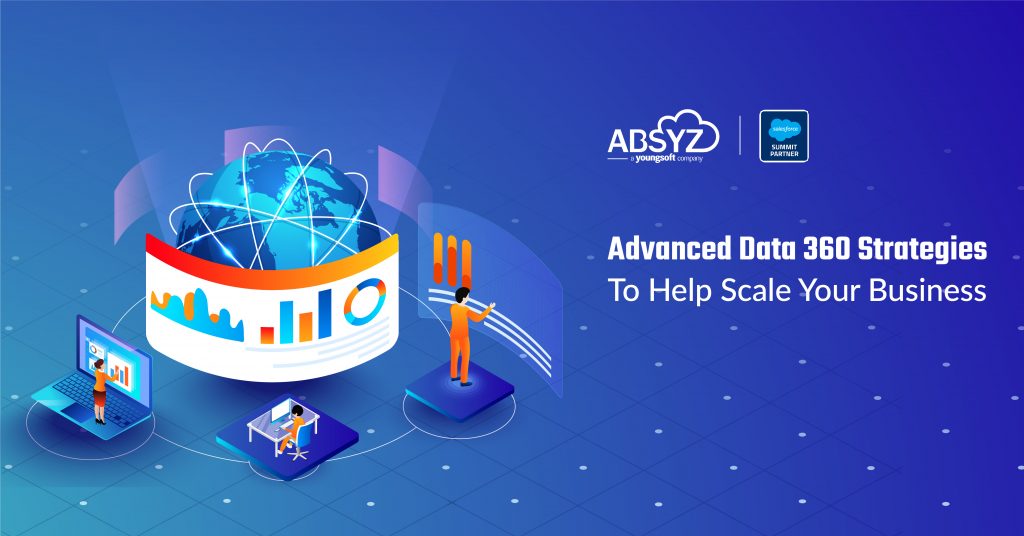
The Problem Isn’t Lack of Data. It’s Data That Doesn’t Scale With the Business.
Most businesses don’t lose control overnight.
They lose it gradually -> A few more customers -> A new region -> Another product line -> One more acquisition.
Suddenly, decisions that once took minutes take meetings. Teams ask for “one more report.” Leaders stop trusting forecasts. AI pilots stall because no one is confident enough to automate anything meaningful.
This isn’t a tooling gap.
It’s a Data 360 maturity gap.
Most organizations believe they have a 360-degree view of their business. In reality, they have multiple partial views held together by process and people. That works—until scale exposes the seams.
Why Most “Data 360” Efforts Break Under Growth
Traditional Data 360 initiatives focus on aggregation:
- Pull sales data together
- Sync service records
- Unify marketing profiles
At low scale, this looks impressive. On a large scale, it becomes brittle.
What actually happens as the business grows:
- Sales and service interpret the same customer differently
- AI recommendations feel inconsistent
- Automation creates exceptions faster than it resolves them
- Leaders debate whose numbers are “right.”
The issue isn’t visibility; it’s that the data hasn’t been designed for decision velocity.
Advanced Data 360 is not about seeing more.
It’s about removing friction as complexity increases.
The Single Customer View Is an Outdated Goal
The idea of a single, static customer profile made sense when CRM was the system of record.
In an AI-driven business, it’s no longer enough.
What leaders actually need is:
- A situational view, not a universal one
- Context that changes based on intent, risk, and moment
- Data that reflects momentum, not just history
A customer in a renewal cycle is not the same customer in a service escalation.
Treating them as one flat record is why AI outputs feel generic and unreliable.
This is where platforms like Salesforce Data Cloud matter—not because they unify data, but because they enable simultaneous contextual viewswithout duplication or delay.
Advanced Data 360 isn’t about one truth.
It’s about the right truth at the right moment.
AI Exposes Weak Data Faster Than Any Dashboard Ever Could
AI doesn’t politely tolerate messy data.
It amplifies its flaws.
When data is unclear:
- AI recommendations get overridden
- Automation feels risky
- Leaders insist on human checkpoints
- Productivity gains stall
The result? AI becomes assistive at best—and ignored at worst.
Advanced Data 360 strategies are built with AI consumption in mind, not retrofitted later. That means:
- Explicit ownership of critical data elements
- Clear trust boundaries
- Context embedded directly into the data model
- Guardrails around what AI can and cannot act on
In the AI era, Data 360 isn’t about completeness.
It’s about confidence.
If leaders don’t trust the data, they won’t trust the AI—no matter how advanced it looks.
The Scale Test: Most Data Architectures Fail
There’s a simple test that reveals whether Data 360 is actually working:
Can frontline teams make better decisions without having to ask for another report?
If the answer is no, the organization hasn’t activated Data 360—it has just centralized data.
Advanced Data 360 pushes context directly into:
- Sales workflows
- Service consoles
- Approval paths
- AI agents and automation logic
Not as dashboards but as embedded decision support.
When data only lives in reports, scale slows. When data lives inside workflows, scale accelerates.
What “Advanced” Looks Like in the Real World
In organizations where Data 360 has matured:
- Leaders argue less about numbers and more about actions
- Forecast conversations shift from accuracy to scenarios
- AI recommendations are explainable—and trusted
- Automation reduces manual work instead of creating edge cases
- Shadow spreadsheets quietly disappear
None of this comes from perfect data. It comes from architectures designed to absorb complexity without breaking. That’s the difference between growing bigger and growing smarter.
Where Most Organizations Misstep
Advanced Data 360 fails when:
- It’s treated as a reporting initiative
- Data perfection is prioritized over usability
- Governance becomes a bottleneck instead of a guardrail
- AI is layered on before trust is established
- Ownership is unclear across functions
The result is a polished data platform that leaders still hesitate to rely on.
Our POV: Data 360 as an Operating Layer, Not a Project
What we consistently see across enterprises is this:
Organizations don’t struggle because they lack data. They struggle because their data architecture doesn’t keep pace with the speed at which decisions need to be made.
At ABSYZ, we don’t approach Data 360 as an implementation milestone. We treat it as an operating layer—one that must support AI, Agentforce, automation, and cross-functional execution without slowing the business down.
The goal isn’t visibility. It’s decisional clarity at scale.
The Bottom Line
Advanced Data 360 is not something you “achieve.” It’s something you grow into deliberately.
The companies that scale well don’t have perfect data. They have data foundations that don’t collapse under pressure.
In the AI era, that’s not a technical advantage. It’s a leadership one.
Author: Vignesh Rajagopal